Day: October 5, 2024

UK Energy White Paper announces very busy 2021


The UK government’s Energy White Paper: Powering our net zero future, published on 14 December 2020, was long promised. Was it worth the wait? If you were expecting the sort of White Paper that sets a new strategic direction, or that describes in a lot of detail how specific policies previously only outlined will be implemented, you will be disappointed. Instead, we have a stock-take of current energy policies and a detailed agenda for what promises to be several years of significant new policy development. It is none the worse for that: the first deliverables highlighted in the White Paper appeared within days of its publication and already show progress in several areas. And what is envisaged will create new markets and may significantly reform existing ones.

The White Paper’s title echoes the 2011 Energy White Paper Planning our electric future: a white paper for secure, affordable and low-carbon energy, which set out the policies of the coalition government’s Electricity Market Reform (EMR) project. A comparison of the two documents shows both how far we have come and how much remains to be done. Huge progress has been made in decarbonising UK electricity generation, but EMR left plenty of unfinished business even there. It did not, for example, try to reform electricity markets or their institutions and governance to reflect the sector’s increasingly distributed and digitalised character or the substantial displacement of fossil fuels by less polluting technologies. Moreover, the challenge now identified by the government is both to achieve deeper decarbonisation of electricity and to go beyond electricity. EMR was able to achieve progress by incentivising actions by a relatively small number of electricity industry players. Government now wants to move forward in other areas: energy efficiency, heat, transport and industrial decarbonisation. Here, millions of consumers and businesses not focused on energy need to invest significant sums, and change their behaviour, if the UK is to achieve net zero greenhouse gas emissions by 2050. Many of them will be “encouraged” to replace fossil fuels with clean electricity, leading to a doubling of electricity demand, met by cleaner energy capacity and modernised energy markets.

The White Paper is explicitly a kind of companion piece to the Prime Minister’s Ten Point Plan for a Green Industrial Revolution (TPP), published less than a month ago, which summarised some of the more eye-catching aspects of the government’s energy and climate policies, and which we have written about here and here. It shares with the TPP an emphasis on how the policies it discusses, as well as contributing to net zero goals in the UK, will also promote a “green recovery” from the COVID-19 pandemic; help to “level up” economically disadvantaged parts of the UK; and demonstrate the UK’s climate leadership role (and so export opportunities) in the (extended) year of its UNFCCC CoP presidency.

We review the White Paper (and some of the follow-up to it that has already emerged) below, using the headings of its six numbered chapters. A theme across the whole White Paper is the critical need for significant change – to the behaviours of business and the public and so to the markets, policies and law needed to secure that change.

Chapter 1 – Consumers

Key messages

The White Paper aims to provide a vision of what “the transition to clean energy by 2050…will mean for [domestic or business] consumers of energy”. The policies it previews aim to ensure consumers get the benefit of new technologies (e.g. smart metering enabling time-of-use tariffs, smart charging and vehicle-to-grid), whilst addressing concerns about the competitiveness of retail energy markets and energy poverty. There is also an awareness that, by itself, technological progress and decarbonisation can cause problems, as well as solving them. For example, how should regulation address the potential impact of consumers taking advantage of the ability to generate their own renewable electricity: who pays for the grid if predominantly affluent households become more or less independent of the public energy networks in this way? More generally, there is the challenge of maintaining consumer protection as technologies and services evolve.

Chapter 1 of the White Paper is dedicated to the viewpoint of the end-users of energy, but it is reflected throughout the document. As it says: “The way that…costs are passed through to bills can incentivise or disincentivise certain types of consumer behaviour”. The challenge is that, so far, millions of domestic electricity and gas customers ignore the existing, basic price signals in the market. Over 50% are on default tariffs, even though almost all know they can switch, and many more or less consciously pay a “loyalty penalty” for not doing so. Will those of us who are still only passive participants in the market be prompted to change our attitude by the prospect of being able to make further savings or gains by running washing machines and charging EVs when wholesale power prices are low, or of charging an extra household battery when they are negative? The answer may be “yes” if a significantly greater share of the home wallet is spent on electricity (because the home EV charging station will replace the petrol station and an electric heating system will replace gas) but the White Paper also hints that regulation may compel as well as incentivise.

Policy pipeline

In “early” or “spring” 2021, the White Paper promises the following.

  • Conclusion of the HM Treasury review on funding the transition to net zero (which began in 2019, at the prompting of the Committee on Climate Change (CCC)). An interim report from the review emerged within a few days of the White Paper’s publication. It contains some useful economic information and analysis, but its conclusions so far are anodyne (samples: “The costs of the transition to net zero are uncertain and depend on policy choices”; “Households are exposed to the transition through their consumption, labour market participation and asset holdings”). Unless we have missed something, there is no hint here of, for example, a decisive shift in carbon taxation, or a move away from subsidising clean energy on the proceeds of consumer levies that are arguably inherently regressive. However, this is essentially an exercise in setting the background to policy, rather than policy itself, and perhaps we should not rush to judgment until the final report emerges.
  • “A call for evidence [by April 2021] to begin a strategic dialogue between government, consumers and industry on affordability and fairness” including the distribution of net zero costs (demographically and, for example, as between gas and electricity consumers).
  • A final decision from Ofgem (spring 2021) on when and how to implement the proposals for market-wide half hourly settlement in the electricity market, which have been gestating for years.
  • Consultations on opt-in switching (to be implemented by 2024) and on how auto-renewal and roll-over tariff arrangements can be reformed (March 2021).
  • A consultation on reforms to ensure consumers have transparent information about things like the carbon content of the energy supplied to them.
  • A consultation on retail market reform, e.g. about regulating intermediaries such as energy brokers and price comparison websites (spring 2021).

We are also promised action in other areas – either in 2021 generally, or without an explicit indication of timing, but in a context that suggests that next steps will or may be taken at some point next year.

  • A consultation on the expansion and terms of the Energy Company Obligation and Warm Home Discount schemes (ECO and WHD) that respectively aim to improve the energy efficiency of the homes, and provide a cash discount on the bills, of poorer customers. ECO and WHD obligations fall on energy suppliers in the first instance, but only if they have more than 250,000 customers. This helps small suppliers, but creates a number of market distortions: how can these best be removed?
  • It is three years since Ofgem’s then CEO asked “Do the ‘supplier hub’ market rules need reform?”. The White Paper is guarded about the need for “market framework changes…to facilitate the development and uptake of innovative tariffs and products that work for consumers and contribute to net zero”. There will be engagement with industry and consumer groups throughout 2021 before a formal consultation, as the government assesses “whether incremental changes…are sufficient or whether more fundamental changes are required”.
  • Data is key to empowering consumers and developing innovative energy business models that can improve their experience, offer them more choice and benefit them financially. In the standard phrase used where primary legislation may be required to introduce new policies, the government is planning to “legislate when Parliamentary time allows” on smart appliances, to address issues of interoperability, data privacy and cyber security. Such provisions could presumably be part of a Bill focused on either “digital” or “energy” issues. No doubt 2021 will also see more outputs from the Modernising Energy Data programme.

Chapter 2 – Power

Key messages

Power (generation) is the area where most decarbonisation has been achieved already, and where the government’s most notable goals and commitments (like 40GW of offshore wind, including 1GW floating, by 2030, and £160 million of investment in manufacturing facilities) have already been extensively aired in the TPP and elsewhere. The White Paper paints the big picture clearly enough: electricity could provide more than half of final energy demand in 2050, up from 17% in 2019. This would require a four-fold increase in clean electricity generation. However, ministers will not determine the precise generation mix and the commitment to market mechanisms remains.

Note – “clean”, and not just green. For more flexible low carbon generation, the government is keen to develop gas-fired power with CCUS (or hydrogen) as part of its industrial cluster SuperPlaces; for low carbon baseload, nuclear remains a major focus of immediate investment and technology development. A few hours before publishing the White Paper, it confirmed its decision to begin negotiations with EDF (and its Chinese state-owned partner) about the proposed Sizewell C nuclear plant. There are significant funding programmes for small modular reactors (SMRs) and advanced modular reactors (AMR), and support for nuclear fusion. These are expected to bear fruit in the 2030s and beyond. In the meantime, there is a target to “bring at least one large-scale nuclear project to the point of FID by the end of this Parliament, subject to clear value for money and all relevant approvals”. The White Paper announces a degree of progress towards a new regulatory and funding framework for public funding and regulation of new-build nuclear (see below), including potential capital support for construction, though it leaves options previously canvassed open.

Though there are no new, immediate funding announcements for them, there is encouragement for investors in battery and long-term storage, demand response technologies and interconnectors, which the government says it expects to form key parts of the (predominantly wind and solar) generation mix, alongside the other clean technologies discussed elsewhere in this note. Less so for wave and tidal technologies, which are to be studied further as evidence about them emerges.

For fossil-fuel plant operators, the day on which the White Paper was published also brought clarity in the form of an announcement confirming that the UK would replace the portion of its carbon pricing regime that has hitherto been provided by the “cap and trade” EU Emissions Trading System (ETS) with a UK ETS, rather than the alternative mechanism of a Carbon Emissions Tax (see Chapter 5 below).

Policy pipeline

On the agenda for 2021 are:

  • opening to SMRs the nuclear Generic Design Assessment process for assessing the safety, security and environmental implications of new nuclear reactor designs;
  • more development of the CfD support framework for renewables. A number of changes to the regime have already been announced or are being consulted on in the context of the fourth CfD Allocation Round (AR4), which is due in “late 2021”, including requiring adherence to developers’ supply chain plans, aimed to deliver 60% UK content in offshore wind by 2030. At the same time, the White Paper confirms this as the primary instrument for public funding of new and existing renewable generation technologies, until these can operate without subsidy, with auctions every two years with increasing scale confirmed. Government is looking beyond AR4 and considering how to maintain growth in renewable deployment while ensuring overall system costs for electricity consumers are minimised and innovative technologies and business models are supported. To this end, it has published Enabling a high renewable, net zero electricity system: call for evidence. The 22 questions in this document cover a wide range of topics: everything from the impact on cost of capital of introducing greater exposure to the market price for power, to the accommodation of hybrid and international projects in the CfD regime, to the interface of the CfD regime and Ofgem’s Access and Forward-Looking Charges Review and the Balancing Services Charges Task Force. This is an extremely important publication that all stakeholders in the GB renewables sector would do well to engage with seriously (the call for evidence runs until 22 February 2021). It seems highly likely that further consultations will follow during 2021 or early in 2022;
  • a call for evidence on the role of biomass in net zero power: in particular, by 2022, it will be established what role biomass with CCS (BECCS) can play in reducing carbon emissions and how it could be deployed (as part of a wider biomass strategy taking account, as biomass policy always must, of how sustainable the use of biomass for energy purposes is). If nothing else, this may be an important part of the evaluation of any bid for CCUS funding that includes the large biomass units at Drax, whose current revenue support expires before 2030. A wider call for evidence on greenhouse gas removal technologies (which includes BECCS, but also Direct Air CCS (DACCS) and others) is currently open;
  • a review of the national (planning) policy statements (NPSs) that provide the policy background for development consents for major new energy infrastructure in England and Wales, with fresh NPSs to be designated by the end of the year. Depending on how far work on this has already progressed, this is not an unambitious target, given the requirements for statutory consultation, appraisal of sustainability and Parliamentary approval before designation. Since the NPSs were originally designated, new technologies, not dealt with in the current versions, have (or will soon have) crossed the 50MW threshold from which they apply, including solar, various forms of storage and floating offshore wind;
  • large-scale gas-fired power – an area where there is likely to be lively debate on the NPSs. In the last decade, much of this has been consented, but almost none built. The prospect of support being available for plants with CCUS raises obvious questions about the existing NPS policies in this area. Should revised NPSs seek to restrict new consents for gas-fired projects to sites with credible links to proposed CCUS clusters? The typical instinct of UK energy infrastructure policy-makers is never to prescribe more than they feel they absolutely have to. Meanwhile, the White Paper promises a consultation in early 2021 on ways to remove the requirement for proposed new combustion plant with a capacity of 300MW or more to be consented only if it is considered technically and economically feasible to retrofit CCS to it within its operational life. Given the range of projects that have been deemed to satisfy this criterion, it may be doubted whether it has in practice been that onerous, but it is, of course, true that there are likely to be more ways for a CCGT plant to become CO2 emission-free in the future than retrofitting CCS – for example, by converting to run on hydrogen (which need not necessarily be produced in a CCUS cluster: it could, for example, be produced by the electrolysis of water using electricity generated from renewable, or even nuclear, sources);
  • CHP – shortly before the White Paper was published, the government released a summary of responses to Combined Heat and Power (CHP): the route to 2050 – call for evidence. A more detailed consultation on CHP issues is to follow in 2021;
  • assessment of the synergies between offshore wind and hydrogen production; and
  • establishment of a “Ministerial Delivery Group” to ensure joined up government.

Supporting analysis/other documents published with the White Paper

The White Paper was published alongside a number of other documents, many of which relate to aspects of power generation policy.

  • In July 2019, the government consulted on a Regulated Asset Base (RAB) model for nuclear. It was thought that a RAB model with some of the characteristics of the funding and support package for the Thames Tideway Tunnel would reduce the cost of capital for future new nuclear projects, making them cheaper than the funding and support package for Hinkley Point C. What we have now is not an elaboration of the elements of a proposed nuclear RAB regime, but a summary of the responses to the July 2019 consultation with some very brief conclusions, such as that “if any model is to attract private financing”, it will require a variable £/MWh price, “allowing for the revenue stream to be adjusted by the Regulator as circumstances change”; allowed revenue during construction “to reduce the scale and capital cost of financing” and reduce total costs; and “some level of risk sharing between investor and consumers/taxpayers”. It sounds as if government will develop policy in the course of its negotiations with EDF and the promoters of other large nuclear projects still going forward.
  • The White Paper states the familiar adage: “The electricity market should determine the best solutions for very low emissions and reliable supply, at a low cost to consumers”. Since “the electricity market” is largely the product of policy and regulatory choices, that comment only takes us so far. However, the government has been refining the modelling that is used to look at illustrative mixes of generation compatible with net zero. Some show two to three times as much nuclear as now, and half to a third as much gas-fired generation, but with CCUS. In all, 7,000 different mixes have been modelled, for two different levels of demand and flexibility and 27 different technology cost combinations, giving more than 700,000 unique scenarios. The accompanying Modelling 2050 – electricity system analysis paper concludes that there is no single optimal mix; that system costs are lowest when carbon intensity is 5-25gCO2/kWh; that there is some substitutability between hydrogen-fired generation and long-term storage on the one hand and nuclear and gas with CCUS on the other; and that more analysis is needed.
  • In 2016, the government consulted on proposals to legislate for the phasing out of coal-fired generation in GB. These have yet to be implemented, but now it has issued a further consultation on Early phase-out of unabated coal generation in Great Britain – the idea now being to ban coal-fired generation from 1 October 2024, rather than 1 October 2025. In the meantime, more coal-fired plant has closed; the amount of capacity with obligations under the Capacity Market has fallen from 10.5GW in the 2017/18 delivery year to 1.3GW in the T-4 auction for delivery in 2023/24; and 2019 has set new records for the number of days that have passed without coal-fired power being exported onto the network. Realistically, with coal unable to compete for Capacity Market payments after 1 October 2024, it may be unlikely that the remaining units would stay operational after that date in any event, but it makes sense to tie up this loose end of policy and secure a potential additional decarbonisation advantage.

Post-White Paper update

  • When the government responded to the July 2019 consultation on CCUS business models in August 2020, it did not provide a great deal of new detail on its evolving thinking. In our own analysis of the 2019 consultation prior to the August 2020 response, we identified 63 questions (many of them with several parts) that government needed to answer in order to move forward with its ambitions for (then) two and (now) four CCUS clusters in the next decade. The August 2020 documents left many of these questions unanswered. We have not yet carried out an exact tally, but it is clear that the update on CCUS business models published on 21 December 2020 has now answered many more of them.
  • The policy on CCUS power, in particular, has advanced considerably. Accompanying the general update document, Chapter 4 of which focuses on power, are a “detailed explanation” and a 111-page “heads of terms” relating to the Dispatchable Power Agreement (DPA) that will channel consumer-funded support to CCUS power stations in the form of Availability Payments and Variable Payments. Together, the documents make it a lot clearer in what respects the DPA terms will follow the pattern of EMR CfDs, and what their provisions will look like where they depart from the CfD model. Most of the “detailed explanation” document is taken up with about 20 pages explaining how the payment mechanisms are expected to work (also making clear the points on which decisions have yet to be made). There are formulae, with several pages defining the terms used in them. This is real progress, though the devil will be in the detail.
  • The material on CCUS power is complemented by Chapter 3 of the update, on the transport and storage (T&S) elements of CCUS, on whose effective functioning everything else in the CCUS value chain ultimately depends. T&S is also the subject of two annexes to the update, setting out “draft commercial principles” for, respectively, a T&S licence and a government support package for T&S. There is less detail here than in the power documents, but it is becoming clearer how the “high impact, low probability” risks associated with T&S will be addressed, even if “the ownership model of the T&SCo” remains under consideration.
  • There is not space here to do justice to the 21 December 2020 CCUS publications. We will comment on them further elsewhere. If you have questions about them, please get in touch.

Chapter 3 – Energy system

Key messages

The energy system chapter of the White Paper is about the physical (gas and electricity) infrastructures that connect energy supply and demand, and about the regulatory frameworks that govern the sector. Three quotes will give a flavour: “The prize is an energy system which is not only cleaner but also smarter”; the plan to “drive competition deep[er] into the operation of our energy markets”; and “Separate networks for electricity, gas for heating and petrol or diesel for cars and vans…will increasingly merge into one system, as electricity becomes the common energy currency”. As the chapter points out, further physical and regulatory adaptation will be needed for hydrogen and CCUS.

The subject matter of this chapter is extremely important but it can sometimes seem a little disparate and the lines of future policy are not always easy to discern from it.

On the gas side, there is talk of reviewing “the overarching regulatory framework set out in the Gas Act 1995”, removing distortions in the existing regulatory structure and allowing competition with lower carbon options while maintaining security of supply. A little later, we find:

We need the operation of national and local energy markets to be managed impartially, without conflict of interest, ensuring they are fully open to competition. We need a robust process for setting and enforcing system rules, an approach which ensures that the rules promote competition and innovation, not act as a barrier to change. There is also a need for a greater co-ordination to drive collaboration between different parts of the energy system which are currently too siloed.

We need to consider, at both the transmission and distribution level, whether the roles which discharge these functions are undertaken by government, Ofgem, industry parties such as the system operator, or by an entirely new body. We will review the right long-term role and organisational structure for the ESO, in light of the reforms to the system operator instituted in April 2019. It is possible that there will need to be greater independence from the current ownership structure, should it be appropriate to confer additional roles on the system operator.

These new roles should help the system achieve our net zero ambitions and meet consumers’ needs. Without them, we risk having an energy system which makes less effective investment and operational decisions, resulting in excessive costs for consumers or a failure to reduce emissions in line with our net zero target.

This sounds potentially quite radical. It echoes the statement in the National Infrastructure Strategy (NIS), published in November 2020: “The government will review the right long-term role and organisational structure for the Electricity System Operator”, and that “greater independence from the current ownership structure” may be required if “additional roles” are conferred on the System Operator. At a similarly fundamental level, the NIS also committed the government to producing “an overarching policy paper on economic regulation” in 2021 (see further below). It is clear that (possibly complete) separation of ownership and operation of the electricity system operator is on the agenda; the separation of the two functions, rather than a simpler nationalisation or ownership divestment requirement, presumably seeks to avoid the need to buy out existing system operator shareholders, who will retain the ownership function.

There is a commitment to “support the rollout of charging and associated grid infrastructure along the strategic road network, to support drivers to make the switch to EVs…”

Policy pipeline

A busy 2021 beckons for regulatory developments in relation to energy systems.

  • The review of the gas legislation referred to above, with industry workshops throughout 2021.
  • The government claims to have implemented two-thirds of the policies in the Smart Systems and Flexibility Plan that it published with Ofgem in 2017, and to be “on track to deliver it in full by 2022, removing barriers to energy storage, enabling smart homes and businesses and properly rewarding providers of flexibility services”. However, there is more to be done: “We are now ready to take the next step in driving flexibility deep into the energy system”, and a new Smart Systems Plan will be issued in spring 2021.
  • Regulations are to be made under the Automated and Electric Vehicles Act 2018 to mandate that private EV chargepoints must be capable of delivering smart charging.
  • There is a promise to define electricity storage in legislation when Parliamentary time allows, although it is not clear whether or how it is proposed to change the regulatory treatment of storage (beyond existing initiatives) once it has been defined. In the shorter term, there is to be a major competition to accelerate commercialisation of first of a kind, longer duration energy storage. This will be focused on non-proven storage technologies.
  • Another topic on which legislation is promised when Parliamentary time allows (and not for the first time) is enabling competitive tendering for, and building, ownership and operation of, the onshore electricity networks (transmission and distribution). Draft clauses on this were published and considered by a Parliamentary committee four years ago, and Ofgem did a considerable amount of work on what was referred to at the time as the CATO regime – aiming to bring some of the benefits of the offshore, OFTO regime to the onshore networks. Although hampered by the lack of Parliamentary follow-through on the required primary legislation, the project also seemed to lack early projects (other than connections to new nuclear power stations) on which to be showcased. Maybe it will be different this time, particularly if government is moving to separate (further) the system operation and network operation/ownership functions or arms of transmission and distribution groups.
  • There is also a linkage with the perception that changes in technology mean that the answer to “network problems” today is not necessarily more traditional network infrastructure, whose value will be added to a network operator’s RAB. It may instead be infrastructure that is inherently more flexible, storage (which is treated as generation and therefore not generally to be owned by the networks) or a pure IT solution of some kind (i.e. not a physical asset at all). The possibility of “system operators” being independent commissioners of solutions from a range of providers/infrastructure owners begins to take shape. The White Paper notes that DNOs have already entered into contracts for 1.2GW of flexibility in 2020 without even having an explicitly recognised system operator function. It suggests that the network innovation funding awarded by Ofgem, which is currently part of the regulatory framework for licensed operators, could be opened up to a wider range of participants. The government wants to encourage more local solutions and open up as many services as possible to competition.
  • Just as onshore networks seek to apply some of the learning of OFTOs, so the government and Ofgem are looking at ways that a more co-ordinated, and therefore perhaps onshore-like, approach could be taken to the development of offshore transmission, as the offshore wind sector is scheduled for enormous growth over the next 10 years. Some output from the current review process is to be expected in 2021, but a full picture will take time to emerge. Indeed, the White Paper seems to suggest that any more radical reshaping of an “offshore grid” may not happen until the 2030s. Although offshore wind projects in development are invited to express an interest in being “pathfinders”, it would perhaps inject too much uncertainty into forthcoming CfD auctions to implement fundamental change earlier.
  • On 16 December 2020, National Grid ESO published a Phase 1 report from its offshore coordination project. This highlights the potential benefits of taking an “integrated approach” to the offshore network sooner (from 2025) rather than later (from 2030), including savings of £6 billion (or 18%), rather than £3 billion (or 8%), for consumers to 2050, and reduced amounts of infrastructure (adding further social and environmental benefits). What does an integrated approach mean? It does not sound like rocket science – for example: considering connection options other than point-to-point offshore network connections, such as multi-terminal meshed HVDC and HVAC options, or considering the onshore system as part of offshore development, rather than looking at onshore and offshore network designs separately. The possible results (by 2030) of going for earlier integration, as shown in Figure 2 (page 19) of the report, make for a strikingly less cluttered map. NG ESO identifies a number of regulatory changes that would be required to enable earlier integration and make recommendations to the offshore transmission review. A Phase 2 report will be issued in 2021.
  • One area in which there may be an early chance to explore new approaches to offshore transmission, particularly given the provisions on UK-EU cooperation in renewable energy contained in the UK-EU Trade and Cooperation Agreement announced on 24 December 2020, is hybrid projects involving both export from an offshore wind farm and an interconnector, possibly with the Netherlands. Notwithstanding Brexit, there is enthusiasm for more interconnectors in the White Paper – potentially 18GW of interconnector capacity by 2030 (three times current levels). Alongside the White Paper, the results of a study by Aurora Energy Research are published. They find that “an increase in interconnector capacity between GB and EU would likely lead to: a decrease in emissions in GB and EU; a reduction in total power market cost in GB, as baseload prices in GB decrease; less thermal generation in GB, with little change in thermal generation in the EU; and less curtailment of renewable energy sources (RES) technologies”. What’s not to like? Of course, at present, Ofgem has more influence than ministers in determining whether new interconnector schemes go ahead, through the “cap and floor” funding regime. The White Paper does not suggest any specific policy initiative on interconnectors beyond exploration of hybrid links.
  • In keeping with the paragraphs quoted above suggesting potentially significant changes in the regulatory architecture, the White Paper promises for spring 2021 a Smart Systems Plan and consultation on ensuring that “institutional arrangements governing the energy system are fit for purpose for the long term” and a dialogue on “the future of gas as we transition to a clean energy system”. Another idea that has been dormant for a while has reappeared in the promise to consult on a Strategy and Policy Statement (SPS) for Ofgem – a strategic steer to the independent regulator from ministers that was legislated for in 2013, with a draft SPS consulted on five years ago. It will be interesting to see how much government thinking has changed in this area.
  • Modern energy systems are at least as much about data as pipes and wires. An energy data and digitalisation strategy is promised for spring 2021. Later in the year, the prototype of a national energy data catalogue will be launched, and Ofgem will consult on guidance about appropriate sharing of data by market participants, and associated licence conditions.
  • The scheduled review of the Capacity Market in 2024 is also confirmed.

Supporting analysis/other documents published with the White Paper

Three important system-related documents are published alongside the White Paper.

  • Some may find that the title Electrical engineering standards: independent review suggests content that is not the most exciting in this suite of publications. They would be wrong. This has turned out to be a very wide-ranging piece of work. It concludes that there is a need to rethink some of the most basic propositions underlying the current electricity system. These reflect the one-size-fits-all, top-down approach of a nationalised industry, where electricity was used in more homogeneous ways than it is today, and consumers were purely passive. A lot has changed in 80 years, but rules on voltage limits or assumptions about the value of lost load have not kept pace with shifts in technology and consumer behaviour. The recommendations of the panel conducting the review include reframing the system of standards around what customers can expect from the system, and what they are expected to provide in return. For example, would you be prepared to pay less for a network connection if you have a battery that can keep your lights on if it suits the system operator to interrupt your supply from the grid? How far does it make sense to oversize new network connections, given possible changes in electricity use in a net zero world? This is a huge area, and there is significant money at stake. The review quotes studies that have found that reforming standards could generate savings of £2-6 billion annually and £5-10 billion on a one-off basis.
  • The summary of responses to the July 2019 consultation on Reforming the energy industry codes does not give away much in terms of government thinking on the subject. As the White Paper says: “We will consider the best future framework for energy codes and consult on options for reform in 2021, building on the government and Ofgem’s joint review of code governance and the work of the independent panel on engineering standards.” As the summary of responses puts it: “We are…aware that reforms to code governance interact with wider questions of system governance, including the current split of responsibilities across Ofgem, the system operator and government. Government are currently undertaking thinking in this area…To achieve the aims set out in last year’s consultation we expect that implementation of reforms will take a number of years, and that the delivery of some elements may need to be staged”. In other words, this is important stuff; do not hold your breath.
  • In a Letter to Ofgem on RIIO-ED2 related energy policies (sent in October 2020, but only published now), Energy Minister Kwasi Kwarteng sets out some “observations” for the benefit of Ofgem as it moves forward with the RIIO-ED2 price control for electricity distribution network operators. This carefully drafted document has to navigate both the fact that government thinking in a number of the areas discussed appears to be still at a formative stage and the need not to trespass on Ofgem’s independence. Amongst other things, it encourages Ofgem to draw “clear distinctions between network operation and system operation activities” without excluding “any particular future institutional model”; and to adopt a “touch the network once” approach to investment wherever possible. There will no doubt be plenty of argument with the DNOs during the price control review process about the extent to which paying for investment in anticipation of, for example, projected take-up of EVs is justified, regardless of whether it is believed (or has been stated) that government would prefer to see formal separation of system operator and network operation at distribution level (mirroring or going beyond what the creation of NG ESO has achieved at transmission level).

Transport

Transport accounts for a quarter of UK greenhouse gas emissions, with more than 90% of it from road use. The White Paper does not give transport a chapter of its own: instead, it gets a section at the end of the Energy Systems chapter. Alongside reminders of points already set out in the TPP, such as support for clean buses and EV charging infrastructure, the main message is that a Department for Transport, Transport Decarbonisation Plan (TDP) will appear in spring 2021.

The TDP will focus on six strategic priorities: accelerating modal shift to “public transport and active travel [cycling and walking)]”; looking at “place-based solutions” to the problem of high emissions; decarbonising logistics (a timely emphasis for those of us worried about the carbon footprint of our online shopping habits); decarbonising vehicles; the UK as a hub for green transport technology and innovation; and action on the international front.

There will be a consultation in 2021 on fleshing out the plans, already announced, to end sales of new petrol and diesel cars and vans by 2030, while the sale of cars and vans “that emit from the tailpipe [but] have significant zero emission capability” continues until 2035.

Chapter 4 – Buildings

Key messages

There is competition for the title of Cinderella of energy policy, but the area of “buildings” has a fair claim. Will it be going to the Ball any time soon?

As the White Paper reminds us, the UK’s buildings are its second largest source of greenhouse gas emissions (behind transport, and just ahead of industry). This is not surprising, as 90% use fossil fuels for heating, cooking and hot water, and 66% of homes have an energy performance certificate rating of D or worse (the residential sector accounts for more than three-quarters of emissions from buildings). The government wants “as many [homes] as possible” to be rated C or better by 2035, as part of a drive to reduce building emissions five times as much by 2050 as we have since 1990.

Existing initiatives, such as ECO and WHD, which are being extended to 2026, with additional funding, will play an important part. A Future Homes Standard will apply to new-build properties, ensuring that they have 75 to 80% lower emissions and are “zero-carbon ready”. In the meantime, there is to be an “interim uplift in standards” to reduce emissions by 31%. Alongside greater energy efficiency both in new buildings and applied through retrofitting, heating needs to be decarbonised. There is no single technology alternative to gas boilers: heat pumps, hydrogen and green gas are all in the mix. In introducing new technology, the aim will be to “target the point of least disruption to consumers and minimise the impact on the housing market and therefore look to use natural trigger points, such as the replacement cycle for existing heating systems”. As a start, the government has already introduced the Green Homes Grant scheme for home energy improvements in England.

Policy pipeline

There is a long list of items on the agenda for 2021. We have tried to group them thematically below.

  • Strategies:A Heat and Buildings Strategy will set out “ambitious plans in further detail, including the suite of policy levers that we will use to encourage consumers and businesses to make the transition [to low carbon heat]”. “Early” or “spring” 2021 will also see the launches of an Updated Fuel Poverty Strategy for England; a “world-class energy-related products policy”; and a green jobs taskforce (to green and manage the transition for those working in high carbon industries).
  • Energy efficiency: There will be a consultation on a performance-based rating scheme for large commercial and industrial buildings. The government will also consult on a scheme to facilitate the installation of efficiency measures by small businesses, either through an auction process or an energy efficiency obligation. There will also be consultation on strengthening the existing ESOS regime, based on options identified in the post-implementation review of that scheme. If changes are needed to the Energy Performance of Buildings (England and Wales) Regulations 2012, as they may be, the power under which those regulations were made is no longer available after the end of the Brexit transition period, and the government will have to wait until Parliamentary time allows for new enabling legislation to be made.
  • More consultations:Significant consumer expenditure on home energy improvements that is not covered by regulated support schemes is likely in many cases to be financed by borrowing, as part of existing mortgage arrangements. There will be a consultation on how mortgage lenders could support homeowners in improving the energy performance of their homes. Consultations will take place on regulations to phase out fossil fuels in off-grid buildings, and on whether it is appropriate to end gas grid connections to new homes built from 2025. As well as responding to the April 2020 consultation on proposals for a Clean Heat Grant to support heat pump installation, the government will consult on ways of supporting the development of the UK heat pump market, including voluntary uptake by consumers in on-grid homes.
  • Responses to consultations:Responses are promised to the April 2020 proposals for a Clean Heat Grant and a green gas support scheme, which is scheduled to launch in autumn 2021. The aim is to reach treble 2018 levels of biomethane injection into the gas grid by 2030.
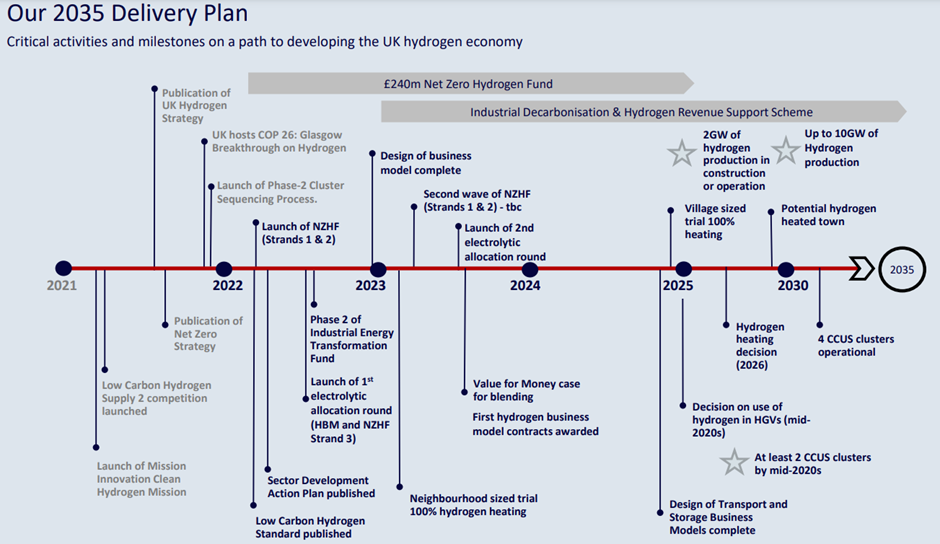
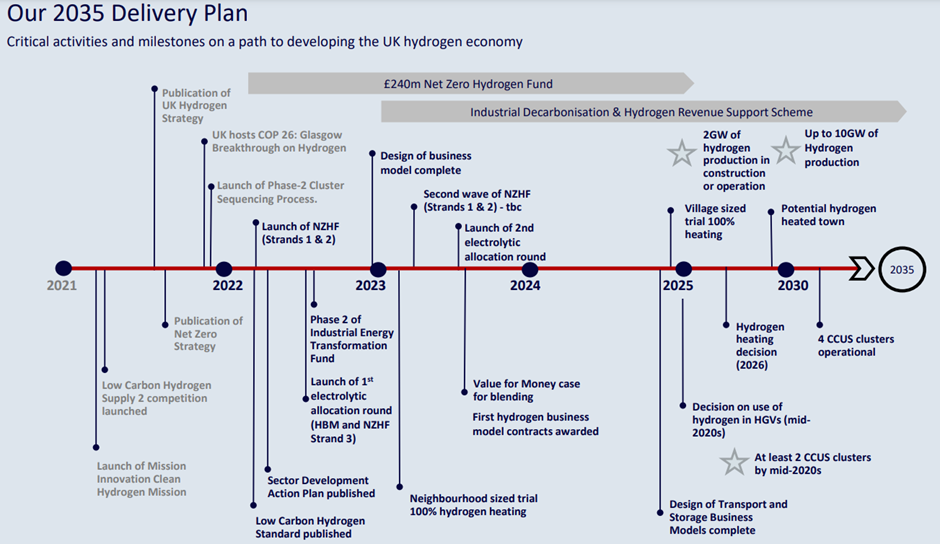
  • Hydrogen and green gas: Building on existing trials of hydrogen in the context of domestic heating and other applications, there will be a neighbourhood level trial by 2023 and a “hydrogen village” by 2025. Strategic decisions about the long-term role of hydrogen in heating should be addressed in the mid-2020s and a “hydrogen town” be seen by the end of 2020. There will be a call for evidence on hydrogen-ready appliances during 2021, and steps will be taken to enable blending of up to 20% hydrogen in the gas grid – which has already been demonstrated to be technically feasible – by 2023, subject to further trials.
  • Heat networks:Converting homes and businesses to low carbon forms of heating is easier if they are supplied by a heat network, rather than all having their own gas-fired boilers. Installing a network also enables other energy efficiency savings to be made. The government has encouraged heat networks through the Heat Networks Investment Project and proposes to continue to do so through the Green Heat Networks Fund. However, there is a consensus that, in order to reach their full potential, heat networks need their own scheme of regulation. The government consulted on this in February 2020 and now proposes to legislate on it “in this Parliament”, as well as taking powers to reduce the reliance of existing heat networks on gas as a fuel. The Scottish Government has already introduced its own legislative proposals (on somewhat different principles) in this area. There will be a consultation on heat network zoning (in England and Wales), with the aim that local authorities should designate heat network zones by 2025.
  • Innovation:The government will explore options for enabling permanent electricity demand reduction to be a viable alternative to building more generation or network capacity. This could involve thermal, hot water or battery storage, possibly combined with time of use tariffs.

Supporting analysis/other documents published with the White Paper

In commenting on the TPP, we noted that the government envisages increasing heat pump installation rates in the UK by a factor of 20. Alongside the White Paper, it published the results of a Heat pump manufacturing supply chain research project, which investigated the supply chain aspects of increased UK use of heat pumps. In particular, this looked at the potential to convert additional heat pump demand into more jobs in the UK heat pump manufacturing sector – some of them potentially replacing jobs that may be lost when gas boilers are no longer installed in new homes (from 2025).

Chapter 5 – Industrial energy

Key messages

The centrepiece of the government’s industrial decarbonisation strategy is CCUS. The TPP signalled an increase in ambition for supporting CCUS clusters from two to four by 2030. The White Paper additionally refers to “at least one fully net zero cluster by 2040”. Hydrogen is also seen as playing a key part, and the White Paper mentions the target of 5GW of low carbon hydrogen production capacity by 2030 and the Net Zero Hydrogen Fund (“£240 million of capital co-investment out to 2024/25”) that were set out in the TPP. Elsewhere, the White Paper indicates that the government is interested in encouraging more forms of low carbon hydrogen production than what are usually referred to as “blue” (methane reforming with CCUS) and “green” (renewable electricity electrolysing water) hydrogen – for example, biomass gasification and use of nuclear power.

Any serious support framework for industrial CCUS or low carbon hydrogen projects needs at least to take into account applicable carbon pricing regimes. The higher carbon prices are, the smaller the subsidy, in principle, that users of CCUS facilities or low carbon hydrogen require, because high carbon alternatives will have become more expensive. Indeed, the value of avoided emissions, based on carbon pricing, is likely to be a key component in calculating CCUS and hydrogen subsidy payments. Confirmation that a UK ETS will take effect from 1 January 2021 in GB is therefore welcome (Northern Ireland remains subject to the EU ETS under the EU-UK Withdrawal Agreement).

The UK ETS has already been the subject of consultation. It is very similar to the EU ETS that it replaces, except in its insularity, although the UK remains “open to linking the UK ETS internationally”. An Auction Reserve Price is included to provide a price floor when emitters bid for the allowances that those covered by the scheme need in order to be permitted to emit greenhouse gases. In principle, by making use of this and other features of the scheme, it may be possible for it to provide a more certain trajectory of future carbon prices than the EU ETS has sometimes done in the past.

However, neither the EU ETS nor the UK ETS will stand still in the next few years. For example, the scope of both schemes is likely to be expanded to cover businesses and sectors that are currently outside it. The government is also interested in exploring the possibility of using the UK ETS to incentivise the deployment of greenhouse gas removal technologies.

Policy pipeline

The policy agenda set for 2021 is as follows (in the order suggested by the White Paper):

  • publication of a hydrogen strategy (Scotland has stolen a march on the UK here);
  • publication of an Industrial Decarbonisation Strategy (spring 2021);
  • consultation on a preferred business model for low carbon hydrogen in 2021, introducing a  commercial framework by 2022;
  • publication of further details on revenue mechanisms for CCUS, to be finalised by 2022.

Other documents published with the White Paper/immediate follow-up Alongside the White Paper, the government published a summary of responses to its August 2019 Creating a Clean Steel Fund: call for evidence. This document reflects both the importance, and some of the complexities, of decarbonising the steel sector. A few days later, the CCUS update offered some insights into the government’s evolving thinking on CCUS for industrial emitters (a subject that we had previously discussed in a November 2020 article). Perhaps inevitably, this is less developed than the business model for CCUS power discussed above. However, chapter 5 of the main update document and its Annex E give us more information than we had already about the central payment mechanism and contract structure for supporting industrial CCUS (drawing again on the existing EMR CfD model), as well as other key features such as eligibility, metering and risk allocation.

Chapter 6 – Oil and gas

Key messages

The UK’s oil and gas sector, centred on the North Sea, has a key part to play in the Energy Transition. The sector’s upstream regulator, the Oil and Gas Authority (OGA) has been emphasising the “net zero” agenda for some time, and there has been no shortage of recent studies of the potential for integrating the North Sea’s “old energy” economy of oil and gas extraction with its “new energy” economies of offshore wind, CCUS and low carbon hydrogen.

The question is what it does or should mean for the North Sea to be “net zero” by 2050 (an aim previously stated by the OGA and repeated by the White Paper). Depending on how it is defined, this could be a much harder goal to grasp or achieve than, say, decarbonising the UK power sector – given the range of emissions impacts of the oil and gas industry (both in its own activities, and upstream and downstream of those).

The OGA consulted in May 2020 on proposed revisions to its governing Strategy that are designed to ensure that the oil and gas industry facilitates the new technologies and does its best to reduce emissions produced by venting, flaring and the supply of power from on-platform combustion units. We have written about this elsewhere (see here, here, here, here, here and here).

Earlier in December 2020, Denmark announced its intention not to issue any more upstream licences, and to aim to end all existing production in its part of the North Sea by 2050. The UK’s vision remains different. The White Paper indicates that, while a return to “business as usual” after the COVID-19 emergency is not an option, ensuring that the UK remains an attractive destination for global capital is seen as the best way to secure an orderly and successful transition away from traditional fossil fuels.

However, there will be a review of policy on future upstream licensing, seeking to ensure its compatibility with net zero. This is presented as an “opportunity for the UK to demonstrate that effective climate leadership can be compatible with maintaining a strong economy and robust energy security”.  It may involve “seeking independent advice on how proceeding with future licensing would impact our climate and energy goals”.

Meanwhile, the UK will join the World Bank’s “zero flaring by 2030” initiative. The OGA will benchmark greenhouse gas emissions to drive performance and create a new asset stewardship expectation for net zero. It will update its guidance and economic assessments to include full carbon costs. The government will tackle regulatory and policy barriers to the use of clean electricity on platforms. It will challenge industry players to address embodied “Scope 3” emissions both upstream (in its own supply chains) and downstream (among those who use its products) of their own activities. Future government support will depend on the sector adopting “meaningful measures which reduce emissions and report[ing] transparently on progress, for example through adhering to the recommendations of the Taskforce on Climate-Related Financial Disclosure”.

On the decommissioning side, the White Paper signals an intention to work with industry and regulators on regulations for re-purposing assets and to develop technical guidance on how to do this safely and securely. There is to be a review of the decommissioning regulatory unit OPRED to ensure that it is fully equipped to drive up environmental standards.

The White Paper sets out the UK’s new policy, announced a few days before its publication, of no new direct financial or promotional support for the fossil fuel energy sector overseas. There are to be some “tightly bound” exemptions for activities that support health, safety and environmental improvements; form part of wider clean energy transitions; support decommissioning or are associated with a humanitarian response.

Policy pipeline

The agenda set out for 2021 is as follows:

  • conclusions on the licensing regime will be published;
  • a North Sea Transition Deal will deliver “new business opportunities, jobs and skills [in] the sector [and] protect the wider communities which rely on the oil and gas sector”;
  • a draft Downstream Oil Resilience Bill will be published, with a view to ensuring “a secure and resilient supply of fossil fuels during the transition to net zero emissions”;
  • there will be a consultation on the use of fuels from non-biogenic waste (such as non-recyclable plastics).

Other documents published with the White Paper/immediate follow-up

Alongside the White Paper, the government published a response to Strengthening the UK’s offshore oil and gas decommissioning industry: call for evidence. The focus here is on improving the competitiveness of the UK’s decommissioning sector, and increasing its export business. There is an emphasis on visibility of the pipeline of projects and benchmarking. Stakeholders pointed out the lack of UK heavy lifting vessels and ultra-deep-water ports, but are said to have urged the government to avoid forms of intervention that could result in marked distortions. Some useful next steps are noted.

Two days after the White Paper was published, the first policy deliverable it identified in the oil and gas space was delivered, in the form of a final version of the revised OGA Strategy, for laying before Parliament. This final version is essentially identical to the version that accompanied the consultation in May 2020, with only a small number of minor drafting changes from that version.

Conclusions

The wait for the White Paper began some three years ago, under a different Secretary of State for Business, Energy and Industrial Strategy, and a different Prime Minister. At around the same time, that Secretary of State had commissioned an independent review of the cost of energy which resulted in the economist Dieter Helm making wide-ranging and often quite radical recommendations about almost all the areas of energy policy now covered by the White Paper.

It is questionable whether anybody ever expected the White Paper to translate Helm’s vision into a programme of legislative and regulatory action, and it does not. However, it does show clear evidence of government thinking across the whole of energy and the sectors most affected by climate policy, and having serious plans, some of which could take a radical turn as they develop, to address the issues that its net zero agenda requires to be addressed as a matter of urgency.

There can be no doubt that, for obvious reasons, UK energy policy has developed more slowly than was desirable over the last four and a half years. However, there does appear now to be a fairly clear plan for how to make up the lost time. That does not guarantee that the execution will follow, but it is a good start, and we now have a much firmer and more detailed schedule, produced by the government itself, against which to measure its performance over the coming years. The progress that has already been made in some areas, such as parts of CCUS policy, shows what can be achieved at pace.

The next big domestic test of the government’s ambition, of course, will be its response – also due in 2021 – to the Committee on Climate Change’s recommendations on the Sixth Carbon Budget. Further events in the political timetable, notably the UK’s leadership of the G7 in 2021, and, of course, its hosting of COP26 in November 2021, can be expected to drive imperatives for major delivery milestones to be met at or before each event. 2021 is indeed set to be a busy year!

Subscribe and stay updated

Receive our latest blog posts by email.



Source link

UK hydrogen policy takes shape (1): publication of the UK Hydrogen Strategy


Sometimes, it is worth the wait. Hydrogen enthusiasts (which, these days, means almost everyone) have been asking for some time why the UK government had not yet produced a national hydrogen strategy. After all, a lot of other countries (and the EU) did so a year or more ago. With the publication on 17 August 2021 of the UK Hydrogen Strategy (the Strategy), we have the answer. The Department for Business, Energy and Industrial Strategy (BEIS) took its time because it was engaging seriously with a complex task, and doing a thorough job.

Background

(We suggest that you skip this section, and possibly the next one, if you already know about hydrogen, for example by having read our earlier publications on the subject, linked at the end of this post.)

Most hydrogen produced today is used as a feedstock in industrial chemical processes, rather than as an energy vector. It is so-called “grey”, “brown” or “black” hydrogen, made from fossil fuels by processes like methane reformation, which emit CO2 and contribute to climate change. However, if made without such emissions, hydrogen could play a key part in the Energy Transition.

Adding carbon capture, usage and storage (CCUS) can greatly reduce, and eventually eliminate, these CO2 emissions. Hydrogen by methane reformation + CCUS is called “blue” hydrogen. Its sustainability depends on the success of the CCUS plant and eliminating methane emissions from the upstream and midstream natural gas industry (something that we need to do anyway).

Electrolysing water with electricity that has been produced without emitting CO2 results in zero carbon hydrogen. Hydrogen produced by electrolysing with renewable electricity is called “green” hydrogen. Inherently sustainable, its viability depends on rapid and massive scaling-up (and consequent cost reductions) of renewable electricity generation and electrolyser technology.

Zero carbon electricity can also break down methane into its constituent elements of carbon (in solid form, “carbon black”) and hydrogen (using pyrolysis, and known as “turquoise” hydrogen), without producing CO2 emissions. This is a potentially promising, but currently less developed technology.

These are not the only ways to make low carbon hydrogen (for example, nuclear power is as good as renewables as a source of carbon-free electricity), but they are the ones most widely considered.

Low carbon hydrogen is not a “silver bullet”. It is only one of the changes in energy production and use that are required to reach Net Zero greenhouse gas emissions. It is not the best (cheapest/most energy-efficient) option to decarbonise all aspects of energy use. However, there are some important things that it does, or could do, particularly well. For example, it can be used to:

  • store electricity for longer periods, more cheaply, and in greater bulk than any battery;
  • provide a fluid vector for transporting renewable energy by ship, between places that could not be linked by electricity transmission systems (e.g. Chile and Europe); and
  • provide energy for industrial heat and transport (e.g. aviation fuel) applications that it is hard to envisage being cost-effectively electrified in the short to medium term.

What is a hydrogen strategy for?

Among the key questions for any government developing a serious hydrogen policy are:

  • How do you overcome the barriers presented by the fact that low carbon hydrogen is currently significantly more costly to produce than grey hydrogen or any of the incumbent fuels/energy vectors for which low carbon hydrogen could be substituted – and, in so doing, to stimulate scaling-up of low carbon hydrogen technologies and progressive reductions in their cost?
  • Since switching to low carbon hydrogen requires not just investments in new production capacity, but also the adjustment and replacement of equipment on the demand side (from new steel manufacturing facilities to new bus-refuelling infrastructure or domestic boilers), what is the best way to overcome those switching cost barriers for businesses and households?
  • In the absence of a pre-existing/readily extendable network to feed into (contrast the position of the first renewable electricity generators, who could take this for granted), how is the demand risk of early hydrogen projects to be mitigated (e.g. in the case of a producer who signs a long-term contract and co-locates with a large industrial user of hydrogen, such as a refinery operator, which then ceases to trade or moves its business to another jurisdiction after a couple of years)?
  • For economies with a mature downstream natural gas industry that provides the primary energy source for much domestic, industrial and commercial heating, how far – and when – should hydrogen start to replace that natural gas (starting by being blended with – increasingly, biogenic – methane in the gas grid, and in time taking over some or all of the gas network completely)? 
  • How do you encourage the development of hydrogen applications whose real commercial potential (e.g. in aviation fuel) is probably at least 10 years away, preferably in such a way as to secure some competitive advantage in those future markets for businesses based in its territory?

Behind, or perhaps prior to, these headline questions, there is a range of more detailed issues about building the physical and economic infrastructure for a market in low carbon hydrogen as an energy commodity. These start with the question of what will count as “low carbon” in the first place, and encompass a variety of questions about the use, or re-purposing, of existing natural gas sector commercial and regulatory models and provisions for the hydrogen economy.

The Strategy’s general approach

The UK is taking a “colour-blind”, open-minded, urgent but cautious approach to developing hydrogen policy. Like some other recent UK energy policy documents, the Strategy is as much a list of future consultations to be held and decisions to be made as it is a statement of matters already decided. However, the timescales for future action look credible and it is clear from the Strategy itself and the other documents published alongside it that BEIS’s thinking is informed by robust analysis.

The guiding principles of the Strategy and the further policies to be developed from it are: long-term value for money (VfM) for taxpayers and consumers; growing the economy whilst cutting emissions; securing strategic advantages for the UK; minimising disruption and cost for consumers and households; keeping options open/adapting as the market develops; and taking a holistic approach.

In a world where talk of multi-GW low carbon hydrogen projects is becoming commonplace, the UK’s (already announced) targets of 1GW of low carbon hydrogen production by 2025, and 5GW by 2030 could seem pedestrian. However, this misses the point. The emphasis is not on numbers-based ambition for its own sake, but on building, as quickly as is sensible, a policy and regulatory environment that – from every perspective – will allow the UK hydrogen sector to flourish in the long term.

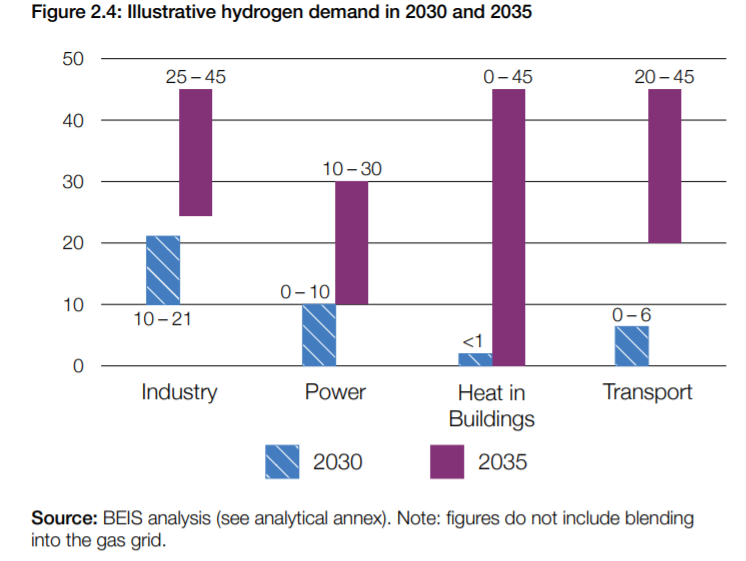
The Strategy is very focused on hydrogen’s contribution to meeting the UK’s Sixth Carbon Budget (“CB6”, covering the period 2033-2037). It notes that in most of the pathways modelled for CB6, hydrogen demand doubles in 2030-2035 and that hydrogen could supply up to a third of final energy consumption by 2050. However, taking account of uncertainty is a key feature of BEIS’s thinking: see, for example, the chart, showing ranges of possible demand (in TWh) by sector in 2030 and 2035.

The Strategy shows an awareness of the range of government and regulatory action needed to support a flourishing low carbon hydrogen sector, but it also sets that in a bigger picture which includes international activity and the role of the private sector. This is summarised in its figure 2.1, which, because of its size, we have reproduced at the end of this article.

Answers to the big questions?

The Strategy does not pretend to have the full answers to all (or, as yet, perhaps any) of the big strategic questions outlined above. However, in the context of those questions, what it says in relation to three areas of policy is particularly notable and encouraging.

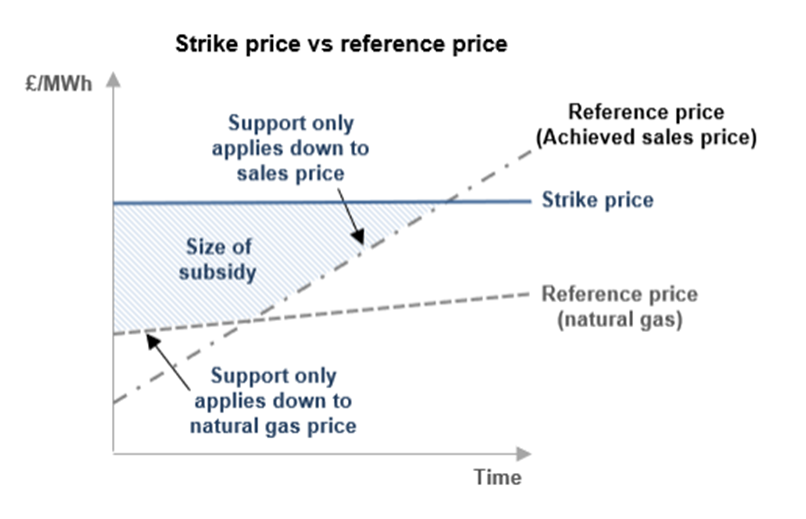
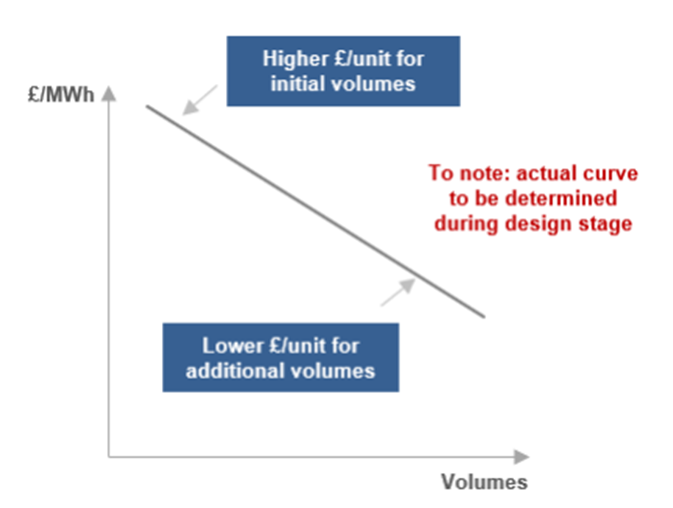
  • BEIS has thought carefully about its proposed hydrogen business model (i.e. a regime of regulated financial assistance for low carbon hydrogen production), which is the subject of one of the consultations published alongside the Strategy. This aims to supplement the market price producers receive where this is lower than their costs of production. It would also address demand risk, by combining a “variable premium”, contract for difference-like price support mechanism and a “sliding scale” mechanism that would pay a higher level of price support on initial volumes, allowing the producer to recover fixed costs at relatively low offtake volumes. We will analyse the detail of these proposals elsewhere. The key point to note for now is that BEIS aims to digest and respond to responses to this consultation in Q1 2022, and to publish indicative heads of terms with that response, in preparation for allocating the first contracts under the business model in Q1 2023. This urgency is partly driven by the timetable of BEIS’s parallel CCUS programme, but the boost that the business model can provide to projects will be available to green, as well as blue, projects.
  • The blending of hydrogen in the gas grid is the subject of a number of innovation projects carried out by GB gas network operators. The ability to export hydrogen in this way offers producers a potentially ideal back-stop means of mitigating demand risk, and the substitution of low carbon hydrogen for some of the methane that would otherwise be consumed by end users connected to the grid could make significant contributions to decarbonisation. In this context, it is very encouraging that the Strategy promises an indicative VfM assessment on blending up to 20% hydrogen by Q3 2022, and a final decision on it in late 2023.
  • For some time now, it has been clear that there will be a strategic choice to be made on what should replace the fossil fuel methane that provides most space heating in the UK. Heat pumps powered by renewable electricity may be an ideal solution from some perspectives but, for a variety of reasons, a “mixed economy” of heat pumps and decarbonised gas-fired heating may be preferable, at least for some consumers. The Strategy sets a date (or at least a year) for taking a decision on the future of hydrogen in heat: 2026. This will be informed by the results of “neighbourhood” level trials in 2023, and “village” level trials in 2025.

Meanwhile, questions about meeting demand-side switching costs and developing the markets for future applications of low carbon hydrogen in the transport sector are partly answered by competitions for funding, details of which accompany the Strategy. These include:

  • £240 million for the Net Zero Hydrogen Fund (2022-2024/25);
  • up to £60 million under the Low Carbon Hydrogen Supply 2 competition;
  • financial support for fuel switching (via the Industrial Energy Transformation Fund, Industrial Fuel Switching 2 Competition and Red Diesel Replacement Competition);
  • up to £41.8 million on marine, aviation and other projects; and
  • £140 million split between buses (£120 million) and HGVs (£20 million), shared with battery technology.

At the same time, there is ample evidence of government pursuing the key background, commercial and regulatory infrastructure issues, such as:

  • reviewing the suitability of Gas Act framework and gas quality standards for facilitating a decarbonised gas future;
  • setting up a Hydrogen Regulators Forum (covering regulators with responsibility for environmental, safety, markets, competition and planning matters);
  • engagement with industry on optimising the benefits of early-adopting clusters; understanding the impacts of full or partial transition to hydrogen via the gas grid on industrial consumers and their needs; the possibility of a research and innovation facility to support hydrogen use in industry and power; and understanding economics and system impacts of hydrogen in the power sector.

Keeping up the pace

The Strategy and the other documents published with it (see below) are just the start. Below is a list of what the Strategy promises by way of further policy development in the coming months.

  • Before the end of 2021, the Strategy promises:
    • “We will set out our aspirations to continue to lead the world on carbon pricing” (in the run-up to COP26). Needless to say, this could be hugely important. A sufficiently rigorous and broad-based approach to carbon pricing has the potential to turbo-charge the development of a hydrogen economy. Might the UK extend its Emissions Trading System to sectors such as heat and transport, as the EU is proposing to do with the EU Emissions Trading System? Might it seek to incentivise energy-intensive industries not only in the UK but beyond to switch to the use of low carbon hydrogen and other cleaner forms of energy by adopting a border carbon adjustment – again, as the EU is proposing to do?
    • A consultation on enabling/requiring new gas boilers to be easily convertible to hydrogen by 2026: for most consumers, this could be their point of entry into the hydrogen economy. Getting both the technical details and the messaging right is very important.
    • call for evidence on hydrogen-ready industrial equipment: a precursor, perhaps, to the business-sector equivalent of the above.
    • A call for evidence on the future of the gas system: clearly an important building block towards some of the key decisions for later in the decade highlighted above.
  • In or by “early 2022”, the Strategy tells us to look out for:
    • further detail on production strategy…including less developed methods;UK standard for low carbon hydrogen – design elements to be finalised;
    • status update on hydrogen storage: review of systemic regulatory/funding requirements;
    • Hydrogen Sector Development Action Plan;
    • initial conclusions and proposals on identifying, prioritising and addressing regulatory barriers;
    • initial conclusions and proposals on developing appropriate market frameworks.
  • On a slightly more leisurely timescale (within a year), we are to expect a call for evidence on phasing out carbon intensive hydrogen and its replacement with the low carbon variety.
  • Finally, the Strategy tells us that a call for evidence on “energy consumer funding, affordability and fairness” (an issue that clearly goes beyond hydrogen, but is very important to the question of how support for low carbon hydrogen is to be funded) is “expected to be published soon”.

For ease of reference/further reading

As already noted, the Strategy was not the only hydrogen policy document released by BEIS on 17 August 2021. For ease of reference, we produce links to the Strategy and all the other documents below. We will be commenting further on these in due course, as well as on the other policy documents that the Strategy promises will be forthcoming, as they emerge. If you have any questions about UK hydrogen policy in the meantime, please get in touch!

UK government launches plan for a world-leading hydrogen economy – press release.

UK hydrogen strategy: sets out the approach to developing a thriving low carbon hydrogen sector in the UK to meet our ambition for 5GW of low carbon hydrogen production capacity by 2030.

Hydrogen analytical annex: supports the policy thinking in the Strategy and other documents below.

Hydrogen production costs 2021: presents levelised cost estimates for hydrogen production technologies, detailing methodology, data and assumptions.

Consultation on a business model for low carbon hydrogen: seeks views on the design for a low carbon hydrogen business model (in other words, a subsidy/revenue stabilisation mechanism).

Designing the Net Zero Hydrogen Fund: seeks views to inform the design of the Net Zero Hydrogen Fund (NZHF), to support at-scale deployment of low carbon hydrogen production in the 2020s.

Consultation on a UK low carbon hydrogen standard: seeks views on design options for a UK standard that defines “low carbon” hydrogen, to underpin our support for hydrogen production.

Options for a UK low carbon hydrogen standard: report: sets out options for a standard that could define what is meant by “low carbon” hydrogen; has informed the consultation above.

Hydrogen for heat: facilitating a grid conversion hydrogen heating trial: seeks views on possible legislative changes to enable the delivery of a hydrogen grid conversion trial.

There are also some relevant funding competitions in the Net Zero Innovation Portfolio:

  • Low Carbon Hydrogen (Stream 2): this aims to support innovation in the supply of hydrogen, reducing the costs of supplying hydrogen, bringing new solutions to the market and ensuring that the UK continues to develop world-leading hydrogen technologies for a future hydrogen economy;
  • Industrial Fuel Switching competition: this will support innovation in the development of pre-commercial fuel switch and fuel switch enabling technology for the industrial sector, to help industry switch from high to lower carbon fuels: expected to launch in October 2021;
  • Red Diesel replacement competition: a £40 million competition to support the development and demonstration of low carbon fuel and system alternatives to red diesel for the construction, and mining and quarrying sectors from April 2022.

Strategy Figure 2.1

The pictures below are taken from Figure 2.1 of the Strategy. It gives a good summary of BEIS’s overall vision of the roles that government and others will play in developing a UK hydrogen economy.

Links to some earlier Dentons publications on low carbon hydrogen

The prospect for hydrogen (a general survey)

Making early hydrogen projects investable (jointly written with Frontier Economics, focusing on regulated financial assistance for blue hydrogen projects in the UK context)

Scaling up green hydrogen in Europe (jointly written with ILF and Operis, including linked webinar)

The Oil and Gas Authority’s Net Zero Goals; Hydrogen

Blending hydrogen in the GB gas grid (two articles, here and here)

Subscribe and stay updated

Receive our latest blog posts by email.


Source link

UK hydrogen policy takes shape (2): defining “low carbon hydrogen”


We have all become used to talking about the various “colours” of “low carbon hydrogen”. When we talk about “blue” or “green” hydrogen, we know we are referring to something whose production is meant to result in fewer greenhouse gas (GHG) emissions than producing standard “grey” hydrogen by reforming methane and venting the waste CO2. However, if, like the UK government, you are going to spend large amounts of public money subsidising the production of “low carbon hydrogen”, with a view to hitting net zero targets, you need to be a good deal clearer about exactly what you are getting.

In this post, we look at two documents: Consultation on a UK low carbon hydrogen standard (Consultation), and an accompanying consultants’ report on Options for a UK low carbon hydrogen standard (Options Report). They were published by the UK’s Department of Business, Energy and Industrial Strategy (BEIS) on 17 August 2021. For background, a full list of the BEIS hydrogen policy documents published on that date and a discussion on the UK’s overarching Strategy, click here.

This is not the first time the UK government has consulted on a low carbon hydrogen standard. It first did so (although only in relation to green hydrogen) in 2015. Since then, as the Options Report outlines, other hydrogen standards have started to occupy the field, including CertifHY, TÜV SÜD, and emerging Chinese and Australian schemes. The EU’s second Renewable Energy Directive’s provisions on “renewable fuels of non-biological origin” (which include those containing green hydrogen), and their implementation, have also forced consideration of a number of key issues. However, for the moment, as the Consultation points out, there is “no single understanding or formal definition of what is actually meant by ‘low carbon’ hydrogen in the UK”, and this gaps needs filling.

Spoiler alert

If you have ever thought about what a low carbon hydrogen standard might look like, you will have got as far as thinking in terms of a limit based on GHG emissions. You might have thought that such a limit could either be set very low – thus potentially including only “green” hydrogen produced by electrolysis using 100% renewable electricity, or somewhat higher – thus also including “blue” hydrogen produced by methane reformation with efficient CO2 capture and storage. But essentially, you were probably thinking in terms of a single, headline threshold figure.

The Consultation does not suggest what the headline GHG emissions limit of a future UK low carbon hydrogen standard should be. However, it does include a graph – Figure 2, reproduced below – which usefully indicates how the consultants who produced the Options Report think that different production technologies compare in terms of emissions intensity. The blue bars in the chart are estimates of the range (from high to low) of GHG emissions associated with different hydrogen production techniques at different points in the next 30 years (with the blue diamonds representing the central estimate of emissions for each technology). The red line indicates “the potential impacts of an example threshold of around 15-20 gCO2e/MJLHV of produced hydrogen”. In other words, if a figure in that range were chosen as the standard, those technologies that are above the line would likely not meet the standard, and therefore not qualify for public financial support, while those technologies that are below the line would meet the standard and qualify for support.

Policy context

The Consultation makes it clear that BEIS wants the standard to encourage, not inhibit, new hydrogen production. Compliance with the standard would be one of the determinants of eligibility for financial support via the UK’s hydrogen “business model” or Net Zero Hydrogen Fund. The Consultation stresses that it is important to ensure that “any investment made today is directed towards production technologies that are consistent with the UK’s net-zero commitments and carbon budgets”.

The Consultation makes it clear that BEIS is engaged with other bodies that have set or are formulating similar standards in other countries and internationally. It is also alive to the possibility of both imports and exports of hydrogen to and from the UK. However, its focus is primarily on domestic production and consumption of low carbon hydrogen.

The aim is to establish a GHG emissions standard for low carbon hydrogen that meets the eight criteria of being inclusive (e.g. technology neutral); accessible (cost-effective, simple and user-friendly); transparent; compatible (working with other UK energy sector schemes and other countries’ standards); ambitious; accurate; robust (with strong penalties for fraud etc.); and predictable.

Multiple variables

The Consultation outlines the many points that need to be decided when establishing a standard, in addition to the headline emissions figure. These include:

  • Matters of scope: Should the standard cover only hydrogen produced and used in the UK? Should it reflect emissions only up to the “point of production” (BEIS’s preference) or some downstream emissions too? Should “production” emissions include those that are “embodied” in equipment or associated with the production of natural gas?
  • Accounting for electricity emissions: BEIS seems wary of adopting a standard that would limit support only to projects with off-grid renewable generation dedicated entirely to hydrogen production. However, should the standard go as far as allowing production by any grid-sourced electricity (see the graph above)? If it is limited to production from renewable power only, should that be on the basis of claims based on production from grid-connected renewables physically linked to the electrolyser, or also on trading and the cancellation of guarantees of origin? Should other conditions be imposed (e.g. temporal or geographic constraints designed to ensure the electrolysers support rather than undermine grid stability)? Perhaps most important is the vexed question of “additionality”: should the standard cover only hydrogen produced from new renewable electricity generating capacity built for that purpose, rather than encouraging its production from other existing or future renewable generating capacity, thereby delaying decarbonisation of the grid – and, if so, how?
  • Other accounting matters: Should there be physical traceability of emissions, through a mass balance system, or should a “book and claim” (certificate trading) system be followed? Should carbon captured and used – rather than stored – in blue hydrogen production count as GHG emissions avoided for this purpose, and if so under what conditions? How do you prove that captured CO2 will not return to the atmosphere over an agreed minimum period of time in this context? How do you account for waste fossil feedstocks or mixed inputs (e.g. if a plant uses a mixture of “clean” and “dirty” electricity sources to power its electrolyser, do you average their emissions over its whole output, or divide its output into green and grey batches)?
  • Core measurement issues: Do you measure how many kgCO2e are emitted per kg of hydrogen produced, or how many kgCO2e are emitted per MJ Lower Heating Value or per kWh Higher Heating Value? BEIS prefers the latter. How do you deal with negative emissions (see the chart above) or measure any non-GHG impacts that may be taken into account (e.g. water consumption or air quality)? Finally, should the GHG threshold itself be defined in absolute terms or in relative terms (e.g. by reference to a fossil fuel comparator)?
  • One size fits all? Whilst BEIS is clear that it wants a standard that applies across technologies, it leaves open the possibility of there being more than one threshold. There could be more less demanding thresholds, as in some existing schemes. As the market evolves, the Consultation also suggests that thresholds may tighten over time, but without retrospectively depriving projects that met an earlier applicable threshold for support.
  • Administrative details: Who is going to run the standard? Will it work on “default” or “actual” emissions data? Who will report (and verify/audit) each participant’s emissions?

All told, respondents are asked no fewer than 42 questions (many of which have more than one part). In many cases, the Consultation does not indicate BEIS’s preferred position, although the Options Report (chapter 6) does include traffic-light coded tables that evaluate each set of options against the eight criteria mentioned above, and the consultants make recommendations based on these.

What next?

BEIS expects “to finalise design elements of a UK low carbon hydrogen standard by early 2022”. In early 2023, it aims to be signing the first contracts under the hydrogen business model, and those involved will need a clear understanding of the standards they will be committing to by then, if not sooner. There is clearly a lot of detailed work to do in a relatively short space of time.

As the Consultation and Options Report show, there are a number of trade-offs to be made in reaching a view on the many choices inherent in specifying a low carbon hydrogen standard. Strategically, perhaps the dominant one is between a “higher” standard/higher initial subsidy costs/lower initial production volumes and a “lower” standard/lower subsidy costs/higher initial production. Arguably, though, the true test of a low carbon hydrogen standard will be how it is received in the market. For example, if today you set up “gold” and “silver” standards, and subsidise projects that meet either, what happens if, when the subsidy contract ends in 2035, the market for low carbon hydrogen that you have succeeded in stimulating has no interest in “silver”-compliant hydrogen?

It is not obvious that there are “right answers” to many of the questions in the consultation, in the overall context of developing a UK hydrogen sector. As usual, the policy will only be as good as the inputs to it. If you have views on the questions raised, you have until 25 October 2021 to respond. We would be happy to help you put your case to BEIS.

Subscribe and stay updated

Receive our latest blog posts by email.
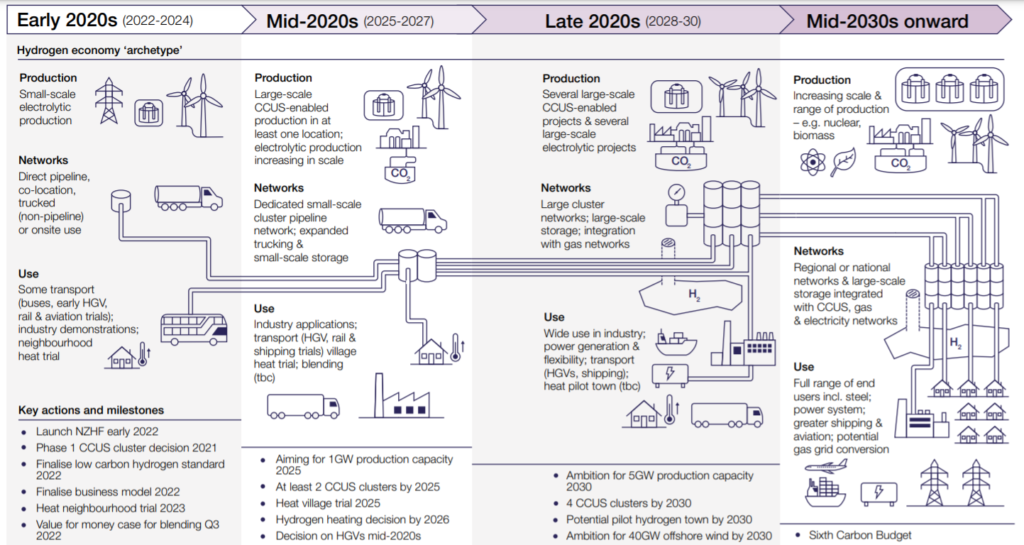


Source link

UK hydrogen policy takes shape (3): financial support (part 1)


As a share of UK electricity generation, renewables increased tenfold between 2004 and 2019. The various forms of public financial support provided to the sector played a major part in this. Government policy is now targeting an even more spectacular increase in the production of low carbon hydrogen in the UK over the next 10 years. Once again, subsidies will be crucial.

In this post, and the next one, we discuss the UK government’s recently published plans for financial support to the low carbon hydrogen sector. These are set out in Consultation on a business model for low carbon hydrogen (BM Consultation) and Designing the Net Zero Hydrogen Fund Consultation (NZHF Consultation). Both documents were published by the Department of Business, Energy and Industrial Strategy (BEIS) on 17 August 2021. For general background, a full list of the other hydrogen policy documents published on the same date and a discussion on BEIS’s overarching Strategy, click here. For a post on the related consultation on standards, click here.

Background

The hydrogen business model and NZHF aim to help low carbon hydrogen production projects overcome a number of barriers: high production costs (relative to alternative, high-carbon (“counterfactual”) fuels); technological and commercial risk; uncertain demand for their product; lack of an established market structure (in sharp contrast to renewable electricity); lack of distribution and storage infrastructure; and policy and regulatory uncertainty (at least, prior to 17 August 2021).

The hydrogen business model would do this by giving projects revenue support during their operational phase. The NZHF would provide capital support, likely in the form of grants payable on the completion of certain milestones. These two schemes are complemented by BEIS’s evolving industrial carbon capture business model, which may support investment in carbon capture retrofitting of existing “grey” (rather than new “blue” or “green”) hydrogen capacity.

BEIS takes the view that both forms of support (revenue and capital) are needed. It also considers that other relevant interventions that could boost demand for low carbon hydrogen (such as broader and sharper carbon pricing) would not be adequate on their own to secure the future of the low carbon hydrogen sector. It sees the central functions of the business model as addressing:

  • market price risk (the risk that the price a producer can get for its hydrogen in the market does not cover its production costs); and
  • volume risk (the risk that the producer cannot sell enough hydrogen to cover its costs: for example, because its customers go out of business, move or switch supplier).

In designing the business model and NZHF, BEIS is mindful that the hydrogen value chain is both nascent and complex; that the value of hydrogen varies considerably between different potential end user groups; and that methane reformation is less flexible than electrolytic production.

In the remainder of this post, we look at BEIS’s overall view of the proposed hydrogen business model and at how it proposes to address market price risk. In the next post, we will look at how the business model would address volume risk, and other aspects of the proposals, including how support under the business model would be allocated to individual projects.

What kind of scheme should the hydrogen business model be?

BEIS says that it would prefer the hydrogen business model to be funded and delivered on a UK-wide basis. It would be applicable to all low carbon hydrogen production technologies that meet the requisite standard in terms of GHG emissions (which is not the same thing as saying that any project using any technology would be eligible for support). It should assist uptake of low carbon hydrogen across a range of potential energy applications.

BEIS appears to see the business model as essentially a domestic scheme: “exports of hydrogen could be permitted for projects benefiting from business model support, although the specific volumes exported would not be eligible for support payments”. Even in the domestic context, it is also designed to provide support only for production, and not for financing significant distribution or storage infrastructure – although “small-scale hydrogen pipelines and non-pipeline distribution and small-scale storage infrastructure could potentially be factored in as part of projects’ overall costs”.

In principle, if you are seeking to close the price gap between low carbon hydrogen and counterfactual fuels, you could do it by subsidising either producers or end users. BEIS prefers the former as being simpler and less vulnerable to complications on the demand side. It also wants to deliver support through contracts, rather than a “policy-based approach” or economic regulation.

UK public support for renewable electricity generating projects has been through a number of iterations, notably green certificates (ROCs), feed-in tariffs and contracts for difference (CfDs). BEIS is determined that the hydrogen business model should be one that stands the test of time. The BM Consultation states that its design should conform to 10 core principles: promoting market development; promoting market competition; being investable; providing value for money (VfM); reducing support over time; being suitable for future pipeline; being compatible with other hydrogen policies; being technology agnostic; being size agnostic; and avoiding unnecessary complexity.

Mitigating price risk in the hydrogen business model

Many European countries began subsidising renewable electricity generation by paying a guaranteed price per unit of electricity generated. This has the merit of simplicity, and works easily enough if there is already a physically connected, liquid market for the commodity in question (electricity). In a market for low carbon hydrogen which (if it exists) has neither of these characteristics, it is less attractive.

BEIS accordingly rejects the “fixed price” approach. It also rejects the idea of a “fixed premium (over market price)” approach on the grounds of risk of producer overcompensation/lack of VfM. Instead, it proposes a variable premium as the best way of mitigating producers’ price risk.

In the renewable electricity world, this has been relatively straightforward to implement – in the UK, as the CfD that supports many GW of generating capacity. For each MW of output, the generator is paid (or makes a payment) based on the difference between a reference price (RP) derived from wholesale market indices and a strike price (SP) set by competitive auction. If SP-RP is positive, the generator is paid by, and if it is negative, it must make a payment to, the CfD counterparty, the Low Carbon Contracts Company (LCCC). The operation of the CfD regime is summarised in the diagram below, taken from LCCC guidance and showing hypothetical changes in the wholesale price of electricity (and therefore the RP) across the 48 half-hourly settlement periods in 24-hour period.

Translating the variable premium approach to the hydrogen context, setting an SP is not difficult in principle. As in the electricity context, it represents the overall value that a producer needs to achieve per unit to cover its fixed and variable costs, financing costs and equity return. The only question is whether you arrive at that figure by BEIS modelling, bilateral negotiations or a competitive process.

The bigger challenge is to decide what the RP should be, since there is not yet a market wholesale price for low carbon hydrogen. Rather, as the BM Consultation points out, the way that BEIS sets the RP will influence price formation in this new market. It goes on to assess seven RP options. It does this in terms of their suitability as proxies for the value of low carbon hydrogen to end users; their ability to promote market development; their likely VfM from BEIS’s perspective; and evolution over time. Crucially, it assesses the options without making assumptions about the level of any other relevant government intervention, such as carbon pricing.

The options rejected (although BEIS finds that even each of these has some advantages) are:

  • input energy price: no necessary positive correlation with hydrogen value; nothing to stop overcompensation where producers sell at a high price; no guarantee of reducing subsidy trajectory; may indirectly subsidise the producer’s other operations (by transfer pricing);
  • natural gas price: may be an excessive subsidy for sales to users of more expensive fuel; those who pay no carbon price are less incentivised; subsidy may not reduce over time;
  • counterfactual fuel prices: take the RP that fits each customer, and each pays the same price as before switching, with a carbon cost saving if they are subject to a carbon price (producers may be incentivised to sell into markets that can absorb highest volumes with least effort, and the incentive to switch is limited to carbon cost savings);
  • carbon price: may not perfectly reflect hydrogen market value – or be strongly correlated with production costs, especially for green hydrogen – and the correlation will weaken over time; suitability may depend on contract length; inherently more suited to demand side subsidy;
  • natural gas price + carbon price: removes price incentive on industrial users to switch, since their fuel cost would be the same and they still have the capex costs of switching.

BEIS’s favoured RP options are:

  • a market benchmark: (i.e. the low carbon hydrogen equivalent of the indices used in renewable electricity CfDs) when this can be robustly and reliably calculated – as such it is the preferred option for future contracts on NOAK projects, but cannot be applied yet;
  • the price at which the producer sells the unit in question, subject to a floor price set at the natural gas price: this will do until a benchmark is available. The starting point for calculating RP in each case would be the actual sale price, but there would be no additional subsidy for selling a unit at a price below the natural gas price if the achieved sales price is lower than the natural gas price. It is not entirely clear whether the “natural gas price” would be the wholesale price or aim to represent what each end user would pay for gas. In practice, it seems likely that producers may set their prices at, or at least by reference to, a gas price. This, the proposed model for the near term, is illustrated from the BM Consultation below.

It is further proposed that there should be “additional contractual measures, such as a gainshare mechanism or a periodic payment linked to achieving or exceeding a defined pricing threshold or benchmark”. Further work on this is to be “discussed with stakeholders”.

The BM Consultation raises the question of how the SP should be indexed to take account of changes in producers’ costs over time, but it does not reach a conclusion on a particular index, having found something to be said both for and against each of: a general price inflation index; increases in actual energy costs; a natural gas benchmark; and an electricity price benchmark.

Already, we have something that is materially more complex than the renewable support CfD structure, even at an administrative level (given the need to record each transaction and its price, rather than simply metering the export from a generating station). However, as we explain in the next post, there are further complexities to the hydrogen business model to deal with volume risk.

Subscribe and stay updated

Receive our latest blog posts by email.
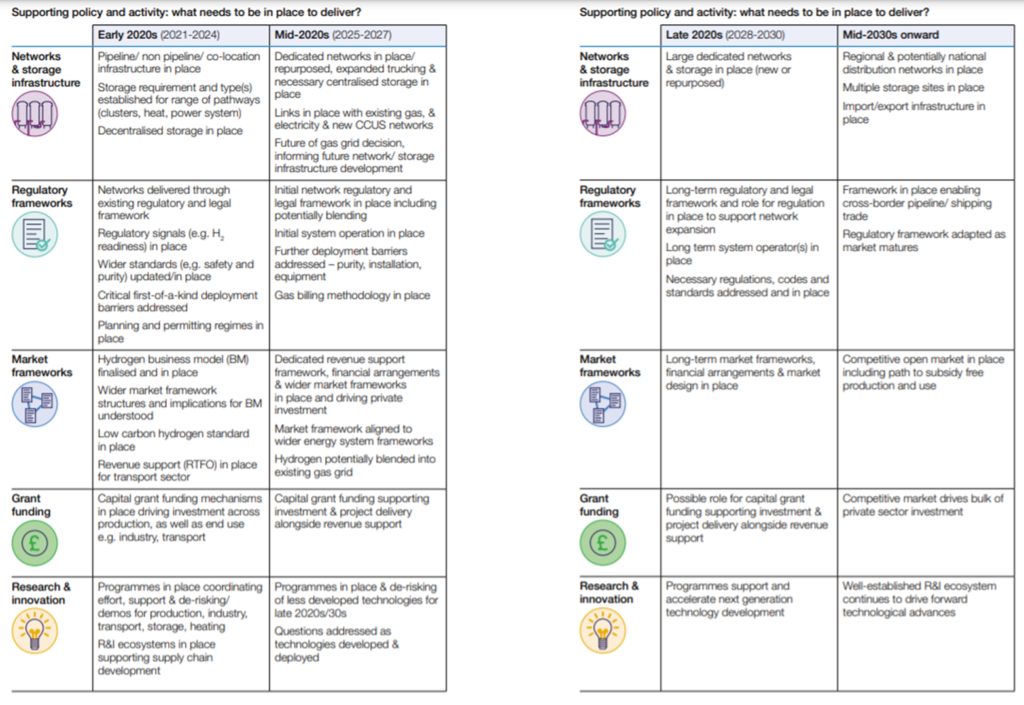


Source link

UK hydrogen policy takes shape (4): financial support (part 2)


This is the fourth in a series of posts on the low carbon hydrogen policy documents published by the UK Department of Business, Energy and Industrial Strategy (BEIS) on 17 August 2021, and the second of two posts on the forms of financial support proposed by BEIS for low carbon hydrogen projects. The three previous posts can be found here, here and here.

Mitigating volume risk in the hydrogen business model

In the previous post, we explained how BEIS’s proposed “business model” (i.e. revenue support scheme) for low carbon hydrogen would mitigate the price risk facing producers. It may not feel like it to readers of the Hydrogen Business Model (BM) Consultation, but dealing with price risk is the easy bit of the business model. The real existential difficulty faced by early low carbon hydrogen projects is volume risk: what happens not when you cannot get a high enough price for the hydrogen you have produced, but when you cannot find a buyer at all? While there are things that can be done to mitigate volume risk outside the hydrogen business model (like facilitating the blending of hydrogen in the grid), these options may not be available to the first projects.

So, what are BEIS’s options for mitigating volume risk within the business model?

  • Payments based purely on availability to produce would cost money without necessarily resulting in decarbonisation. They are no good for methane reformation technologies (which cannot ramp up quickly). Like capacity mechanisms in the electricity sector, they could turn out to be a drug on which the market gets hooked (with some insight, BEIS doubts its ability to refuse to NOAK projects what it would have conceded to FOAK projects in this regard).
  • Government could purchase part of the producer’s output at a price that allows it to cover fixed costs, maintenance, debt servicing and a “minimum economic return” (MER) on equity.  Government would be able to “take or pay” (or sell, store, flare or vent the hydrogen). This is highly interventionist, may distort the market and is less suitable for intermittent projects.
  • Government could act as a buyer of last resort for volumes with no end user buyer. Rather than purchasing a set volume in each period, it would step in on a contingent basis and purchase the first volumes that cannot otherwise be sold. In any given period, this might be nothing, a bit, or a lot (subject to a cap). The price would have to be attractive enough to cover the MER, but unattractive enough to discourage reliance. The “backstop Power Purchase Agreement” for renewable electricity generators with CfDs who are unable to find commercial offtakers (included in the CfD as a confidence-building measure) is a partial model here. This approach would weaken incentives for producers to seek market demand; may undermine market formation; and would be hard for HMG to budget for.
  • A government obligation to purchase could be triggered when the hydrogen offtake volume falls below the level at which the producer cannot cover MER. It would thus apply to lower volumes than the previous option, but with higher levels of support per unit. The producer would be obliged to sell the “government share” first: if it cannot achieve the guaranteed price, the government would make up the difference. If it achieves a higher price than the guaranteed price, it would pay the difference to the government. This shares some of the problems of the previous option.
  • Finally, there is the sliding scale. This would allow the producer to earn higher unit prices where offtake volumes are low, with support declining per unit as they rise. It would incentivise the producer to find offtakers because it would not be paid for not producing. It would avoid the risks and complexity of government buying “in the market”. More negatively, it delivers no support if volumes fall to zero; it is likely to become a permanent feature of the market; and it would be necessary to avoid perverse incentives around plant sizing.

The sliding scale is BEIS’s current preference. It would be delivered through the mechanism of a variable premium set by the relationship between a reference price and strike price, outlined in the previous post, but the BM Consultation does not say exactly how the sliding scale would be overlaid on this.

Other aspects of the hydrogen business model contract

Important as price and volume risk are, other things matter in a support contract too.

The BM Consultation lists a number of factors relevant to fixing the duration of support contracts and notes the precedent of 15 years for renewables CfDs, but offers no firm proposal.

It raises the pertinent question of “volume scaling”. If a plant increases its capacity, should it get business model support for the increase in capacity? The options are “yes” (potentially expensive and poor VfM); “no” (could limit market development); and “up to a pre-agreed maximum at a reduced level”.

BEIS indicates a robust line on construction overrun risks, technology/decommissioning costs; and input fuel supply disruption (all would be for the producer to manage), but it is looking at ways to help producers manage specification risk where the failure to meet specification is not their fault.

Contract allocation

BEIS’s discussions on how to address price and volume risk are at pains to be even-handed, pointing out where one option or another may not work well for a certain type of project. That does not mean that all kinds of hydrogen project will have an equal chance of obtaining business model support.

The renewables CfD regime has allocated funding largely through strike price-based auctions since 2015, but it was first road-tested with a less transparent allocation process that awarded eight (fairly generous) early CfDs in 2014. For the hydrogen business model, BEIS sees auctions as the way forward in the medium term (including different “pots” for certain kinds of project, as with renewables CfDs) but, in the first instance, it envisages that contracts will be awarded through negotiations. For projects embedded in CCUS clusters, this would be part of the ongoing CCUS cluster competitions; a similar process for non-CCUS enabled projects will be announced in due course.

In either case, the key words in the BM Consultation are: “We expect to set out specific eligibility criteria each time we open an opportunity to allocate BM support”. In other words, there will be further hoops for projects to jump through. These may not detract from the technological neutrality of the business model, but they may well be designed to focus early support on those projects that appear, for example, to be least exposed to volume risk.

NZHF and projects outside the hydrogen business model

We have not said much so far about the Net Zero Hydrogen Fund (NZHF) Consultation. Compared with the BM Consultation, it describes a rather simpler policy at shorter length and in less detail. The key points are as follows.

  • Although the hydrogen business model and Renewable Transport Fuel Obligation (RTFO) will provide revenue support for low carbon hydrogen projects, BEIS still sees a role for upfront capital cost support to reduce the quantum of costs and risks for such projects. There is a clear concern that projects will need a “bridge” between the innovation funding that may have supported their earliest stages and commercial financeability.
  • The NZHF aims to stimulate new low carbon hydrogen production, demonstrate commercial use of the technologies and build a pipeline of projects towards the 5GW 2030 target.
  • It will be based on capital grants. Equity participation and capital guarantees are ruled out as unduly complex; government loans “may not go far enough in removing risks and barriers”.
  • Funding will, in principle, be available both to projects that do and to those that do not require revenue support (e.g. via the hydrogen business model) – although the expectation, or hope, would be that capital co-funding for projects should reduce the revenue support they require.
  • Projects supported outside the hydrogen business model are likely to be “smaller, often electrolytic” projects supplying transport sector end users and benefiting both from the relatively high cost of the counterfactual fuel (diesel) and RTFO revenue support.
  • The focus would be on capex co-funding (“offering a percentage of the initial project cost estimate, including contingency”) and on supporting development expenditure at the feasibility, pre-FEED, FEED, and post-FEED/pre-FID stages.
  • Projects would be expected to “demonstrate [their] socio-economic and industrial benefits”. They must be UK-based, with core technology at Technology Readiness Level 7 or higher.
  • If applying for capex funding, they must “prove they have an agreement in principle with an offtaker for some or all of their production volumes”. For devex funding, there is a vaguer requirement to “demonstrate demand for the hydrogen”.
  • Private sector financial backing must be demonstrated, and an ability to take FID by 2025. RTFO approval must be obtained where RTFO funding is relied upon.
  • A series of periodic competitions for funds is scheduled to start in early 2022.

Where will the money (and the legal powers) come from?

On the question of how payments to producers under business model contracts will be funded, the BM Consultation offers two thoughts. “A Call for Evidence on energy consumer funding, affordability and fairness is expected to be published soon.” “Further details of the revenue mechanism [to fund the business model] will be provided later this year.” The recent increase in domestic energy bills as a result of a rise in gas prices has come at an awkward time for new energy funding schemes, given the UK’s historic reliance on consumer levies to fund new low carbon projects (a trend of which the latest representative is the draft Green Gas Support Scheme legislation for biomethane). Watch this space.

Clearly, any levy or other funding mechanism for the hydrogen business model similar to those that have underpinned renewable electricity subsidies would require legislation. More generally, it is hard to imagine how the whole scheme of the business model would or could be implemented without new legislation, probably including primary legislation, to support it.

The same is not true of the NZHF. It is assumed that government already has the money for this, and that it can be disbursed contractually, relying on existing industry-funding powers.

However, both the NZHF and hydrogen business model will need to comply with applicable subsidy control rules (although the NZHF Consultation highlights this issue more than the BM Consultation). At present, the UK regime is in transition from being governed by EU state aid rules (which, however, still apply in respect of Northern Ireland) to a new domestic regime that is still being legislated for.

The BM Consultation notes that BEIS is keen to explore the possibilities of projects “revenue stacking”, with different elements of public financial support. The concept of “revenue stacking” has been central to the development of many new electricity generation and storage projects in recent years. However, where the layers in the stack may be classified as subsidies (which has not been the case with, for example, revenues from grid ancillary services), care needs to be taken to avoid “overcompensation” and therefore breach of the subsidy rules.

What next?

With heads of terms for the business model due to be published, alongside a response to the BM Consultation, in Q1 2022, and the first contracts to be signed in 2023, BEIS has no time to lose in putting flesh on the bones of the business model as outlined here. And, as noted above, the launch of the NZHF is scheduled for early 2022, indicating rapid movement on that front too.

In the meantime, the background will not stand still. In particular, although the BM Consultation carefully tries to examine the various options for designing the business model in isolation from other policy developments, the Hydrogen Strategy promises an announcement on the UK’s “aspirations to continue to lead the world on carbon pricing” in the run-up to COP26 in November.

Even though it does not see carbon pricing as sufficient in itself to stimulate low carbon hydrogen projects, there are plenty of things that the government could do to help mitigate both price and volume risk by extending the reach or increasing the level of UK carbon pricing. For example, it could tweak the climate change levy and its many exemptions, or mirror the EU’s proposed extension of GHG emissions trading to new sectors (heat and transport) or its proposed adoption of a border carbon adjustment – all steps which could have benefits (and costs) beyond the hydrogen sector.

These are exciting (albeit, in the short term, rather uncertain) times for UK hydrogen projects. Those hoping to benefit from the support proposed in the BM Consultation and NZHF Consultation have until 25 October 2021 to respond to BEIS with their views. If you would like to discuss how the proposals may affect your project or how to put your case most effectively to BEIS, please get in touch.

Subscribe and stay updated

Receive our latest blog posts by email.
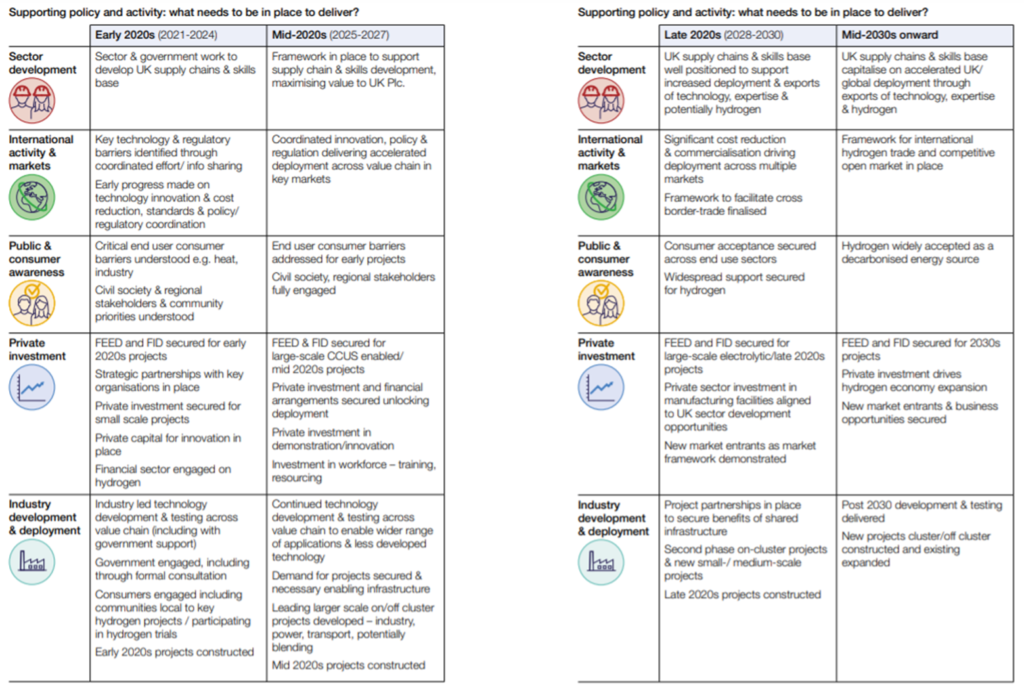


Source link

Petroleum Industry Act 2021 – a new dawn for the Nigerian petroleum industry


After more than a decade of various attempts, the Nigerian oil and gas industry (the Industry) will finally have a new look following the enactment of the Petroleum Industry Act 2021 (PIA).

For many years, the Federal Government of Nigeria (FGN) sought to overhaul the Industry by introducing a new legal, regulatory and fiscal regime. The first major attempt was in 2008 when the first Petroleum Industry Bill (PIB) was introduced. Since 2008, there have been other unsuccessful attempts at reforming the Industry through reworked drafts of the PIB in 2012 and 2018.

In 2020, the FGN reintroduced the PIB 2020 to the National Assembly and, after months of deliberations, both arms of the National Assembly passed the PIB 2020 in July 2021 and the President signed the PIB 2020 (now the PIA) into law in August 2021. Based on the gazetted copy of the PIA, the PIA regime commenced on 16 August 2021.

The PIA comprises five chapters that cover the following issues:

a. Chapter 1 – Governance and Institutions: Deals with the creation of efficient and effective institutions and entities with clear and separate roles for the Industry, such as the Nigerian Upstream Petroleum Regulatory Commission (Commission) for upstream matters, the Nigerian Midstream and Downstream Petroleum Regulatory Authority (Authority) to regulate midstream and downstream operations and the Nigerian National Petroleum Company Limited – a limited liability company and commercial entity to succeed the current Nigerian National Petroleum Corporation. Chapter 1 also sets out the powers of the Minister of Petroleum Resources (Minister), which are significantly reduced vis-à-vis the regulatory framework pursuant to the Petroleum Act that confers significant powers on the office of the Minister.

b. Chapter 2 – Administration: Focuses on transparent and efficient administration/management of the upstream, midstream and downstream sectors of the Industry. While the Commission will regulate the upstream sector, the midstream and downstream sectors are within the regulatory ambit of the Authority.

c. Chapter 3 – Host Community Development: Deals with the provision of social and economic benefits to host communities. The aim is to support the development of host communities.

d. Chapter 4 – Petroleum Industry Fiscal Framework: Aimed at encouraging investment in the Industry, balancing rewards with risks and enhancing revenues to the FGN. Chapter 4 of the PIA completely overhauls the existing fiscal regime.

e. Chapter 5 – Miscellaneous Provisions: Contains provisions such as those dealing with legal proceedings, amendments, repeals, savings, transfer of assets and liabilities, transfer of employees condition of service, and interpretations.

It is indeed a new chapter for the Industry and Dentons ACAS-Law will walk through this new dawn with its clients and potential investors seeking to take advantage of the new-look Industry. Please look out for our subsequent publications where we will be providing more detailed analyses of the PIA and its impact on the Industry.

Subscribe and stay updated

Receive our latest blog posts by email.
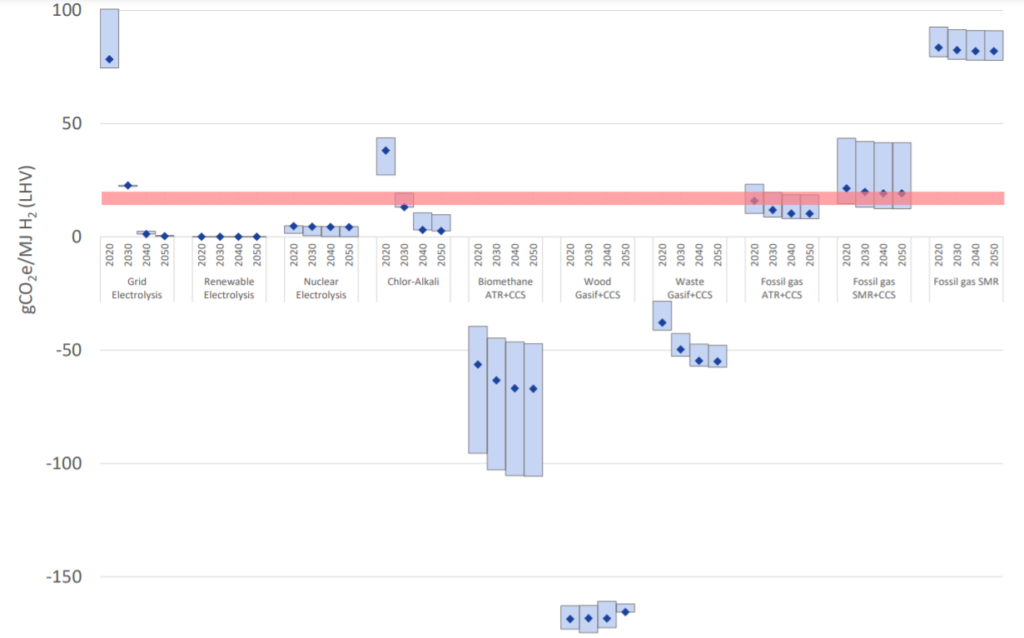


Source link

Administration of marginal fields under the PIA: Assessing the legal and commercial impact on farm-out arrangements


Introduction

One of the key changes introduced to the Nigerian petroleum industry (the “Industry”) by the Petroleum Industry Act, 2021 (the “PIA” or “Act”) is the complete overhaul of the administration of marginal fields. Importantly, the PIA has categorized existing marginal fields under 2 transitional structures based on whether the marginal field is a producing field or a non-producing field. The new framework introduced by the PIA raises pertinent issues that require clarity. In this edition of our Newsletter, we discuss the new transitional framework and its impact on existing farm-out arrangements.

Transitional Framework for Marginal Fields under the PIA

The PIA seeks to create a more direct relationship between the marginal field holder (“Farmee”) and the Nigerian government (“Government”) by the mandatory conversion of the marginal field1 to either a petroleum prospecting license (“PPL”) or a petroleum mining lease (“PML”), depending on whether the marginal field is producing or not. The PIA also provides that no new marginal fields will be declared under the Act2 and that existing marginal fields will be transitioned under 2 main categories namely: (a) producing marginal fields; and (b) non-producing marginal fields – which have been further classified into non-producing marginal fields declared before 1 January 2021 which have been transferred to the Government, and non–producing marginal fields which have not been transferred to the Government by the holder of an oil mining lease (“OML”) within 3 years of the effective date of the PIA3 (“Effective Date”). 

A. Producing Marginal Fields

Under this category, a holder of a producing marginal field is permitted to continue operations based on the original royalty rates and terms of the existing farm-out agreements (“FOA”) entered with the farmor of the marginal field (“Farmor”) but is mandatorily required to convert to a PML4 (“Conversion”) within 18 months of the Effective Date (“Conversion Period”) to benefit from the new fiscal regime5.

A Farmee may, therefore, elect to convert to a PML at any time within the Conversion Period. However, in the absence of such election to convert during the Conversion Period, the marginal field will automatically be converted to a PML upon the expiration of the Conversion Period. Interestingly, the early Conversion to a PML is likely to be driven by the more favourable economics introduced under the new fiscal regime, as the reduced headline tax rates from 85%6 to around 47.5%7

Essentially, a producing marginal field that is converted to a PML appears to have been given special status as it stands to benefit from a lower hydrocarbon tax rate (i.e.,15%) compared to the 30% applicable to OMLs converted to PMLs. Nevertheless, while the tax changes seem clear, the applicable royalty rates require further scrutiny as the PIA allows producing marginal fields to retain the existing royalty rates.8

Furthermore, it is pertinent to note that the PIA has not provided a clear direction in relation to the cut-off period for which the terms of the FOA will cease to apply upon Conversion to a PML. It, therefore, seems that the operations of marginal fields under this category (i.e., marginal fields converted to PMLs) may be governed by a dual regime under the existing terms of the FOA and the provisions of the PML Model Lease9 embodying the relevant terms and conditions pursuant to the PIA10. Should this be the case, it will give rise to several regulatory and commercial issues and would beg the question of how any conflict between the terms of the FOA and the PIA will be resolved and, where applicable, to what extent the PIA provisions will supersede the commercial arrangements of the parties which had been agreed prior to the enactment of the Act.

B. Non-Producing Marginal Fields

i. Non-Producing Marginal Fields declared before 1 January 2021

The PIA provides that non-producing marginal fields declared as such prior to 1 January 2021 shall be converted to a PPL and shall benefit from the fiscal terms for new acreage under the Act. Effectively, the recent 2020 Marginal Filed Bid Round (“MFBR”) awardees will fall under this category and the Nigerian Upstream Petroleum Regulatory Commission (the “Commission“) has the authority to issue a PPL to such awardees (“PPL Awardees”)11.

Amongst other constitutional documentation requirements, the Guidelines for Farm Out and Operations of Marginal Fields – 2020 (“Guidelines”) and the award letter12, require an awardee to execute a FOA with the Farmor. While this has been the usual practice, the validity or relevance of the FOA to marginal fields under this category (i.e., non-producing marginal fields declared before 1 January 2021) has generated ongoing conversations among stakeholders. At this stage, it is important to examine the implication of the provisions of the PIA in relation to FOAs executed pursuant to the Guidelines and the award letter, particularly in relation to obligations that have been captured under the PIA.

Click here to read the full article.

Subscribe and stay updated

Receive our latest blog posts by email.
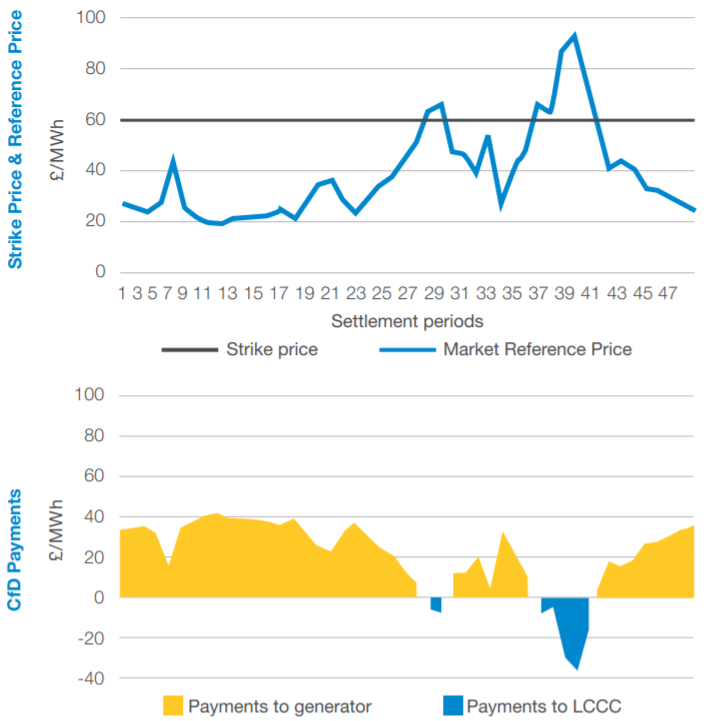


Source link

UK hydrogen policy takes shape (5): the Hydrogen Investor Roadmap


In August 2021, the UK government published its Hydrogen Strategy and a number of consultations on policies to encourage the development of a UK low carbon hydrogen sector (see posts (1) to (4) in this series here). In a sector where countries are competing keenly to be among the first to capitalise significantly on the coming low carbon hydrogen revolution, momentum is crucial, and April 2022 saw the publication of a further batch of UK hydrogen policy documents, including the government’s responses to the earlier consultations. This is the first in a series of posts on the April 2022 documents. We start with the Hydrogen Investor Roadmap, because it gives a convenient overview.

The roadmap summarises policies designed to attract investment into the UK low carbon hydrogen economy. It contains important information about the timings for the launch of public funding rounds and other steps the government is taking to boost the investment case for UK hydrogen projects.

UK investment case

The government makes the case to investors for being one of the world’s most attractive business environments for hydrogen. They reference, amongst other things, the 130% capital allowances super-deduction on plant and machinery equipment, generous R&D and patent tax reliefs, lower labour costs and business-friendly employment laws.

Hydrogen investment case

The government also highlights the opportunities in an advanced and growing sector. These include:

  • revenue support: projects may apply for revenue support through the Hydrogen Business Model, which will focus initially on electrolytic and CCUS-enabled hydrogen production;
  • allocation rounds: there is a commitment to allocate support to projects in 2023 and 2024, with an annual allocation round;
  • regulatory environment: a UK Low Carbon Hydrogen Standard is being developed to provide a yardstick for public funding of projects and to help build market confidence;
  • existing assets: the UK has salt caverns and depleted oil and gas fields that are suitable for hydrogen storage as well as existing (and in some cases currently redundant) gas pipeline infrastructure that can be redeployed to transport hydrogen;
  • expertise: the UK’s deep resources of both renewables and oil and gas sector expertise mean that there is no shortage of the skills or creative thinking needed to make projects happen – the UK is consistently in the top ten countries globally for hydrogen technology patent rates;
  • pipeline of projects: over a dozen large-scale low carbon hydrogen projects are ongoing or under development, as well as two or three times as many smaller-scale ones. As the illustration below makes clear, these cover a range of technologies and applications.
Illustration from page 9 of the Roadmap document

The government tells the market how they are providing certainty to the market through:

  • supporting a variety of production methods, as well as research and innovation in hydrogen infrastructure;
  • stimulating demand through grants to potential end users of hydrogen, delivering pilot trials and completing innovation work;
  • enabling infrastructure for the hydrogen value chain through hydrogen production projects supported by the Net Zero H2 Fund and the ongoing replacement of iron gas distribution networks with plastic;
  • stimulating investment by consulting on fund design, delivering CAPEX grant funding and targeted Development Expenditure (DEVEX) support to stimulate the project pipeline;
  • establishing a supportive regulatory framework through developing a greenhouse gas emissions threshold for “low carbon” hydrogen and working to implement changes to the existing non-economic regulatory framework to support hydrogen.

The paper also highlights the government’s 2035 Delivery Plan for critical activities and milestones for developing the UK hydrogen economy, as summarised in the picture below:

Bringing it all together: the master timeline from the Roadmap document

There is always more that can be done to support this new industry (as the recent report by RenewableUK, for example, points out). However, the UK is making a strong case to attract investors in a UK low carbon hydrogen economy, and this should provide a springboard for hydrogen projects in the UK. We have advised on low carbon hydrogen projects both in the UK and internationally and are ready to help you seize opportunities, assess risks and comply with the latest legal requirements in this exciting, but challenging, new sector.

Subscribe and stay updated

Receive our latest blog posts by email.
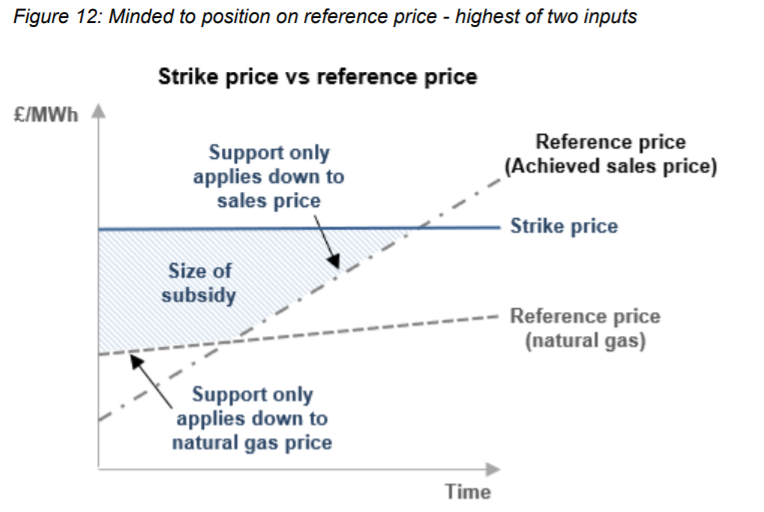


Source link

UK hydrogen policy takes shape (6): Update on the Low Carbon Hydrogen Business Model


In August 2021, the UK government published its Hydrogen Strategy and a number of consultations on policies to encourage the development of a UK low carbon hydrogen sector (see posts (1) to (4) in this series here). In a sector where countries are competing keenly to be among the first to capitalise significantly on the coming low carbon hydrogen revolution, momentum is crucial, and April 2022 saw the publication of a further batch of hydrogen policy documents, including the government’s responses to the earlier consultations.

This is the second in a series of posts on the April 2022 documents (see here for the others): it focuses on the outcome of the consultation on a Low Carbon Hydrogen Business Model (Consultation), in which the Department for Business, Energy & Industrial Strategy (BEIS) sets out its proposed policy and current thinking in light of the Consultation responses, and is accompanied by indicative heads of terms for the Business Model. As outlined in two of our earlier blog posts (see here and here), the Business Model is intended to provide financial support to the low carbon hydrogen sector by incentivising production and the use of low carbon hydrogen by overcoming the cost gap between low carbon hydrogen and cheaper higher carbon alternative fuels.

Scope of support

The Business Model will support newly constructed hydrogen facilities built for the specific purpose of producing hydrogen that can meet the requirements of the UK Low Carbon Hydrogen Standard which is being developed. Existing producers of hydrogen looking to retrofit CCUS technology so as to produce “blue” rather than “grey” hydrogen will not be eligible for support through the Business Model (but may be eligible to apply for support through BEIS’s separate Industrial Carbon Capture Business Model).  Projects that produce hydrogen as a by-product will also not be eligible.

BEIS has not yet determined whether to enable blending of up to 20% hydrogen (by volume) into the GB gas grid and is targeting a policy decision in 2023. BEIS currently views blending as a transitional option only and not a required step for the use of hydrogen in heating. BEIS is keen to ensure that the supply of pure hydrogen is prioritised for those end users who require it to decarbonise.

While projects that export hydrogen will be eligible, the specific volumes exported will not be eligible for support payments.

Support mechanism

The Consultation highlights two main risks for the production of low carbon hydrogen:

  • price risk – the price the producer receives from the sale of hydrogen may not cover production costs and returns on equity (especially where the market price for competitive fuels such as natural gas is lower); and
  • volume risk – the producer cannot sell enough hydrogen to cover costs with reasonable confidence.

BEIS is proposing to provide support to overcome these risks under a Low Carbon Hydrogen Agreement (LCHA). The LCHA will have many features of the existing Contract for Difference (CfD) that supports low carbon electricity generators and will be designed to provide a revenue stabilisation mechanism and ultimately encourage hydrogen production.

Price risk

As under the existing electricity CfD, the LCHA will provide for payments to be made representing the difference between a reference price for the producer’s output and an agreed strike price for that output. 

Reference price

Under the electricity CfD, the reference price is the wholesale market price for electricity established by reference to indices. In the absence of indices recording an observable market price for hydrogen (the hydrogen market is as yet not developed enough for this), BEIS’s proposal is that the LCHA will use the actual sales price for hydrogen achieved by the producer (the Achieved Sales Price).

Recognising, however, that using the Achieved Sales Price as reference price does not encourage the producer to achieve a higher selling price, and might distort other energy markets, BEIS is also proposing that the reference price will be floored at the price of natural gas. To the extent there is a shortfall of the Achieved Sales Price beneath the gas price, it will not be topped up by the LCHA.

As a further incentive for producers to seek higher priced sales and to aid price discovery, a contractual mechanism will be included that allows the producer to share in the benefit of sales values above the natural gas price floor. Options being discussed include an amount linked to the increment by which the reference price exceeds the natural gas price floor for each unit of hydrogen sold and a constraint on sale prices above a certain level. The contractual mechanism may result in the subsidy actually received being greater than the difference between the reference price and the strike price.

Strike price vs reference price

Strike price

BEIS states that the strike price will reflect the cost of low carbon hydrogen production as well as an allowed return on investment for the relevant project on a project-by-project basis (although BEIS is still considering this position). The level of cost components and the strike price are likely to vary for different low carbon hydrogen technology types. The intention is to move to a competitive allocation process (e.g. an auction) in the medium term. The UK government’s recent Energy Security Strategy sets out the ambition to move to price competitive allocation by 2025. BEIS is minded to include different allocation rounds/pots for future competitive allocation.

BEIS is considering the constitution of the strike price but has indicated the following non-exhaustive list:

  • capex and opex associated with the construction and operation of the facility (excluding any capex funded by grant funding (for example, under the Net Zero Hydrogen Fund);
  • capex, but not opex, associated with small-scale hydrogen transport infrastructure. The exclusion of opex is designed to encourage efficiencies in transportation infrastructure;
  • capex and/or opex associated with a small-scale hydrogen storage infrastructure. Opex is to be taken into account as it is a key requirement in safely maintaining storage facilities; and
  • an allowed return on investment.

BEIS is considering the indexation of the strike price to protect: (i) producers against unmanageable and uncontrollable changes to input costs; (ii) government from oversubsidy and (iii) end users with security of supply. BEIS has yet to determine the preferred indexation option.

Calculation of difference payments

As with the electricity CfD, payments are two-way: if the reference price exceeds the strike price, payments of the difference between the reference price and the strike price will flow from the hydrogen producer to the LCHA counterparty. However, in this scenario, the reference price floor will be the lower of the gas price and the strike price. That ensures that if the Achieved Sales Price is higher than the strike price and lower than the gas price, the producer will only pay the difference between the Achieved Sales Price and the strike price.

Under the electricity CfD, difference payments are made per MWh of electricity output. Under the LCHA, the multiplier will be sold units of hydrogen. But in what units can the strike price, the gas price floor and the Achieved Sales Price Payments be expressed on a like-for-like basis?  BEIS states that payments will be calculated on a £ per MWh higher heating value (HHV) basis. HHV has been chosen because the gas price is reported in HHV in the UK, and it reflects the full energy potential of the relevant fuel.

Volume risk

To mitigate volume risk, BEIS is minded to provide volume support to the producer through a sliding scale mechanism. The producer earns higher unit prices where offtake volumes decrease to help recover fixed and marginal costs. The support will decrease as the offtake volumes that the producer secures increase (with the last volumes only recovering the equity returns and marginal costs).

Volume support will only be available if sales are made. If actual sales fall to zero, there is no volume support to be provided. This was flagged as a major concern during the consultation process (especially where a project has a sole offtaker that falls away) but BEIS indicated that value for money was important for the Business Model.

As for the treatment of higher than expected volumes, BEIS states that any increase in the volume of hydrogen produced relative to that agreed in the hydrogen support contract between the producer and the contract counterparty will not be subsidised. However, no detail is given as to whether the producer, if it sells the additional volume, can retain the additional revenue from such sale. Timing the calculation of any volume support (such that it is only calculated once production levels for a certain period are known) may go some way to reduce any overcompensation risk.

Other considerations

BEIS intends to allow projects where the producer and consumer of hydrogen are the same entity (or closely affiliated) to be eligible. However, BEIS is currently considering options to accommodate this arrangement where there may be little or no commercial incentive for the producer to increase the price that the producer receives from the sale of its hydrogen and facilitate price discovery.

The use of intermediaries in the supply chain and reporting requirements is being considered (especially where the intermediaries take ownership of the hydrogen) to ensure that subsidised hydrogen is sold to qualifying end users and to avoid oversubsidisation if intermediaries are used.

BEIS also intends to allow hydrogen producers to receive subsidies for sales to feedstock users but notes the potential for overcompensation and causing potential market distortions and so is considering if additional measures are required (e.g. relying on the price discovery mechanism to incentivise sales at a higher price to feedstock users or using an alternative reference price).

Funding

The Low Carbon Hydrogen Agreement will initially be funded by the taxpayer, but BEIS is expecting to transition to a levy funding taking place no later than 2025, subject to legislation being in place.  Meanwhile, the government has announced an initial £100 million will be provided as part of the Industrial Decarbonisation and Hydrogen Revenue Support (IDHRS) scheme. This is also to cover the ICC business model. Further, up to £100 million of funding was announced as part of the Net Zero Strategy to award contracts of up to 250MW of electrolytic hydrogen production capacity in 2023.

Subscribe and stay updated

Receive our latest blog posts by email.



Source link

UK hydrogen policy takes shape (7): Hydrogen for heat: facilitating a grid conversion hydrogen heating trial – government response published


In August 2021, the UK government published its Hydrogen Strategy and a number of consultations on policies to encourage the development of a UK low carbon hydrogen sector (see posts (1) to (4) in this series here). In a sector where countries are competing keenly to be among the first to capitalise significantly on the coming low carbon hydrogen revolution, momentum is crucial, and April 2022 saw the publication of a further batch of hydrogen policy documents, including the government’s responses to the earlier consultations. This is the third in a series of posts on the April 2022 documents (for other posts on these documents, see here).

One of the great unresolved questions of hydrogen policy concerns its potential role in space heating (either as a substitute for methane or blended in the gas grid). In this post, we look at the UK government’s response to its August 2021 consultation on a “grid conversion” hydrogen heating trial.

Trial and trial again

The possibility of replacing natural gas with hydrogen in the gas grid is still at the nascent stage of research, development and testing, as information needed to assess its feasibility, cost and benefits is gathered. As part of this, the UK government has spent £25 million on the Hy4Heat programme which looked into the innovation work on the potential of domestic hydrogen use, and plans a neighbourhood trial by 2023, a village scale trial by 2025 and a potential hydrogen-heated town before the end of the decade. The outcomes of all this research will feed into the decisions which will be made in 2026 on the role of hydrogen for heat decarbonisation and whether to proceed with a hydrogen-heated town. The focus on heat in particular stems from the Department for Business, Energy and Industrial Strategy’s (BEIS) analysis for the UK’s Heat and Buildings Strategy (2021). Heating in buildings currently accounts for around 23% of national carbon emissions, with the vast majority of this fuelled by natural gas.

The possibility of replacing natural gas in the grid is far-reaching – it will affect the existing gas networks down to the appliances in people’s homes which will need to be able to take hydrogen instead of natural gas. This will all need to be offered to the consumer at an attractive rate. There will also need to be infrastructure in place for people who do not want to participate in the trial, raising the question of how the natural gas and hydrogen networks will be separated. The recent Goldman Sachs “Carbonomics” report on hydrogen published in February 2022 estimates that, while hydrogen boilers have high greenhouse gas abatement potential (in comparison to other hydrogen abatement technologies) at circa 46 Gt CO2eq, the cost is also comparatively high at circa 650 US$/tnCO2eq. Further technology advancements will be needed in order to drive this price down.

Despite the challenges, the hope is that the trials will deliver essential evidence on the feasibility, costs, convenience and consumer acceptability of transporting 100% hydrogen safely and securely in the grid and using it in buildings for day-to-day activities. The illustration below, from the UK government’s Hydrogen Investor Roadmap (April 2022) shows how the heat strand fits into wider UK policy on low carbon hydrogen.

Our 2035 Delivery Plan: Critical activities and milestones on a path to developing the UK hydrogen economy

Hydrogen-ho

The August 2021 consultation sought views on the proposal that legislation is needed to enable the gas networks to successfully deliver a grid conversion trial, building on the “neighbourhood trial” due to take place in Levenmouth, Fife in 2023. The consultation also asked stakeholders whether additional consumer protections are required and how these should be implemented.

To convert from natural gas to hydrogen for a trial, the Gas Distribution Network company (GDN) and its delivery partners will need to carry out works within homes and businesses. There are currently limited grounds on which GDNs have the right to enter private property, and it is expected that GDNs will always aim to reach agreement with occupiers before entering premises unless it is an emergency (as they do currently with homes heated with natural gas). Nevertheless:

  • to make premises suitable for heating with hydrogen, it is possible that GDNs will need to carry out some additional alterations which are not needed for natural gas; and
  • for any consumers who do not wish to participate in the trial, it will be necessary to move their connection away from natural gas supplies safely.

In the context of consumer protection, consumers in a grid conversion trial area will no longer have the option of using natural gas during the period of the trial. Those consumers will need to either switch to hydrogen supplied through the gas distribution network or to an alternative heating solution offered by the GDN. In these circumstances, additional rights and protections may be required to ensure that consumers have a clear choice and are treated fairly.

Having completed the consultation, the government now intends to proceed with:

  • the proposed legislative amendments required to facilitate hydrogen heating grid conversion trials; and
  • measures to strengthen consumer protection for those in the trial area.

Primary legislation (to apply only for the purposes of a hydrogen grid conversion trial) is proposed in order to:

  • extend the GDNs’ existing powers of entry – anticipated to only ever be used as a last resort to ensure consumer safety;
  • make regulations requiring the GDNs to follow specific processes to engage and inform consumers in an appropriate way about the trial; and
  • make secondary legislation for the purposes of ensuring that consumers are protected before, during and after the trial – so that, as well as continuing to enjoy the same protections that they have as natural gas consumers (e.g. the ability to switch supplier), they will not be “financially disadvantaged as a result of the…trial…including with respect to the installation and maintenance of either hydrogen heating or an alternative solution”.

The village trial may deliver critical real-world evidence on the practicalities of converting the gas grid and individual properties to hydrogen and using hydrogen for heating and cooking.

Rolling out the blue/green carpet

Of course, the idea of a hydrogen trial is not completely novel and there are some existing projects which have already helped to pave the way.

HyDeploy, run by Cadent and Northern Gas Networks, was the first project in the UK to blend hydrogen into a natural gas network. This was a project with 100 homes and 30 university buildings on a private gas network at Keele University. Up to 20% hydrogen was blended into natural gas networks for a period of 18 months which ended in spring 2021. This blending allowed the customers to keep their existing appliances. Backed by Ofgem’s Network Innovation Competition, the £7 million project was led by Cadent in partnership with Northern Gas Networks and Keele University.

SGN’s H100 Fife project is for a green hydrogen-to-homes heating network on the Fife coast. Taking electricity generated by wind turbines for the production of green hydrogen, this project will then operate through a newly built gas network to 300 opted-in homes. Customers’ appliances will need to be replaced with hydrogen-ready ones, and the project is due to have a four-and-a-half-year duration.

To blend or not to blend

The possibility of hydrogen in the gas network raises a rich range of legal and structural issues. Customer choice, keeping down costs and providing gas blends as requested by customers are all questions to consider, first at the smaller trial scale and then at the national scale. There is also the issue of blending hydrogen into the gas network, to then deblend at the exit point at the different hydrogen-to-natural-gas content that individual customers may require. HyDeploy claims that if hydrogen were blended with natural gas across the UK at a similar level to its project (up to 20%), it could save around 6 million tonnes of carbon dioxide emissions every year – the equivalent of taking 2.5 million cars off the road.

Dentons’ UK Energy team was among the first to highlight some of the commercial and regulatory aspects of a gas grid functioning on a mixture of gases in two earlier articles (here and here). We have advised on low carbon hydrogen projects both in the UK and internationally. If you would like help with evaluating potential opportunities and risks in this exciting, but challenging, new sector, please get in touch.

Subscribe and stay updated

Receive our latest blog posts by email.



Source link