Day: October 6, 2024

Another interesting year ahead for European renewables


On 5 February 2019, Dentons held its
fourth annual workshop on investing in European renewables. Here we outline
some of the key messages that emerged.

Setting the scene

At first glance, these should be happy
days for the European renewables sector. Energy from renewable sources (RES) is
firmly established in the mainstream of the power industry. Installation costs
for wind and solar continue to drop: having fallen already by 75 percent in
2010-2017, PV costs are projected to fall by more than half again in 2015-2025.
Mindful of their international and in some cases also their domestic
commitments, governments have been setting some ambitious renewables targets
for 2030 and beyond. Even the IEA, once a notably sceptical voice on
renewables, has predicted that wind will be the largest source for power
generation in Europe by 2027.

But of course life is never that simple.
The days when the industry could sustain strong growth in revenues and
profitability just by chasing the fattest feed-in tariffs, surfing the waves of
subsidy as they washed across Europe, are long past. With maturity, the sector
faces more complex problems. It must grapple with the fundamentals of commodity
markets; sell itself to new classes of customers and investors; and work with
governments, regulators and system operators to exploit the new technologies
that can make whole power systems work in more sustainable and efficient ways.
And whilst the broad outlines of the next stages in the energy transition are
widely accepted, the details of how best to achieve it remain a matter of
debate.

Country snapshots

No two jurisdictions in Europe present
the sector with quite the same opportunities or challenges. Dentons lawyers
gave brief sketches of the renewables sectors in their home markets, covering
12 of the 20 countries featured in Investing
in renewable energy projects in Europe – Dentons’ Guide 2019
. We
summarise below the key talking points from their presentations (the slides
from which can be accessed here).

Germany produced more electricity from renewables than from coal for the
first time in 2018. The growth in RES capacity may not be so large in 2019, but
if buildout rates are slowing down a little, the Energiewende overall is changing gear rather than coming to a halt.
The new financial support mechanisms are functioning well. The recently
announced conclusions of the German government’s Coal Commission

point the way to a complete phase-out of coal-fired generation. The publication
of an action plan for grid expansion
further indicates the German
government’s continuing commitment to taking the energy transition into its
next phase, and interest is strong from other sectors of industry, as the
activities of German companies in the e-mobility and hydrogen sectors show.

In France,
the government plans to more than double wind and solar capacity by 2023, with
a further doubling of solar and 50 percent expansion of wind in the following
five years to 2028. Auction mechanisms have succeeded in bringing down the
price of supporting RES. Procedural changes should reduce the potential for
objectors to delay projects. At the same time, it is worth remembering that the
initial trigger for the gilets jaunes
protests was an increase in carbon taxes: in France as elsewhere, there is an
inevitable tension between the need to adopt policies to avert the “end of
the world” and the need of ordinary citizens to survive financially until
the “end of the month”.

The market fundamentals for the RES
sector in Turkey remain strong –
notably, growing demand for power and a strong government commitment to
reducing dependence on imported fuel.  At
present, the regulatory regime favours either very large (1 GW+) or quite small
(up to 1 MW) projects.  For the latter,
there is a feed-in tariff / premium support mechanism; for the former, support
is based on auctions. It is unfortunate that two of these were cancelled in
2018 – one of which would have included the country’s first offshore wind
project – but it is hoped that these will be reinstated.

In Poland,
2019 should be a very busy year for RES projects, as the government focuses on
meeting its 2020 RES targets. After a period in which various measures were
taken to discourage onshore wind, auctions will be focused on solar and onshore
wind. As in many markets, the longer term future depends on electricity market
reform to integrate large amounts of intermittent renewable power.

Italy has set itself ambitious plans for increasing its share of RES to
2030, focused on wind and solar. At present, it is a little less clear how
these will be supported in terms of any public subsidy. On the other hand, the
secondary market remains active, and Italy is one of the jurisdictions where
there is considerable excitement around the prospect of subsidy-free
developments, possibly financed in part by arrangements with non-utility
industrial offtakers (corporate PPAs).

The Czech
Republic
and Slovakia
demonstrate some of the same features as the Italian market, in slightly more
extreme form. The boom years were some time ago, and for the moment, these
jurisdictions present secondary market, rather than development opportunities.
As in Italy and some other jurisdictions, the authorities are now investigating
whether the subsidies of some existing projects were properly awarded – did
they, for example, commission exactly when they claim to have commissioned?
Careful due diligence is therefore required when assessing acquisition
opportunities.

In the UK, the renewables industry faces some challenges as a result of
Brexit, particular if the UK leaves the EU with no deal. However, the
government has recently committed to continue to hold subsidy auctions with a
focus on offshore wind every two years, and – with a third of UK power already
coming from RES – it is starting to address the decarbonisation of the heat and
transport sectors. For those technologies without the prospect of new regulated
support (solar and onshore wind), apart from a proposed new “smart export
guarantee” for sub-5 MW projects, the position is starting to improve as
steps are taken to make grid charging rules work better for storage and
progress is made towards developing corporate PPA models that work in a
subsidy-free market.

In the Netherlands, the government continues to contest the case brought
by the Urgenda Foundation and others (and now twice upheld by the Dutch
courts), that it is legally obliged to reduce greenhouse gas emissions by 25
percent against a 1990 baseline by 2020. But it has in any event allocated
generous subsidies to RES, including €10 billion under the SDE+ regime this
year. As in the UK and Germany, offshore wind is set to grow strongly in the
next few years.

Spain is another jurisdiction where interest in corporate PPAs is high,
particularly among projects that have not secured support in the auction-based
regime that began to operate in 2017. Some projects that did secure such
support face a challenge to meet their commissioning deadlines. For those with
deep pockets, there are opportunities to secure grid capacity where earlier
developers’ rights have expired. There are separate incentives for
self-consumption and projects in the Spanish islands.

For the renewables industry in Russia, progress has been slow for many
years. Local content requirements and a bureaucratic, highly centralised power
regime, have not helped, and the method of procuring RES power, being based on
capacity and capital expendture, also sets it apart from other jurisdictions.
But there are signs that the pace is starting to pick up. There are good
prospects for self-consumption projects up to 25 MW, and for the energy from
waste sector.

The renewables sector in Ukraine continues to attract
international investment, driven by attractive feed-in tariffs and exemptions
from import VAT. This looks set to continue under the new auction-based support
regime that will take effect from 2020, but the industry’s resources will be
stretched to meet the end-of-2019 deadline for projects to be eligible for
subsidies under the old regime.

Alongside our own colleagues, industry
stakeholders contributed insights in keynote speeches and a panel discussion
(the slides from the keynote speeches can be accessed here
and here). 

Conclusions

The broad, long-term direction for the
renewables industry appears to be set, and in the right direction. As always,
stability of regulation will be an important factor in realising the sector’s
potential. But increasingly, its success will depend on the development of new
investment approaches – not only to RES projects themselves, but to the
development of the grid and of technology to make it work more efficiently,
harnessing the power of big data, and facilitating new market models.

If you would like to discuss any of the issues raised in this post, or any other aspect of European renewables, please get in touch with any of the lawyers listed in our guide, or your usual Dentons contact.

Subscribe and stay updated

Receive our latest blog posts by email.


Source link

FER1 Decree 2019: Incentives Regime for Renewable Energy Plants in Italy


On July 8, 2019, the Italian government
signed a ministerial decree that will grant new incentives to renewable energy
sources (the so-called FER1 Decree).

Six years after the expiry of the fifth Conto Energia, photovoltaic plants can
once again benefit from incentives. Other sources benefiting from the scheme
include onshore wind, hydroelectric and sewage gases. The scheme will apply
until the end of 2021 and will provide new incentives of about €1 billion per
year.

The government expects that it will allow for the construction of new plants
with a total capacity of about 8,000 MW with investments estimated to be in the
region of €10 billion.

Please download below the guide to have more
information.

Click here to read the guide

Subscribe and stay updated

Receive our latest blog posts by email.

Carsten Steinhauer

About Carsten Steinhauer

Dr. Carsten Steinhauer, LL.M. is a partner in Dentons’ Rome and Milan offices.

Carsten is a transactional lawyer who focuses on mergers and acquisitions, private equity and project development transactions in a broad range of industries, frequently with a cross-border element.


Full bio

Riccardo Narducci

About Riccardo Narducci

Riccardo Narducci is an Associate in Dentons’ Rome office and member of German desk in Italy.

He is a transactional lawyer who focuses on cross-border M&A deals and Renewable Energy, with a high knowledge and experience base in solar industry and Real Estate projects.


Full bio


Source link

The way towards a competitive bidding process for new offshore wind farms in Belgium


To meet the challenge of the nuclear phase-out scheduled for 2025 as
well as ambitious climate change goals, the Belgian federal government has
established a new legislative framework aimed at achieving an additional
offshore wind energy capacity of at least 1.75 GW.

The amended “Electricity Law” introduced a competitive tender procedure
for the construction and operation of offshore renewable sources. The current
support mechanism, under which the installation benefits from a subsidy per MWh
produced, remains applicable.

Several calls for tenders will be launched in Belgium in the next few years,
providing opportunities for new investors.

Read the full article

Subscribe and stay updated

Receive our latest blog posts by email.

Nora Wouters

About Nora Wouters

Nora Wouters developed a state of the art practice and advises on regulatory financial services, banking and insurance laws. She has extensive experience in commodities, clearing and settlement systems, payment institutions (including Fintech), derivatives (including weather derivatives), securities lending, public listing, debt and fund listings, securitization structures, and collective investment, hedge and pension funds.


Full bio


Source link

The “net zero” debate: UK General Election 2019 (and beyond)


Climate and energy issues are clearly very important to many voters, even if what the parties say on these issues may be unlikely ultimately to be a decisive factor in determining the outcome of the election. This is the first UK general election to take place since:

  • the world reached 1 degree C of
    warming from pre-industrial levels in 2017;
  • the Intergovernmental Panel on
    Climate Change issued a report in
    October 2018 showing the importance of keeping global warming to 1.5 degrees C
    – which probably means achieving net zero greenhouse gas (GHG) emissions by 2050; and
  • the UK Climate Change Act 2008 (CCA 2008) was amended
    (in June 2019) to reflect a version of that 2050 net zero target (UK net
    emissions, as defined in that legislation, are to be “at least 100%
    below” 1990 levels by 2050).

The target

The new CCA 2008 target was set on the recommendation of the Committee on Climate Change (CCC) in a report of May 2019. The CCC pointed out that:

  • current policies across the full range of relevant sectors (including energy, transport, agriculture and the built environment) are unlikely to deliver even the 80% reduction on 1990 GHG emissions required by the CCA 2008 in its original form;
  • the way that the CCA 2008 regime currently measures net emissions does not take account of emissions for which the UK economy is responsible but which are released into the atmosphere outside its borders (emissions from international flights and shipping to and from UK destinations and from e.g. factories in other countries that make goods consumed in the UK), but it does take account of UK carbon offsetting – so far the CCC’s recommendations for changes in these areas (see the report and also here) have not been implemented;
  • it should be possible to achieve a net zero GHG emissions target by 2050 (even one that was more strictly defined to include e.g. international aviation and shipping emissions), and to do so at no greater net cost than achieving the previous 80% reduction target (up to 2% of GDP);
  • this will, however, require massive efforts on the part of government, a range of industries, and individual consumers.

The CCC divides the additional efforts on top of current policies into two categories, of “further ambition” and “speculative” options.

  • In the former category are things like achieving 90% low carbon heating (current level – 4%); quadrupling low-carbon power generation capacity; having all new cars and vans on the road electric by 2030 or 2035 rather than the current target of 2040; installing hundreds of thousands of public EV charging points; and a 20% reduction in consumption of beef, lamb or dairy. Carbon capture, usage and storage (CCUS) is seen as a crucial technology, supplying some of the flexible low carbon power; helping to halve emissions from industrial process heat; supplying hydrogen to use as a substitute for hydrocarbons in other industrial processes and powering trains and HGVs; and helping to generate negative emissions by combining the carbon neutral use of sustainable biomass to generate power with capture and storage of the CO2 emitted (BECCS).
  • All the “further ambition” options together would get us to a 96% GHG emissions reduction by 2050. We would need to make some of the “speculative options” work to achieve the rest. They include deeper reductions in meat and dairy consumption (50%); direct air carbon capture and storage (DACCS, at present largely experimental); limiting the increase in passenger flights to 20-40% above 2005 levels; and using synthetic carbon-neutral fuels to power aviation (a blend of hydrogen and CO2 captured from the air using DACCS).

Common areas of energy and
climate policy discussion

It is interesting to see how far each party is prepared to go, in manifestos that to a greater or lesser extent are aiming to sell themselves to a wide electoral audience, in confronting some of the hard choices that future governments in the UK and elsewhere will have to face if they are to meet net zero targets.

In the table below we have summarised the policies of six parties relating to energy and climate matters, as stated in their respective 2019 manifestos. We have selected the Conservative, Labour, Liberal Democrat, Green and Scottish National Parties, and Plaid Cymru (the Party of Wales). All were represented in the previous House of Commons, and all represent constituencies within the GB electricity and gas markets (Northern Ireland’s energy markets being separate).

Energy is not a ring-fenced area of policy. It has a major interface with transport, for example. And not every party covers exactly the same areas in its manifesto discussion of energy and climate change matters. The table focuses on what may be thought of as core energy areas, on which all six manifestos put forward policies. Below the table, we draw out some of the areas that are more distinctive to one or more parties.

Summary table of key energy and climate policies discussed in the
six parties’ manifestos

Net zero headline targets
Conservatives Labour Lib Dem Green SNP Plaid Cymru
Continue towards current target of carbon neutral by 2050. Aim to make net zero by 2030 as achievable as possible, following their previously published 30 by 2030 report. Aim for carbon neutrality by 2045, with emissions halved by 2030. Committed to aim of carbon zero by 2030. Already committed to net zero by 2045; further aim of 75% reduction in emissions by 2030. At least 55% emissions reduction by 2030, aiming for net zero by 2030.
Net zero headline targets
Conservatives Labour Lib Dem Green SNP Plaid Cymru
Continuation of the Future Homes Standard policy; consultation on existing homes and public buildings to be produced in early 2020. Also committed to investing £9.2 billion in energy efficiency in dwellings and public buildings, support the creation of new kinds of homes with low energy bills. Aim to make all newly built homes carbon neutral by 2030 and upgrade almost all 27 million homes to highest energy efficiency standards.

  • Roll out heat pumps, solar hot water and hydrogen as electricity sources
  • Invest in district heat networks using waste heat
  • Expand power storage and invest in grid enhancements
Retrofit 26 million homes by 2030 and retrofit all fuel poor homes by 2025. Future-proof all newly built homes. Every home built after 2021 to adhere to high energy efficiency targets. 100,000 new homes for social rent per year to be built to Passivhaus standard, improve every UK home to be insulated using sustainable materials, with additional deep retrofitting of 10 million homes. Improve 1 million existing homes/ other buildings per year to reach highest standards (above EPC A grade). Greener tax deal for heating and energy efficiency improvements in homes and businesses, with tax incentives to enable people to make the switch to low-carbon heating at a lower cost. Ensure that all new homes must use renewable or low carbon heat by 2024. Roll out a £3 billion home energy efficiency programme.
Renewables
Conservatives Labour Lib Dem Green SNP Plaid Cymru
Planning to continue the shift towards renewables at the pace currently exhibited in government, with some slightly more ambitious targets for investment:

  • Offshore wind industry to reach 40 GW by 2030
  • Invest £800 million to build CCS cluster by mid-2020s
  • Invest £500 million for energy-intensive industries to move to low-carbon techniques
90% of electricity and 50% of heat to be produced by renewable sources by 2030.

  • 7,000 offshore wind turbines
  • 2,000 onshore wind turbines
  • Enough solar panels to cover 22,000 football pitches
  • Expand tidal energy
  • Invest in low-carbon hydrogen production.
Accelerate the pace at which the energy production transitions to renewable, aiming to reach 80% renewable electricity by 2030. Additional funding of £12 billion over five years for this and storage, demand response, smart grids and hydrogen. Aiming for 100% of energy to be renewable by 2030, with 70% being provided solely by wind.

  • Roll out solar panels and other domestic renewable energy generation for over 10 million homess
  • Work with Crown Estate to open more coastal waters for offshore wind and marine energy
  • Subsea connections to Norway and Iceland
  • Effective storage of electricity from peak periods of renewable generation
Aim to press government for devolution in order to have more ambitious renewables targets, such as allowing wind and solar power to bid for ‘contracts and difference’ support. Overturn existing UK government policies by e.g.:

  • Delivering a wave and tidal energy industrial strategy
  • Pressing government to ditch plans to quadruple VAT on home solar
  • Supporting diesel scrappage scheme
Similar aims to SNP in terms of seeking own, self-sufficient renewables programme for Wales. This would see Wales become 100% self-sufficient in renewable electricity by 2035.
Nuclear
Conservatives Labour Lib Dem Green SNP Plaid Cymru
Continue to support nuclear energy, viewing it as an alternative to traditional fuel sources. Want new nuclear power for energy security. No mention of nuclear energy in manifesto. Prohibit the construction of any more nuclear power stations. Oppose any new nuclear power plants. No mention of nuclear energy in manifesto.
Net zero headline targets
Conservatives Labour Lib Dem Green SNP Plaid Cymru
Put forward an ‘oil and gas sector deal’ to support the transition from oil and gas to a net zero economy. Fracking moratorium to continue unless science shows it is safe. Priority for the transition away from oil and gas is the workers in this sector, which they will help through a windfall tax on companies “that knowingly damage our climate”. Ban fracking. Ban fracking. Want a marked transition away from the oil and gas industry which will be achieved through removing subsidies to oil and gas industries. Ban fracking. Aim to protect jobs in the North Sea oil and gas industry, in particular by providing £12 million Transition Training Fund. Ban fracking. Similar position to Liberal Democrats. No specific mention of the oil and gas industry, but a plan as to how it will be phased out. Ban fracking
Electric vehicles
Conservatives Labour Lib Dem Green SNP Plaid Cymru
Support clean transport to ensure clean air and consult on the earliest date by which sale of new conventional petrol and diesel cars can be phased out. Strong desire to implement use of electric vehicles as commonplace. Accelerate the transition to ultra-low emission transport through taxation, subsidy and regulation. End the sale of new petrol and diesel fuelled vehicles by 2030 and ease transition by incentivising purchase of electric vehicles with a network of charging points. Campaign for the UK government to bring forward plans to move the transition to electric vehicles to match Scottish target of 2032. Start the transition towards a wholly electric fleet of public sector vehicles.

Where do the parties’ approaches differ?

Some of the differences between the parties will be apparent from the table. But we note some further points that distinguish their approaches below.

The energy and climate change section of the Conservative manifesto is less expansive than the others. But the party is presenting itself as continuing with current government policies, presumably including the output of a large crop of recent energy-related consultations in areas such as nuclear power, CCUS and energy efficiency in buildings.

Labour’s energy policy is closely linked to its broader plans for taking certain utility industries back into public ownership, and for investing very large amounts of public money in infrastructure projects. For them, and for the Green Party, facilitating energy transition is part of a process of bringing about wider social and economic changes.

  • They have proposed the creation of a National Energy Agency to own and maintain “the national grid infrastructure” and oversee delivery of decarbonisation targets, as well as new Regional Energy Agencies to replace existing distribution network operators and hold “statutory responsibility for decarbonising heat and reducing fuel poverty”. The supply businesses of the “Big Six energy companies will be brought into public ownership”.
  • Their plans for very substantial public funding of infrastructure include a £400 billion National Transformation Fund, £250 billion of which will be directed to a Green Transformation Fund. Apparently in addition, a National Investment Bank and Regional Development Banks, would provide “£250 billion of lending for enterprise, infrastructure and innovation over 10 years”.

The Liberal Democrats have a number of policies focused on devolving net zero powers and responsibilities to local authorities. They would “regulate financial services to encourage green investments”; and “end support from UK Export Finance for fossil fuel-related activities”. They also focus on reducing the climate impact of aviation “by reforming the taxation of international flights to focus on those who fly the most, while reducing costs for those who take one or two international return flights per year” and “placing a moratorium on the development of new runways (net) in the UK”.

As one would expect, energy and climate change issues are perhaps most prominent and fully integrated into the overall programme for government put forward by the Green Party. As the summary table above indicates, they tend to go furthest in any given area of activity that could promote net zero: they even propose to plant more than 10 times as many trees as the next strongest advocates of this form of carbon sink (700 million as against 60 million). But perhaps the most notable feature of their manifesto in this respect is that they appear to be the only one of these parties advocating comprehensive carbon tax reform (a prospect that may be facilitated by Brexit). They would apply a carbon tax to “all fossil fuel imports and domestic extraction, based on [GHG] emissions produced when the fuel is burnt” and on “imported energy, based on its embedded emissions”, with a view to “rendering coal, oil and gas financially unviable as cheaper renewable energies take their place”. The tax would also cover “meat and dairy products over the next ten years”. Revenues would be recycled in particular ways – for example to fund a “universal basic income” and provide transitional assistance to farmers. It is to be expected that most political parties do not promote new forms of taxation in their manifestos, but the general lack of engagement with the notion of a progressive and redistributive carbon tax, which has been presented by Policy Exchange last year in the UK and has strong support from many economists, is unfortunate.

The SNP and Plaid Cymru focus on the importance of taking forward projects in their own countries (e.g. the Swansea Bay and other tidal lagoons in the case of Plaid Cymru). Their manifestos recognise that in the absence of full Scottish and Welsh independence or increased powers of the devolved Scottish and Welsh administrations in respect of energy and climate change matters, the most they can do is to apply pressure to the new UK government. For example, the SNP manifesto includes a “demand” for the “ring-fencing of oil and gas receipts [i.e. taxes on oil and gas companies currently paid to the UK government], creating a Net Zero Fund, to help pay for the energy transition through investment” in areas such as renewables, EVs and CCUS.

Beyond 12 December

It is not our job to rank what the parties have said about their intentions in relation to energy and climate change matters, or to try to use the manifestos as a basis for predicting whose proposed programme would be most likely to succeed in achieving the CCA 2008 net zero target. In any event, election manifestos are not usually detailed statements of policy, and what these manifestos say about energy and climate matters is generally no exception to that rule.

However, we do offer a view on what the
key elements of any future government’s plans for achieving a net zero target
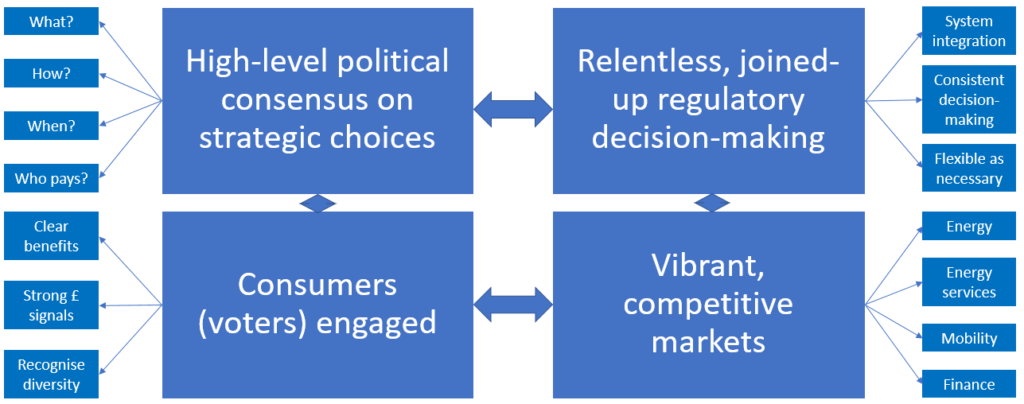
must include, and this is summarised in the diagram below.

Net zero diagram

High-level political consensus on strategic choices: You need to start with clear objectives that command support across a sufficiently broad base. It’s important to be ambitious, and for those ambitions to be consistent with the net zero target. But most net zero policies will need to be delivered across the lifespan of multiple Parliaments, and the best way to enable their implementation to survive changes of government is if they command a good measure of cross-party support in the first place. Clear answers to all the questions highlighted at the side (top left) of the diagram (what/how/when/who pays?) is essential, and the more controversial those answers are likely to be, the more you need to have an honest debate about them at the outset. (There are obvious parallels here with the debate over funding social care in the long term.)

Relentless, joined-up regulatory decision-making: Turning high level net zero policy into regulation isn’t easy.

  • Everything in the energy sector interacts with everything else, often in unexpected ways.
  • The regulatory regime, particularly as embodied in licences and industry codes, has become almost impossibly complex, and is seen as being a barrier to innovation. BEIS and Ofgem have now acknowledged this, but the scope of possible reforms is still unclear and it is going to take a number of years, at least as regards industry codes.
  • Increasingly, net zero regulation has to embrace things and organisations that aren’t subject to energy sector rules to achieve results: data ownership (and monetisation), for example, or financial reporting of climate risks – not to speak of car ownership, planting trees and not eating beef.
  • Overall policy consistency is crucial (and harder to achieve than it sounds), but inevitably there has to be room to be flexible on some points over time.
  • Some would argue that neither the statutory duties of Ofgem as regulator of the downstream gas and electricity sectors, nor the remit of the Oil & Gas Authority as regulator of the upstream oil and gas industry in the UK, are as consistent as they should be a net zero target. This point is controversial, but probably needs to be considered more deeply and transparently from a political and technical standpoint than has so far been the case.

Vibrant, competitive markets: Alongside effective regulation, the need for competitive markets also becomes more acute. Even the largely nationalised energy sector envisaged in Labour policy statements would need competitive markets (e.g. in equipment manufacture) to supply it. In the market structure that we have at present, ensuring effective competition is key to Ofgem’s mission, and there are clear indications of market failure or immaturity in areas such as the financing of energy efficiency or heat networks. Looking beyond the traditional energy market, it will be a lot easier to achieve a target of 100% new EVs when there are a good many more models to choose from than at present – but will that happen without some regulatory “encouragement”?

Consumers (voters) engaged: So far, decarbonisation has largely taken consumers for granted. As a whole, at least on the electricity side, they have had the costs of various forms of subsidy, levied in the first instance on suppliers, passed through to them (or not, if they Energy Intensive Industries). Some have been the recipients of supplier-funded energy efficiency measures. Now, we need them all to become more actively engaged in energy markets, and potentially to make some big spending decisions and lifestyle changes in the name of net zero. We can talk about showing them what the benefits are clearly and sending price signals, but will that work? Remember, these are the same people who for years didn’t switch energy suppliers when they were losing significant amounts of money by sticking with their existing provider. The winning policies will be those that are approved by behavioural scientists, as well as economists. In the end, as the arrows in the diagram suggest, it may come back to the political level: not for nothing do some now speak of the energy transition involving democratisation, alongside the more familiar decarbonisation, decentralisation and digitalisation of energy.

What next?

The party manifestos suggest that any future government will recognise net zero as a priority. All their programmes in this area will require major efforts to implement. The UK has a number of achievements to be proud of to date, such as the rapid expansion of its renewables sector and the adoption of the net zero target itself. But the scale and complexity of the challenges highlighted by the CCC’s report mean that whatever happens on 12 December 2019, there can be no room for complacency on any aspect of energy and climate change policy.

This
post was prepared with the assistance of our London Energy team solicitor
apprentice, Megan Goacher.

We are running a series of events to discuss net zero policies and their impact on energy and related sectors during 2019-20. Please get in touch with the author or join the Dentons Net Zero Energy Community on LinkedIn if you would like to learn more about these events.

Subscribe and stay updated

Receive our latest blog posts by email.


Source link

A smart carbon tax: the silver bullet for the (just) energy transition?


There is a broad
consensus among economists that, globally, over time, reaching net zero greenhouse
gas emissions by 2050 will cost less than not reaching net zero.[1] In
that very broad, long-term, high-level sense, it is clear that there is no
conflict between carbon neutrality and economic interests. But if everybody
thought it was already in their economic interests to aim for net zero today,
we would probably not be so far off track from achieving that goal as we
currently are.[2]
  

Researchers
working within the framework set by the Intergovernmental Panel on Climate Change
(IPCC) have mapped out four indicative pathways to net zero.[3] They
all involve at least halving global consumption of fossil fuels by 2040. That
is not quite the future that most oil majors, and governments with a stake in
the industry, seem to be planning for.[4]
Others argue that net zero in 2050 is compatible with fossil fuels still
dominating the global energy sector at that time, but that this would depend on
massive shifts in investment – for example, into new technology to reduce the
carbon footprint of fossil fuel extraction, hydrocarbon supply chains and use
of fossil fuels. The majority of the industry is as yet not visibly committed
to such shifts.[5]

To persuade
people to take action that seems to be against their economic interests, at
least in the short term, you need to change the balance of incentives.

Again, the economists have a straightforward answer: you put a price on carbon. You make it more expensive to produce and/or consume fossil fuels and products with a heavy carbon footprint. People then pay up front for the otherwise unpriced damage caused by their emissions, which means that they have a reason to choose lower carbon products and forms of energy.

There is no
shortage of support for the principle of carbon pricing, which has been
endorsed by royalty, the European Commission and senior bankers, to name but a
few.[6] However,
in practice, existing carbon price mechanisms have had limited effect, and
there are serious risks in seeking to decarbonise with policy instruments that
could impose significant costs on those least able to afford them. Any tax
based on consumption risks having a regressive effect, and people with
proportionally more carbon-intensive lifestyles often lack the financial means
to switch to lower carbon options. The gilets
jaunes
protests in France began with an increase in carbon taxes.[7]

Carbon pricing
may take the form of a straight tax on emissions, or of an emissions trading
scheme. The former is arguably the better approach. For example, setting a tax
rate is not always easy, but it is easier to make adjustments to a tax than to a
market mechanism, where it can be difficult to recover from an initial
miscalculation of the optimum number of emissions allowances to issue at the
outset, as in the case of the EU Emissions Trading Scheme (EU ETS).

The ideal carbon
tax would be economy-wide, and have three further key features. 

  • The price of emissions would
    start considerably higher than in most current carbon pricing schemes, and
    increase over time in a carefully calibrated way.[8]  
  • To ensure popular support, government
    would pay back some or all of the tax receipts in the form of a “carbon
    dividend” in a fiscally redistributive way.[9]
  • To make it possible to start
    with a national, rather than a global version of the tax, and to avoid exporting
    the taxing country’s emissions to countries without a carbon tax, it would be
    necessary to charge a “border carbon adjustment” tariff on goods
    imported from jurisdictions with no equivalent tax.

Such an approach
has plenty of heavyweight intellectual support.

  • Just over a year ago, the Wall
    Street Journal carried a self-styled “largest public statement of
    economists in history” in which no fewer than 3,558 US economists espoused
    something along these lines that was proposed from a US perspective. This is
    the “Baker-Schultz” plan, re-branded in February 2020 as the
    “Bipartisan Climate Roadmap”.[10]
  • In October 2017, leading UK
    regulatory economist Dieter Helm put a carbon tax at the heart of his report to
    the UK government on how to address the rising cost of energy in the context of
    its climate change policy goals.[11]
  • In July 2018, the UK think tank
    Policy Exchange produced The Future of
    Carbon Pricing: Implementing an independent carbon tax with dividends in the UK
    ,
    with a foreword jointly authored by a former Labour Chancellor of the Exchequer
    and a former Conservative Foreign Secretary.[12]

Of course, any
attempt to implement such a tax would need to address a great many issues, both
in terms of high level design and practicalities.

  • Do you just tax fossil fuels,
    or do you also tax products in whose manufacture fossil fuels have been
    consumed? In the case of fossil fuels, at what point(s) in the chain between
    the upstream producer and the final downstream user should the tax be levied? For
    example, you could impose a tax on upstream hydrocarbon producers or refinery
    operators that was based just on the emissions from their activities, rather
    than from the presumed activities of end-users of refined petroleum products, such
    as electricity generators or motorists.
  • At whatever point(s) a tax is
    applied, at what rate should it be levied? What assumptions about the emissions
    intensity of downstream processing and/or use should underpin the calculation
    of that rate? How do you ensure that the imposition of the tax, and any
    increase in the rate, has the desired effect of incentivising changes in
    behaviour (i.e. shifts to lower carbon technology)? Will taxing the ultimate
    consumer more heavily incentivise the upstream or midstream operator to reduce
    emissions from flaring or fugitive methane? If I fill up my car with fuel from
    a retailer who promises to offset the emissions that my driving will cause,
    should I get a rebate on the tax element of my purchase?
  • Tax law has a natural tendency
    to become complicated. Take for example the Climate Change Levy (CCL) legislation,
    that supplements the EU ETS in UK domestic law. In outline, this is quite a simple
    scheme: electricity and certain fossil fuels are “taxable
    commodities” and a levy is charged on “taxable supplies” of
    them. But quite quickly, the desire to incentivise, protect, or discourage
    particular activities turns the scheme into an abstruse and intricate mesh of
    exemptions, exclusions, and exceptions from exemptions or exclusions.
  • Both fossil fuels and products
    manufactured using them are traded internationally, but carbon taxing is
    currently national (or in the case of the EU ETS, regional), and is likely to
    remain so for the foreseeable future. In order to encourage other countries to
    adopt similar regimes, and to stop its domestic industry being undercut until
    they have done so, a taxing country will want to impose a carbon border
    adjustment on imports. This may involve charging tax at a point further down
    the value chain than would be the case with domestic industry. For example: you
    apply a domestic carbon tax on electricity, which increases the costs of
    aluminium smelters, so you need to apply the carbon border adjustment to
    imports of aluminium from a country that does not levy a similar carbon tax on
    electricity or aluminium production.
  • But suppose there are two
    aluminium producers in the aluminium exporting country: one powered entirely by
    renewable energy, and the other by a coal-fired power station. And suppose that
    some of the aluminium that reaches the aluminium importing country arrives in
    the form of finished products. If two identical stepladders are imported, one
    made of “brown” aluminium and the other of “green”
    aluminium, the tariff charged on the latter should be lower.

This prompts
some further reflections on the kind of system that is needed. 

  • To work well, our hypothetical
    carbon tax needs to be very granular. That means handling a lot of data, and
    mining that data for insights – for example, about how particular applications
    of the tax affect the behaviour of particular groups or economic sectors.
  • You will also need to be able
    to keep records. Suppose somebody is awarded a rebate but it turns out they
    should not have had it. Suppose you want to allow people to borrow against
    their future carbon dividends in order to invest in making their homes more
    energy efficient. You may well want to track supply chain emissions – including
    for the oil & gas industry itself.   
  • Very soon, you are looking at
    information flows that are too numerous and diverse to be managed by a central
    counterparty.
  • This points to a system that
    can facilitate large numbers of transactions automatically, within set
    parameters – in other words, smart contracts.
  • That system must be very
    secure, and capable of encouraging parties who do not have direct contact with
    each other to trust each other.
  • Above all, you need a system
    that records, in immutable form, every transaction that is made within it.

This sounds like
a job for some kind of distributed ledger technology (sometimes, but strictly
inaccurately, referred to by the generic label “blockchain”). No
jurisdiction in the world has yet implemented the ideal version of a carbon
tax. But if and when they do, it should arguably be a data-rich, deeply
digitalised, regime that can be integrated with smartphones and the internet of
things: capable of tracking individual products through the supply chain, and
perhaps distinguishing between hydrocarbons from different sources on the basis
of the emissions intensity of the processes by which they have been extracted,
transported and refined.

The Policy
Exchange paper referred to above highlights the role of “blockchain”
in this regard. It also points out that the UK’s withdrawal from the EU provides
it with a potential opportunity to strike out on a new course in terms of
carbon pricing. Research by the UK energy regulator Ofgem shows that even the
UK’s existing carbon pricing tools, the much-criticised EU ETS and its domestic
supplement, the Carbon Price Support element of the CCL, have been the single
most effective regulatory driver of decarbonisation in the UK power sector.[13]

However, a government
consultation issued in May 2019 on the future of UK carbon pricing was
essentially focused on how to replace the EU-derived existing regime with
something similar but UK-only.[14]
It made no reference to the kind of ideas put forward by Policy Exchange, the
3,558 US economists, or Prof. Helm as regards a carbon tax. It is to be hoped
that the new government will be prepared to reconsider this approach and look
seriously at some of those ideas.[15] At
the same time, the UK government will need to think how to respond to the EU’s
plans, as part of the European Green Deal proposals of the new European
Commission President, Ursula von der Leyen,[16]
to establish an EU border carbon adjustment to avoid “carbon leakage”
through the importing of cheaper products of energy intensive industries from
countries with weaker carbon emissions controls.[17]   

In the energy
sector, distributed ledger technology, smart contracts and related innovations
are not just of interest to wonkish proponents of better carbon pricing. Oil companies
and others in the sector have a keen interest in all these developments, because
they have the potential to save them huge amounts of money.[18]

  • By exploiting existing sub-surface
    data, upstream oil and gas players can make the exploration process less
    hit-and-miss by identifying good prospects and likely dry holes before drilling.
    Earlier this year, the UK Oil & Gas Authority released 130 terabytes of
    data about the North Sea. They think that making good use of this data could
    reduce exploration costs by 20%.[19] 
  • Using blockchain and smart
    contracts they can reduce the costs and cost-overruns of building new infrastructure
    – some would argue, by up to 50%.
  • There is potential to make
    upstream facilities operate more efficiently by making better use of all the
    data they gather.  Wood MacKenzie
    estimate that US shale producers could reduce operating expenses by 10% and add
    $25 billion of value by putting mature wells on smart production management
    systems.[20]
  • Physical oil and petroleum
    product trading can be made much more efficient by replacing the old
    paper-based trade finance system with a distributed ledger.[21]  

It is perfectly
possible to find oil and gas industry veterans who are sceptical of these
developments. But their reason is not that they doubt the technology. Their
response tends to be more along the lines of: “It sounds great, but when
the oil price is high, we don’t need to cut costs, and when it’s low, we have
other things to worry about”.

However, a
digitalised carbon tax could provide the constant, incremental pressure that is
needed to get the industry to exploit the power of digitalisation to
decarbonise.   

And the industry
needs to do this, because it faces all sorts of other challenges. By some
measures, its energy return on investment is declining.[22]
It may become vulnerable to climate change litigation. It may face competition
from lower carbon alternatives that are cheaper and more effective substitutes
for what it offers than are currently available.[23] But
if the industry saves costs, it will become less risky, and it will be more
able to invest in areas where its expertise will be crucial, like hydrogen and
carbon capture and storage, that can give it a longer-term future.

Bring on the
smart carbon tax of the future, then, and everyone should be a winner. In the
meantime, even if the fully digitalised and personalised kind of platform
outlined above lies too far in the future to be relied on as the only way
forward, there is still plenty of scope to make more widespread use of carbon
pricing, at higher and therefore more incentivising levels, and with
redistribution and carbon border adjustment elements – and there is a strong
case for doing so urgently.

The author is
extremely grateful to the World Energy Council (Austria) and the Organisation
for Security and Co-operation in Europe for inviting him to speak on the
subject of “carbon neutrality vs. economic interests” at the 2nd
Vienna Energy Strategy Dialogue in November 2019 (which was themed around
“The Impact of Big Data in Energy, Security and Society”). This
article is a version of his contribution on that occasion.


[1] The proposition that, as regards climate
change, mitigation of undesirable outcomes before they materialise is cheaper
than adaptation to them once they have arrived, was authoritatively stated in the
Stern Review of the Economics of Climate Change, commissioned by the UK
government and published in 2006. The UK government’s independent advisory body
on climate change, the Committee on Climate Change, found in its 2019 report recommending the adoption of a “net
zero” target for UK greenhouse gas emissions in 2050
that this would not cost any more than the
previous statutory target of an 80% reduction against 1990 levels (itself
partly triggered by Stern’s conclusions).

[2] The gap between the emissions trajectories
of current and announced policies and what is needed to avert unacceptable
adverse impacts of climate change has been highlighted in many places, including
the IPCC’s 2018 special report on Global Warming of 1.5ºC and the UN Environment Programme’s 2019 Emissions Gap
Report
.

[3] See page 90 of the Committee on Climate Change report on net zero for graphics and full citation.

[4] See for example The Production
Gap Report

(2019), produced by the Stockholm Environment Institute and others.

[5] See for example the International Energy
Agency’s 2020 report, The Oil and
Gas Industry in Energy Transitions
, and a number of publications by consultancy Thunder Said Energy.

[6] See for example the article by Gillian Tett
in the Financial Times, UK edition for 24 January 2020, “The world needs a
Libor for carbon pricing”.

[7] See for example the article by Philip
Stephens in the Financial Times, UK edition for 24 January 2020, “How
populism will heat up the climate fight”.

[8] See the Report of the High-Level Commission
on Carbon Prices chaired by Joseph Stiglitz and Nicholas Stern (Carbon Pricing
Leadership Coalition, May 2017): https://www.carbonpricingleadership.org/report-of-the-highlevel-commission-on-carbon-prices. Among the Commission’s conclusions: “Countries may choose different instruments
to implement their climate policies, depending on national and local
circumstances and on the support they receive. Based on industry and policy
experience, and the literature reviewed, duly considering the respective
strengths and limitations of these information sources, this Commission
concludes that the explicit carbon-price level consistent with achieving the
Paris temperature target is at least
US$40–80/tCO2 by 2020 and US$50–100/tCO2 by 2030,
provided a supportive policy environment is in place
.” (Emphasis added.)

[9] For an analysis of the different ways of
implementing a “carbon dividend”, see D. Klenert, L. Mattauch, E.
Combet, O. Edenhofer, C. Hepburn, R. Rafaty and N. Stern, “Making Carbon
Pricing Work for Citizens”, Nature 8 (2018), 669-677.

[10] The “Economists’
Statement on Carbon Dividends
” was signed by, amongst many others, 4 former
Chairs of the Federal Reserve, 27 Nobel Laureate Economists and 15 Former
Chairs of the Council of Economic Advisers. See now also https://clcouncil.org/Bipartisan-Climate-Roadmap.pdf.

[11] Helm’s report was commissioned by the then Secretary of State for
Business, Energy and Industrial Strategy, Greg Clark. At the time of writing, the
government had yet to issue a substantive response to it.

[12] See https://policyexchange.org.uk/wp-content/uploads/2018/07/The-Future-of-Carbon-Pricing.pdf.

[13] Ofgem, State of the
Energy Market 2019
,
page 129 (figure 5.10).

[14] See https://www.gov.uk/government/consultations/the-future-of-uk-carbon-pricing.

[15] At the time of writing, a government
response had not yet been issued in respect of the majority of this
consultation.

[16] See https://ec.europa.eu/info/strategy/priorities-2019-2024/european-green-deal_en.

[17] For commentary, see Sandbag’s report, The A-B-C of BCAs An overview of the issues around
introducing Border Carbon Adjustments in the EU
. The ultimate relationship between the UK
as a whole and the EU ETS remains to be determined, but the agreement between
the UK and the EU on the UK’s withdrawal from the EU requires the EU ETS rules
to continue to be applied in Northern Ireland as part of the basis for
continuing the operation of the Single Electricity Market on the island of
Ireland. If the EU border carbon adjustment is implemented as part of the EU
ETS regime, the UK may be under pressure to adopt a similar measure.

[18] For a general survey of the distributed
ledger technology and its potential applications in the energy sector, see https://www.dentons.com/en/insights/guides-reports-and-whitepapers/2018/october/1/global-energy-game-changers-block-chain-in-the-energy-sector.

[19] See https://www.ogauthority.co.uk/news-publications/news/2019/the-oil-and-gas-authority-launches-one-of-the-largest-ever-public-data-releases/.

[20] See https://www.woodmac.com/press-releases/digitalisation-in-us-lower-48/.

[21] There are various
examples in the publication cited in note 19 above, but see also https://www.gazprom-neft.com/press-center/news/gazprom-neft-and-s7-airlines-become-the-first-companies-in-russia-to-move-to-blockchain-technology-i/.

[22] See https://www.sciencedaily.com/releases/2019/07/190711114846.htm.

[23] See https://www.climateliabilitynews.org/2019/12/23/climate-litigation-threat-financial-filings/.

Subscribe and stay updated

Receive our latest blog posts by email.


Source link

UK government looks forward to 2030 (and beyond) with CfD consultation


On 2 March 2020, the UK Government issued a consultation on proposed changes to the contracts for difference (CfD) regime of support for renewable electricity generators. The item that attracted most attention was that onshore wind (in GB as a whole, rather than just on Scottish islands) and solar will be allowed to apply for CfDs again in 2021, but there are other points worth noting too. There are proposals to change aspects of the CfD regime relating to offshore wind and biomass conversions, as well as cross-cutting proposals (on areas including negative pricing, non-delivery incentives and “supply chain plans”) that would affect all technologies.

Offshore for net zero

The CfD regime is becoming mature. It was first consulted
on in 2010; was legislated for in 2013/2014; saw the first, “FID
enabling”, contracts awarded in 2014; and held its first auction in 2015. Already,
more than 20 projects with CfDs have been commissioned and are receiving
payments under them. They have a combined capacity of more than 4 GW. A further
10 GW is expected to be added by 2026, based on the delivery of projects that
were awarded CfDs in the first three auctions. Offshore wind is, increasingly, the
dominant technology in the CfD portfolio.

As of June 2019, the UK has a target of net zero emissions
by 2050. And before then, the government wants to achieve 30 GW (as per the
March 2019 Offshore
Wind Sector Deal
), or even 40 GW (as per the December
2019 Conservative manifesto
) of offshore wind capacity by 2030. The most
recent CfD auction saw just
under 5.5 GW of offshore capacity awarded CfDs for delivery between 2023 and
2025
, but – assuming that this is all delivered – can such levels of
activity be sustained? Even if they are, with auctions occurring every two years
and projects bidding to deliver in five or six years’ time, it is not certain
that the higher of the two 2030 targets would be reached.

Get off the bottom and go with the float

Although the costs of offshore projects have fallen
significantly, and it has become feasible to build them much further from the
shore than was once the case, there are concerns about whether it will be
possible to fulfil the high ambitions for 2030 while relying entirely on
monopile, jacket or suction bucket foundations into which the turbine tower is
built. These “fixed bottom” arrays cannot readily be deployed in
waters more than 60 metres deep. As the industry grows, and occupies more of
the available areas of shallower water, the cumulative impact of each new
project on e.g. seabird mortality increases, potentially
posing more problems under nature conservation legislation
. The Crown
Estate recently
announced a plan-level Habitats Regulations Assessment
of its fourth
leasing round of sites for offshore wind development, with a view to addressing
these issues.  

So the government would like to stimulate more rapid
adoption of floating offshore wind technology. Just as the construction of
North Sea oil rigs progressed from fixed bottom to floating structures, the
expectation is that offshore wind can do the same. If it does so successfully, it
will become possible to locate turbines over a wider area. This would reduce
cumulative adverse environmental impacts and likely increase security of supply
(reducing the risk of loss of generation because the wind happens to have
slackened or stopped blowing in the areas where turbines are located). The
consultation document also suggests that floating turbines could provide clean
electricity for offshore oil and gas infrastructure. Moreover, with an eye to
export markets, at a global level, the technology will become much more useful in
markets such as Japan and California that do not have shallow coastal waters.

Floating wind can of course already apply for a CfD, but in
its current state of development, the technology is unlikely to win against
fixed bottom and the other technologies that it would compete against in the
“Pot 2” category. At present, the CfD regulations do not recognise
floating offshore wind as a separate technology. The government proposes to
change that, by introducing a new concept of a “floating offshore wind CfD
Unit” – defined as consisting entirely of floating turbines. It would then
be possible in future auctions to set a framework that effectively reserved part
of the budget to such units – or at least ensured that they were not in direct
competition with low-cost fixed bottom developments.

In a class of its own?

The government proposes to retain the current 1500 MW cap
on phased offshore wind projects, “to strike a balance between economies
of scale and facilitating new entrants to the market”. But a final notable
proposal in relation to offshore wind is that in future auctions, offshore wind
projects might only compete against each other, rather than – as previously –
against other “Pot 2” technologies such as advanced conversion
technologies, or against “Pot 1” technologies like onshore wind and
solar. Whilst it is arguable that offshore wind no longer fits the “less
established” designation of Pot 2, the very large scale of the fixed
bottom projects now coming forward does make it somewhat mismatched with other
technologies. As the consultation document notes, such a restructuring of the
Pots would require “regulatory approval”, but there is plenty of
precedent for mechanisms designed to offer support specifically to offshore
wind projects being approved under the EU state aid rules, and there is unlikely
to be any lack of competition for CfDs in an offshore-wind only category.

Meanwhile, back on dry
land…

The extent to which the fortunes of the onshore wind
industry have been restored by this consultation should not be overstated.
Previous governments took more than one decision that curbed its growth. As
well as deciding not to include onshore wind in the second and third CfD
allocation rounds (unless they were on remote Scottish islands, in the case of
the third round), and accelerating the closure of the previous subsidy regime,
the Renewables Obligation (RO see here
and here),
they adopted a planning
policy that restricted the pipeline of new consented projects in England
. The
promise to include onshore wind and solar in the next allocation round, to be
held in 2021, does not change that.

However, it is still likely that a significant number of
consented sites have been “awaiting construction” primarily because
of the lack of RO or CfD support or any adequate substitute for the revenue
stability they provide. There should be plenty of competition for the next
auction in Pot 1, not least in Scotland, where there is plenty of wind and there
has been no Scottish Government policy similarly restricting the pipelines of
consented projects since the closure of the RO. The consultation notes that, although
there are unsubsidised “merchant” solar and onshore wind projects being
constructed, “there is a risk that if we were to rely on merchant
deployment of these technologies alone at this point in time, we may not see
the rate and scale of new projects needed in the near term to support
decarbonisation of the power sector and meet the net zero commitment at low
cost”.

The consultation does not suggest how much money might be
offered to the part of any future auction in which onshore wind and solar would
compete (“Pot 1”). We note, however, that there are some illustrative
figures in the accompanying impact assessment (albeit they are expressly
“not an indication of future allocation round parameters”) that seem
to envisage that in a future round where about the same amount of offshore wind
was awarded CfDs as was the case in the third allocation round (5.5 GW, with
strike prices of £45/MWh at 2012 prices), 300 and 700 MW of onshore solar and
onshore wind might be similarly successful (with strike prices of £33 and
£34/MWh). In the first CfD auction in 2015, the largest successful solar
project was 19 MW – today, the whole of a hypothetical 300 MW of solar CfD
capacity could be swallowed by a
single development
.

It’s not just about the
clean energy

The consultation also focuses on the importance of renewables
projects benefiting local communities. It proposes updating existing
guidance and creating a register of projects’ community benefits. It also cites
some examples of good practice and asks for further ideas in this area.
Previously, it has proved difficult, particularly for larger commercial projects,
to deliver what might be the most obvious community benefit (cheap, clean,
locally-generated power) directly to the communities that host them, because of
the way that the GB electricity industry and its licensing and network charging
regimes are structured. But it may be that the commoditisation of battery
storage could help going forward.

A key element for CfD projects with a capacity of more
than 300 MW has been the requirement to submit a “supply chain
plan”
as part of the application process. The intention has been to
ensure that the development of the renewables industry – and the offshore wind
sector in particular – delivers some benefit to the UK industrial base. The
consultation notes that Ministers can take account of an applicant’s failure to
implement a supply chain plan when considering subsequent applications. Potentially,
all partners with a 20% or greater share in a project can find themselves
excluded from an allocation round as a result. It further notes that the government
wants to ensure that the regime contributes to the Grand
Challenges of its Industrial Policy
and “advances the low carbon
economy in places which stand to benefit the most by boosting productivity,
driving regional growth”. It is therefore asking how it could strengthen
the supply chain policy so as to ensure it remains “fit for purpose”.

Among the possibilities mentioned in the consultation
document are: increasing the quality of supply chain plan commitments and
closer monitoring of their implementation; extending the requirement to provide
a supply chain plan to projects below the current 300MW threshold; and “considering
the carbon intensity within supply chains and how this could be measured and/or
reported, and taken into account, as we transition to a net zero economy”.
The last of these points reflects a familiar tension between free markets /
free trade and environmental policy that the EU
Green Deal
also seeks to address, and that could, potentially, be resolved
by a scheme
of carbon pricing that incorporated border adjustments on goods imported from
countries with less stringent carbon emissions regimes
.

After the end of coal-fired power – the end of its
afterlife

A significant chunk of current CfD funding (as of RO
funding before it) goes to former coal-fired capacity that has been converted
to burn biomass. The CfDs awarded to biomass conversion projects have a shorter
duration than other renewable CfDs, being scheduled to end in 2027. The
government is “reviewing the role of biomass conversions and…seeks views
on the proposal to exclude new biomass conversions from future CfD allocation
rounds”. The consultation document points out that “since the government’s
2012 Bioenergy Strategy we have been clear that coal-to-biomass conversions
have been supported as a transitional, rather than long-term technology”
and that those “which are not otherwise subsidised may apply to
participate in the Capacity Market”.

What does this mean? At present, there are only five
coal-fired plants remaining in operation in the GB market. Of these, Fiddler’s
Ferry and Aberthaw B are scheduled to close by the end of March 2020. Drax
recently announced
that its remaining coal-fired units would not operate beyond 2022
. The
operators of West Burton B and Ratcliffe have yet to announce plans to close
them before the government’s deadline of the end of 2025 for ceasing GB
coal-fired generation. That deadline, although confirmed
policy
, has yet to be specifically enacted as legislation, although limits
imposed by EU law on the eligibility of higher emissions fossil fuel plant to
participate in capacity markets are expected to make it hard for them to
operate economically (a consultation
of July 2019 that sought to address the detail of implementing this restriction

has yet to see a government response).

Against this background, one can see why it is possible that some remaining or recently closed coal-fired plants might be interested in the prospects of biomass conversion. The attraction of biomass in the earlier phases of promoting renewable electricity generation, and particularly in the form of conversion from coal, was that it could deliver large amounts of renewable power that was not intermittent (like wind and solar) and made use of existing generation and transmission infrastructure. At the same time, there has always been a debate about how truly sustainable the burning of large amounts of solid biomass can be, particularly if it is imported from e.g. the other side of the Atlantic. Then again, if it is accepted that biomass combustion can be carbon neutral, combining it with carbon capture, use and storage (to make so-called BECCS), offers the prospect of “negative emissions”, as part of the drive to offset some of the hard-to-remove emissions that would otherwise stop us meeting the net zero target.

Since the government is considering the CfD as a mechanism for funding CCUS power projects, would it be legitimate to infer that the government does not expect future BECCS projects to be conversions of coal-fired plant? Not necessarily: the CfD legislation currently treats “biomass conversion” and “CCS” (the latter being defined without reference to the fuel that is used to power it) as distinct categories of “eligible generating station”. So it may be that excluding biomass conversions from future auctions would still leave the way open for a BECCS CfD.

Clearing the road to 2030

The government plans to hold the next allocation round in
2021 and to hold subsequent rounds every two years thereafter. In order to
further provide long-term certainty to developers investing in bringing forward
new projects and to support the level of ambition needed to meet the 2050 net
zero target, it proposes to extend the CfD legislation’s definition of
“delivery years” to go as far as 31st March 2030.

It’s never too early to think about decommissioning

There are already almost 2,000 offshore wind turbines in
the sea around the UK. Decommissioning costs for those in operation or
construction in 2017 alone has been estimated at £1.28bn-£3.64bn (in 2017
prices). Against this background the government wants “to ensure
developers give appropriate consideration to decommissioning during the
development stage”, so as to minimise the risk to taxpayers of the government
having to act as decommissioner of last resort, and it is considering “whether
it would be appropriate to include specific decommissioning obligations in the
CfD regime”.

Administrative strike prices

The government is considering changing the method that it
uses to calculate the administrative strike prices that function as
“reserve prices” in CfD auctions. The current method produces administrative
strike prices that are too far adrift from auction bids for some technologies.

Never mind the carrot, is the stick big enough?

The government is considering sharpening the incentives to
deliver CfD projects, and do so on time. It is concerned that as “prices
come down and the greater benefit of CfDs shifts from providing subsidy towards
offering the support for successful applicants to secure finance for their
projects, there may be an increasing risk that a generator does not proceed to
deliver on its contract but considers it preferable to deliver on a merchant or
other basis”. This, the government says, would be unfair on other
generators who might have wanted to make use of the CfD support if they had had
the opportunity. It proposes to extend by three years the period during which
the site of a project that has allowed its CfD to lapse or had it terminated is
“sterilised” for the purposes of a further auction.

Consultees are invited to suggest other potential
mechanisms to guard against non-delivery. One model that is mentioned is that
of bid bonds such as are used in the Capacity Market (applicants pay an amount
based on the project’s capacity, to be forfeited if it is not delivered under
the CfD regime).

Negative pricing

One of the things that has changed over the last five
years is the extent to which increasing amounts of intermittent renewable
capacity is driving – and is, in the future, expected to drive – negative
pricing in wholesale electricity markets. In 2015, the government thought that
this might happen 0.5% of the time in 2035. With 30 GW or more of offshore
wind, it now thinks it could happen 4.5% of the time.

As part of its clearance of the CfD regime under the state
aid rules, the European Commission required that support should be capped at
the level of the strike price in periods of negative pricing, and that if these
persist for six hours or more, “the difference amount under the CFD
Contract will be set to zero for the entirety of that period”. The
government would now like to remove any incentive on CfD generators to generate
when there is oversupply in the market. It therefore proposes to “extend
the existing negative pricing rule so that difference payments are not paid to
CfD generators when the Intermittent Market Reference Price is negative”.

What else is in store?

One of the ways that CfD generators might, at least
hypothetically, wish to mitigate the risks associated with periods of negative
pricing – and one of the ways in which they might be able to play a part in
restricting the incidence of such periods – would be if they could generate,
but not immediately export (or be treated as having exported) their power, by
making use of storage facilities. Storage is, more generally, as the
consultation document acknowledges, “a means to mitigate some of the
potential negative impacts of intermittent renewable generation on the system”.

The government therefore asks three quite open-ended
questions: “What storage solutions could generators wish to co-locate with
CfD projects over the lifetime of the CfD contract? What, if any, barriers are
there to co-location of electricity storage with CfD projects? What, if
anything, could be changed in the CfD scheme to facilitate the colocation of
storage with CfD projects?”.

Co-location of storage with renewables projects already
takes place in the GB market. Some large wind projects (onshore and offshore) have
relatively small associated small storage facilities. Some smaller projects
such as solar farms have proportionately larger amounts of associated battery
capacity. Their storage facilities can enable these projects to earn
supplementary revenues in the ancillary services markets or the Capacity Market,
and help to optimise their assets in other ways.

What is arguably missing are incentives for the
development of much larger scale facilities that could be capable of absorbing,
for example, a significant proportion of several windy nights’ worth of
offshore wind generation for which there is no immediate demand. Also useful,
perhaps, would be incentives to develop commercial scale electrolysis
facilities into which surplus power could be diverted for conversion into
“green” hydrogen that could be substituted for hydrocarbons in power,
heat or transport applications. But whether the CfD regime would be a suitable
vehicle for such incentives (and, if so how it would need to be adapted to provide
them), is another question.  

Conclusion

The two most prominent pillars of GB’s early 2010s Electricity
Market Reform regime, CfDs and the Capacity Market, are now established
features of the landscape. The present CfD consultation, and the recent five
year review of the Capacity Market
, appear to confirm that no fundamental
changes to or replacement of either regime (such as was proposed
by Dieter Helm
) is planned – although it should be noted that the
consultation on effectively
replacing CfDs as the subsidy route for new nuclear projects
, which would
be a significant change to the EMR vision, has yet to be responded to by
government (nuclear goes essentially unmentioned in the present consultation
document).

At the same time, there is a recognition that – like any
element in the complex ecosystem of energy regulation – the performance of the
CfD regime needs constant monitoring, and there is a willingness to consider
potential improvements. As the regime enters its second decade (counting from
the first consultation) or its second five years (counting from the first
auction), this is not a bad place to be.

Subscribe and stay updated

Receive our latest blog posts by email.


Source link

COVID-19 and force majeure positions on Oil & Gas industry standard agreements


The consequences of the COVID-19 outbreak for the energy sector have been wide reaching, with issues such as workers self-isolating, rig closures and disrupted supply chains. Several oil and gas companies have become increasingly concerned that this will result in an inability to fulfil their contractual obligations, causing a surge of enquires related to invoking the “force majeure” provision of contracts. As force majeure is a contractual concept under English law (though not under certain civil law regimes), each case has to be regarded on its own individual merits.

In practice, force majeure clauses may have a variety of forms, some of which are further detailed below, but the overarching principle is that an unprecedented event has occurred, which prevents a party from actually performing its contractual obligations (rather than it is more expensive to do so) and typically that force majeure event is the sole cause of the party’s inability to perform. This may clearly be more of an issue where performance is also influenced by the recent crash in the oil price (which would not qualify as force majeure). In addition, the party relying on force majeure would usually have to take steps to mitigate the effects of a force majeure event – the spread of COVID-19, or government announcements regarding the risks, do not in themselves constitute force majeure.

Current events are particularly notable when contrasted against the Ebola outbreak of 2014 where the government controls were similar (and potentially qualified as a change in law causing force majeure) but the impact was much more localised, allowing greater opportunities for international companies in particular to withdraw employees or otherwise mitigate the effects of force majeure.

Force majeure is distinguished from the English common law doctrine of frustration, which requires a more stringent standard of proof to be met, with the requirement being it has become impossible to perform the contract, rather than merely more difficult. For this reason, it is often more feasible to invoke a force majeure provision, provided that the contract allows for it.

There are four considerations to be made when attempting to rely upon a force majeure clause:

  • Are there specific references to “epidemic,” “pandemic,” “acts of God” or “acts of government” in the definition of force majeure event?
  • What are the conditions that must be met in order to invoke the clause?
  • What would the contractual consequences be if the clause were to be invoked? This could include termination of contract, suspension of particular contractual obligations (e.g. take-or-pay liabilities), extensions of time or allocation of losses.
  • Is there any interaction with mandatory local law? It is vital to ensure that enforcing any force majeure provisions would not contravene any legislation in the jurisdiction in which the contract is based.

The table below sets out some of the different applications of force majeure in oil and gas industry standard contracts, varying from the “exhaustive list” approach of LOGIC contracts, to the somewhat more restrictive approach of the AIPN JOA, which covers only “lockouts, and other industrial disturbances.”

Force majeure and COVID-19 in various oil and gas industry standard agreements

Agreement Summary of FM provision Application to COVID-19 and analysis
AIPN JOA
(Article 16)

AIPN UUOA
(Article 18)

The definition of force majeure in the AIPN JOA and UUOA generally mirrors the associated upstream petroleum contract. The affected party should consider force majeure in line with such agreement. One of the specific events listed in the optional provision of the AIPN model contract is “lockouts, and other industrial disturbances even if they were not beyond the reasonable control of the Party.” It is arguable on the commonly received meaning of the term that a lockout can only apply in the context of a labour dispute, though an industrial disturbance would likely be of wider application and may be more useful. 
South Eastern Africa upstream licence
  • Any failure to comply, or delay in complying, with any non-payment obligation (in whole or partially) set out in the [licence] by either Party will be justified and to the extent that such failure/delay has been caused by force majeure.
  • Force majeure means any cause or event beyond the reasonable control of the affected Party, which is the cause of the default or delay in compliance. Force majeure events include epidemics, blockages, public order disturbance, labour disturbance, quarantines and government illegal acts.
One of the specific events listed in the [licence] force majeure clauses is an “epidemic.” COVID-19 has been classified by the World Health Organisation as a pandemic, a further level of materiality, though depending on the circumstances it may be that its local effects (and, most importantly, its effect on the claiming Party) are less severe.

Other events that may be applicable are “quarantines” or “public order disturbance” i.e. the Concessionaire is unable to carry out minimum work obligations due to the lack of manpower caused by a quarantine order issued by the host government.

Northern Africa upstream licence
  • Any event delaying or preventing the performance by a Party of its non-financial obligations under the PSC is considered as force majeure provided that the occurrence of such event or circumstances is:
    • irresistible;
    • unforeseeable; and
    • independent of the will of the party invoking force majeure.

    In exceptional circumstances an extraordinary or supernatural event, foreseeable but irresistible and independent of the will of the invoking Party, may also constitute force majeure. 

Whilst the PSA does not contain a list of specified force majeure events, it is drafted very broadly and states that any event causing the delay/preventing the performance of the affected party can be considered as force majeure, provided that such event is irresistible, unforeseeable and independent of the will of the party invoking force majeure.
Energy Charter Treaty Force majeure means “irresistible compulsion or coercion, unforeseeable course of events, fulfilment of contract.” In the absence of the express inclusion of relevant events such as “epidemics,” “acts of government” or “quarantines” as force majeure events, it is challenging to establish that the non-fulfilment of contractual obligations is impossible.
It may be worth reviewing other applicable provisions in the ECT, such as the stabilisation clause or hardship clause (if applicable). For instance, where a hardship clause is provided, the affected party may be entitled to call for renegotiation of the contract, if the continued performance of the affected party’s obligation has become excessively onerous due to the outbreak of COVID-19.
LOGIC Contract (Clause 12)
Leading Oil & Gas Industry Competitiveness
  • Neither Party is responsible for any failure to fulfil its contractual obligation to the extent that fulfilment has been delayed or temporarily prevented by a force majeure occurrence, which is beyond the control and without the fault or negligence of the affected Party exercising reasonable diligence.
  • Force majeure includes the occurrence of the following: “other natural physical disaster (excluding weather conditions)” and “changes to any general or local Statute, Ordinance, Decree, or other Law, or any regulation or bye-law of any local or other duly constituted authority or the introduction of any such Statute, Ordinance, Decree, Law, regulation or bye-law.”
While the force majeure definition is an exhaustive one, as social distancing is now statutory in a number of countries, to the extent that companies are required to close their operations this may qualify as a change in law.
Beach UK gas sales terms 2015 (Clause 9)
  • Force majeure means any event/circumstance or combination of both beyond the reasonable control of the affected Party (acting or having acted as a Reasonable and Prudent Operator) which results in or causes the failure (including by delay) or inability by the affected Party to perform its contractual obligations, and such failure/inability could not have been overcome by exercising the standard of a Reasonable and Prudent operator.
  • Force majeure includes:
    • in the case of the Seller, the loss, physical inoperability or failure of the Seller’s Facilities but only to the extent that such loss or physical failure has been caused by an event or circumstance beyond the reasonable control of the operator of the Seller’s Facilities acting and having acted as a Reasonable and Prudent Operator which has resulted in the Seller being unable to satisfy its obligations to supply Natural Gas to any Person; and
    • in the case of the Buyer, the loss, physical inoperability or failure of the National Transmission System and any inability of the National Transmission System to receive at the Delivery Point or transport Natural Gas from the Delivery Point.
  • Force majeure does not include:
    • any failure by the Party to the extent that such failure is attributable to the affected Party’s inability to make a profit or achieve a satisfactory rate of return; or
    • the failure by the Seller to tender for delivery Natural Gas to the Buyer as a result of the inability or geophysical failure of any reservoir to produce Natural Gas or the failure of performance, depletion or exhaustion of any reservoir.
The British government has issued new rules on “social distancing” to address the outbreak of COVID-19. Whilst one of the four reasons that one can leave home is travelling to and from work, this is only permitted where such work cannot be done from home. One potential consequence of these restrictions is a lack of manpower at a Seller’s Facilities, though it is questionable whether, as a Reasonable and Prudent Operator, the Seller would order the complete shutdown of its Facilities.

For the Buyer to invoke force majeure relief, the Buyer must establish that the force majeure event (i.e. failure to transport Natural Gas from the Delivery Point) is caused by the outbreak of COVID-19, not due to the reduced downstream demand or lower market price. The Buyer is also required to show that there are no alternative means for performing its obligations and it has taken reasonable steps to mitigate or avoid the effects of the force majeure event i.e. whether the Buyer has taken steps to solve the transportation issue.  

Next steps

Given the widespread effects of COVID-19, it is important to clarify whether force majeure is applicable in your contracts and to consider an appropriate legal strategy early. Incorrectly invoking force majeure may itself amount to a repudiatory breach and there might be better contractual ways to deal with the current disruption to your operations. If you are currently negotiating a new contract, or conducting due diligence, you should review carefully any proposed force majeure clause and other contractual terms to consider if risks in respect of COVID-19 are appropriately addressed.

If you have any concerns in relation to your oil and gas contracts or require specific assistance with any of the points noted above, please contact a member of the Dentons Energy team.

Subscribe and stay updated

Receive our latest blog posts by email.


Source link

Keeping the lights on (in lockdown Britain) when the sun is shining


Will some smaller generators find themselves disconnected from the grid during the course of the UK’s upcoming VE Day anniversary bank holiday (8 May 2020)? We look here at an urgent modification to the Grid Code that is intended to facilitate such disconnections – as a measure of last resort.

For some time, it has been clear that on hot, sunny days in summer, balancing maximum output from solar installations and minimum demand for electricity presents a challenge for National Grid ESO (NG ESO) as GB system operator. NG ESO has developed, and continues to develop, a number of ancillary services tools to address this on a commercial basis, providing incentives for other forms of generation to turn down, or demand to turn up, for example.

However, recent falls in overall electricity demand arising from the UK’s current “lockdown” conditions have gone rather further than is usual. The lack of demand from commercial and industrial premises, where businesses are not operating as a result of COVID-19, has not been offset by additional residential sector demand from those who have been furloughed or are working from home. Particularly with the bank holiday looming, NG ESO envisages that it may have to take additional measures, including, as a last resort, disconnecting generators to maintain grid stability.

Where a generator is connected to the distribution, rather than the transmission network, NG ESO has no means of instructing it to disconnect or de-energise. Although in some cases NG ESO will be able to achieve an equivalent result, for example through the Balancing Mechanism, this is not the case with those “embedded generators” that do not have connection agreements with NG ESO and are not otherwise party to industry frameworks such as the Balancing and Settlement Code.

In such cases, the obvious way for NG ESO to achieve disconnection or de-energisation of an embedded generator is by instructing the operator of the distribution network to which it is connected to disconnect or de-energise it. Given the thousands of pages of industry codes to which NG ESO and the DNOs are parties, it might be expected that somewhere there would already be a provision that clearly enables NG ESO to disconnect or de-energise a generator as a measure of last resort in the kind of circumstances that may soon arise (even if the COVID-19 crisis itself is unprecedented).

Arguably, such a provision does exist, but it is expressed in very brief, vague and generic terms. If DNOs are going to be instructed to take such drastic action, it seems appropriate to have clearer and more focused wording. Accordingly, NG ESO put forward on 30 April 2020 an urgent modification to the Grid Code, for which it sought approval by 7 May 2020 (in time for the VE Day Bank Holiday). Ofgem’s decision, granting urgent status and dated 1 May 2020, was published on 5 May; the Grid Code Panel’s recommendation was published on 6 May and Ofgem’s decision approving the modification was published on 7 May 2020.

The main change is time-limited until 25 October 2020. It gives NG ESO the right to issue DNOs instructions requiring them to disconnect embedded generators. This “includes the disconnection of [embedded generators]…which are owned or operated by generators that are not BM Participants”. The instructions may: “i) be specific and require the [DNO] to disconnect specified [embedded generators]; ii) be for the [DNO] to disconnect [embedded generators] supplied via one or more specified Grid Supply Point(s) with an aggregate Registered Capacity of a specified value; or iii) be for the [DNO] to disconnect [embedded generators] supplied via one or more specified Grid Supply Point(s) such that a specified proportion of the aggregate Registered Capacity is disconnected”.

If NG ESO instructs DNOs to de-energise embedded generators, the Distribution Connection and Use of System Agreement would oblige the DNOs to re-energise them “as quickly as reasonably practicable after the circumstances leading to the De-energisation have ceased to exist”. There is no provision for compensation to be paid to generators for any revenue lost during the period of de-energisation (unlike many cases where emergency instructions operate as bid or offer acceptances in the balancing mechanism).

The modification proposal stressed that NG ESO would only exercise its new/clarified right as a last resort, and that it is only a stop-gap solution. As well as considering the development of further ancillary services, NG ESO indicated that in the longer term it intends to develop “a more considered solution…potentially by developing a roughly symmetrical arrangement to the existing demand control conditions contained in section OC6 of the Grid Code”. OC6 is the part of the Grid Code that enables NG ESO to respond to situations of “insufficient Active Power generation being available to meet Demand” on the transmission system by, for example, requiring DNOs to disconnect a certain proportion of demand within their areas on two minutes’ notice. OC6 covers some 10 pages, compared to the 10 or so lines of drafting in the modification.

Industry codes are not noted for their brevity of expression, but it seems likely that some more developed provisions on this point are desirable, even if it is to be hoped they never need to be used. For example, the modification introduces the concepts of disconnecting a certain proportion or amount of embedded generation associated with a particular Grid Supply Point, or a specified embedded generator. This mirrors the concept of rolling disconnection of tranches of demand in OC6, but there is more to be said, perhaps about the basis on which DNOs would exercise any discretion they have in determining how to carry out instructions from NG ESO that are not generator-specific. It may also be appropriate to refer to disconnection of embedded generation in a revised edition of the Balancing Principles Statement that NG ESO is required to produce under condition 16 of its licence. The fact that a proposal submitted at such short notice attracted comments from 69 interested parties in a few days, and the number of questions raised by the Panel in its report on the proposal, also suggest that we are some way from hearing the last word on this subject.

The authors are extremely grateful to Charles Wood for his assistance with this post.

Subscribe and stay updated

Receive our latest blog posts by email.


Source link

The clean green gas of home? UK government consults on (initial) successors to RHI


The Department for Business, Energy and Industrial Strategy (BEIS) has unveiled in a consultation proposals for a Green Gas Support Scheme, providing support for injecting biomethane into the grid, and a Clean Heat Grant Scheme, offering grants of up to £4,000 to encourage uptake of heat pumps, and in some cases biomass heating. Entitled Future support for low carbon heat, the consultation is one of three linked documents published together on 28 April 2020 which between them set out how BEIS proposes to replace the Renewable Heat Incentive (theRHI) in the short term. The consultation is scheduled to close on 7 July.

Background

The UK is the first major economy in the world to set a legally binding target to achieve net zero greenhouse gas emissions by 2050. Currently, heating the UK’s homes, businesses and industry, dominated by the burning of fossil fuel, is responsible for approximately one third of the country’s greenhouse gas emissions.[1] In its report to government that led to the adoption of the net zero target in 2019, the Committee on Climate Change (CCC) highlighted the scale of the challenge that the UK faces in decarbonising heat: currently, the share of heat demand met by low carbon heating needs to increase from around 4.5% today to around 90% in 2050.

Successive UK governments have adopted a number of measures designed to enhance the energy efficiency of buildings (thereby reducing heat demand) and to encourage the installation of more efficient and lower carbon heating equipment. Heat policy is necessarily a complex jigsaw, with important aspects ranging from planning, agricultural and waste policy to industrial strategy, but the RHI has been at the forefront of government heat policy now for some 10 years. It aims to encourage the production of biomethane (enabling the supply of gas through the gas grid to become “greener”) and the installation of low carbon heating equipment such as heat pumps and biomass boilers.

The intention was that the RHI would do for renewable heating technologies what subsidies for renewable electricity generation (like the UK’s Renewables Obligation and Feed-in Tariffs regimes, and their counterparts in other jurisdictions) have done for solar panels and wind turbines: make installing them financially attractive to a mass market, thereby stimulating demand and bringing costs down, allowing subsidy costs to decline over time and demand to increase in a virtuous circle. However, it has not proved easy to replicate in the heat sector what worked so well in the power sector.

The RHI has done much to build the supply chains for a range of low carbon heating technologies, but it cannot be said to have had a transformative effect on the market.

  • At a high level, in the words of the CCC’s net zero report: “Over ten years after the Climate Change Act was passed, there is still no serious plan for decarbonising UK heating systems and no large-scale trials have begun for either heat pumps or hydrogen.”
  • More specifically, the RHI has been criticised for failure to provide value for money, and falling short of the levels of deployment that it was originally expected to achieve (see in particular the 2018 report of House of Commons Public Accounts Committee (PAC) on the RHI).[2]
  • Whilst an incentive scheme like the RHI is only one element in determining the uptake of low carbon heating technologies, and all national energy markets are different, the UK’s recent performance in this area is not particularly impressive by European standards. In 2018, 10 times as many heat pumps were purchased in France as in the UK, while Norway, Sweden, Denmark and Finland, whose combined population is less than half that of the UK, purchased more than 13 times as many heat pumps as the UK between them.[3]

Renewable Heat Incentive

The RHI is a UK government scheme established to encourage uptake of and investment in low carbon heat technologies through financial incentives. It is the first renewable heat incentive scheme in the world. There are separate schemes for domestic and commercial projects, that were introduced in 2011 and 2014, respectively. The RHI provides quarterly payments to individuals or organisations for the generation of heat from several different renewable energy sources, including biomass boilers and plants, ground source heat pumps, water source heat pumps and solar thermal or (for non-domestic RHI) injecting biomethane into the gas grid.

Under the RHI, Ofgem pays quarterly support payments to participants for a period of seven years (for Domestic RHI) or 20 years (for Non-Domestic RHI). The payments are calculated according to the particular RHI tariff that applies to the installation at the time it was installed. Such payment is intended to cover the additional capital and running costs of renewable heat installations (compared to traditional installations). The government initially set the level of tariffs to achieve a 12% rate of return on additional capital invested (except for solar thermal).

Some notable features of the RHI are: 

  • Tariff guarantees, which allow RHI applicants to secure a tariff rate before an installation is commissioned and fully accredited by Ofgem or before biomethane for injection into the grid has been produced.
  • RHI payment rates are subject to a degression mechanism (if triggered), a pre-determined monthly downward adjustment of tariff levels for new installations where uptake of RHI technologies is greater than forecast. This cost control measure is intended to bring deployment down so that it is within anticipated levels.
  • Non-domestic RHI payments cannot be assigned and transferred to allow a third party (e.g. a lender) to directly receive the payments, unless there is a change of ownership.

Seen from the perspective of the consumer of heat, the RHI has a number of drawbacks – or perhaps it would be fairer to say that it does not go far enough to overcome the factors that may inhibit take-up of technologies such as heat pumps.

  • Beyond the satisfaction of “being green”, consumers’ decisions to switch to renewable heat are likely to be influenced by the prospect of saving money by switching to low carbon heat. They will only have this if they first replace their existing equipment (typically a gas boiler) withrenewable technology, and then make savings that pay back the capital cost of the new equipment over a period that makes sense to them.
  • The RHI makes no upfront contribution to the costs of equipment purchase and installation, which consumers must incur before they can be eligible for RHI payments.
  • Consumers’ calculations of potential payback will therefore have to be based entirely on their anticipated levels of RHI payments over time: how many years will it take to get their money back? The answer is that they cannot always be certain. There are a number of potential complexities involved in making the necessary calculations under the RHI, and until consumers receive accreditation from Ofgem, they cannot be sure that they will in fact receive the particular level of payments on which they may have based their calculations when deciding to move to renewable heating and enter into any associated financing for the purchase of equipment.[4]

The RHI was due to close to new applications on 31 March 2021, but in the March 2020 budget it was announced that the closure date for the Domestic RHI would be deferred until 31 March 2022. The Non-Domestic RHI will close to new applications on 31 March 2021. This was confirmed in a notice published alongside the consultation. A second consultation published at the same time sets out further detail on the closure of the Non-Domestic RHI and other aspects of its future operation (including a third allocation of tariff guarantees with a flexible commissioning deadline). In the remainder of this post, we focus on the consultation about the schemes that will replace the RHI.[5] 

The proposals

BEIS’s consultation introduces proposals (the Proposals) for a Green Gas Support Scheme and a Clean Heat Grant, each mirroring aspects of the current RHI scheme. In broad terms:

  • the Green Gas Support Scheme replaces the Non-Domestic RHI in so far as it has been a supply-side measure relating to the production of biomethane, and is similar in structure to the RHI in that it would involve the payment of a tariff per kWh of gas; and
  • the Clean Heat Grant replaces the Non-Domestic and Domestic RHI as a demand-side subsidy for heat pumps and biomass heating, but rather than providing payments per kWh of renewable heat, it would take the form of a (probably) capped grant towards the cost of purchasing and installing the equipment, rather than payments per kWh of renewable heat.

Green Gas Support Scheme

Biomethane injection into the gas grid accelerates the decarbonisation of gas supplies, and is a necessary step towards meeting the UK’s net zero greenhouse gas emissions target. The proposed Green Gas Support Scheme seeks to increase the proportion of green gas in the grid through support for injection of biomethane produced through anaerobic digestion (AD). The potential importance of biomethane can be seen from the estimates made in a report prepared for the Energy Networks Association (ENA) in 2019 (Pathways to Net-zero: Decarbonising the Gas Networks in Great Britain). Looking at what the position might be in 2050, this considered a “Balanced Scenario”, where “[g]as demand volumes are approximately 50% of present levels with hydrogen and biomethane supplying 240 TWh and 200 TWh respectively” and an “Electrified Scenario”, where “gas plays a more limited role delivering a combined 220 TWh of energy demand between hydrogen and biomethane, equivalent to 25% of today’s gas volumes” (but still a lot of biomethane). To put these figures in context, in 2018, biomethane accounted for 0.4% of UK gas supply.

The proposed scheme focuses support on biomethane because currently biomethane is the only green gas commercially produced in the UK. However, BEIS acknowledges that to further decarbonise the gas grid, it may be appropriate to widen support to other green gases in the longer term and therefore invites views on what mechanisms might be appropriate for longer-term green gas support, and on the potential for including alternative sources of green gas, such as hydrogen blending, in the future. One advantage of biomethane is that its physical properties are more or less the same as those of methane from natural gas. Accordingly, introducing it into the gas grid does not require the kinds of significant commercial and regulatory changes that would be likely to be required to take account of hydrogen blending (hydrogen and methane being very different molecules).

Tariff tiers and periods

BEIS highlights in the Proposals the need to balance incentivising continued AD deployment and delivering value for money to taxpayers. To incentivise AD deployment, a three-tier tariff mechanism for AD plants, which closely mirrors the RHI tariff mechanism, is proposed. This is based on volumes of gas injected into the grid and aims to reflect the different costs of producing different volumes of biomethane. Under the RHI scheme, the highest tariff is available for the first 40,000 MWh of eligible biomethane injected into the grid over a 12-month period (Tier 1). BEIS understands that, in AD plants that have been commissioned since RHI tiering was introduced, more than 90% of biomethane is produced under Tier 1. To encourage the development of larger AD plants that can achieve better economies of scale, under the Green Gas Support Scheme BEIS proposes to increase the Tier 1 limit to 60,000 MWh.

However, to lower total costs and ensure better value for public money, and to reflect developments in AD technology, BEIS is exploring the possibility of a 10- to 12-year tariff period (the RHI period is 20 years). A shorter tariff period may run the risk of undermining the principle of encouraging investment in AD deployment, given that an insufficient tariff period could impact project bankability and discourage AD plant developers by potentially rendering debt repayments unmanageable. 

Tariff changes and guarantee budget cap

The Proposals aim to retain a degression mechanism, building on the mechanism under the RHI. However, BEIS aims to make the mechanism more cost-effective and suggests adjusting the frequency and size of degressions. Although degression under the RHI, alongside tariff guarantees, provided some certainty for investors, it is worth noting that the biomethane tariff has also been reduced outside the degression mechanism a number of times.

BEIS proposes to replicate the RHI tariff guarantee mechanism. However, a tariff guarantee budget cap is also proposed to temporarily halt new tariff guarantee approvals if the cap is reached.

As the impact assessment that accompanies the consultation points out, payments under the scheme are not the only revenue stream for AD plants producing biomethane. They are assumed to receive a payment for their gas (at market rates) and – to the extent that they use waste as a feedstock – they will also receive a “gate fee” (although the impact assessment indicates that it may be difficult for individual plants to secure long-term fixed-price contracts with waste contractors). There is also an emerging market in green gas certificates (not, as yet, it would appear backed on the demand-side by any particularly strong segment of consumer demand specifically for green gas).

Waste feedstock requirements and sustainability

In general, BEIS intends to reflect the existing RHI sustainability criteria (as they apply to feedstock for biomethane) in the Green Gas Support Scheme. However, the consultation document also raises two questions about these criteria.

The Proposals stress the advantages of food waste as a feedstock for AD plants, due to the significant carbon savings achieved by reducing greenhouse gas emissions from the waste compared, for example, to sending it to landfill. Further, diverting food waste to AD contributes to England meeting its target to work towards eliminating food waste to landfill by 2030. While the Proposals acknowledge the fluctuating nature of food waste and cite energy crops (a key alternative feedstock, along with sewage and manure) as having practical importance for many biomethane producers by providing a stable feedstock supply and producing a higher yield of biogas, the Proposals state that BEIS is keen to promote the use of waste feedstocks due to the greater environmental benefits.

The Proposals refer to separate food waste collections in Wales and Scotland and the recently published Environment Bill, which would require that every household and business in England has a separate collection for food waste, so that this can be recycled. BEIS expects the Environment Bill measures to commence from 2023 and that this will significantly increase the amount of separately collected food waste available for AD. 

However, having made all these points, the Proposals do not definitely propose an increase on the proportion of biomethane feedstock that is required to be made up of waste under the RHI (50%). They simply ask for views on whether it should be increased under the new scheme, and if so what a suitable new figure should be.

The second question is a more technical one: whether the new scheme should mirror the sustainability criteria of the revised EU Renewables Directive (RED II). Not doing so could be an early exploitation of the freedom to depart from previously binding EU rules following Brexit.

Green Gas Levy

Like the March 2020 Budget, the consultation states that the Green Gas Support Scheme will be funded by a Green Gas Levy. This is to be the subject of further consultation, and the present consultation does not disclose any further details.

The funding of the scheme is of some importance. The RHI has been funded directly by government and therefore effectively by taxpayers rather than by energy bill-payers via a levy on licensed suppliers, as has been the case with most of the UK’s electricity subsidy programmes.

The imposition of such levies on electricity suppliers has been a material factor in the retail price of electricity in a way that has not really been paralleled in relation to the supply of gas. If a Green Gas Levy were added to consumer gas bills, it would probably not increase them greatly over the life of the Green Gas Support Scheme but, in the longer term and on a larger scale, measures that make gas more expensive for consumers could help to persuade them that they would save money by installing heat pumps, which run on electricity. It is worth noting in this context that the enabling powers under which the RHI legislation is made, and under which the consultation implies that the secondary legislation for the new scheme would also be made (s.100 of the Energy Act 2008), does make provision for the funding of heat subsidy payments out of a levy on “designated fossil fuel suppliers”.

A short-lived scheme?

The Green Gas Support Scheme is presented as something of a stop-gap measure, running only from 2021/22 to 2025/26. The consultation anticipates further consultation (it does not say when) on what mechanisms might be appropriate for longer-term green gas support. It raises, by way of example, the possibility of a “supplier obligation” scheme like the Renewables Obligation for electricity (under which licensed suppliers would presumably be obliged to purchase quantities of green gas proportionate to their shares of supply), and of Contracts for Difference (a model already used for low carbon electricity and possibly about to be adapted to fit the context of carbon capture and storage from non-power generating industrial emitters).

Over about 20 years, renewable subsidy regimes have helped to increase the UK’s renewable electricity generation to a point where it accounts for more than a third of UK electricity. Could the successor to the Green Gas Support Scheme have a similarly dramatic impact on the production of biomethane, and perhaps also hydrogen – as it would need to do in order to start to move towards the levels of green gas required in Net Zero scenarios contemplated in the report for ENA quoted above?

Clean Heat Grant

The Clean Heat Grant is most obviously a replacement for the Domestic RHI, which is closing to new applicants on 31 March 2022. The Clean Heat Grant Scheme is expected to begin in April 2022 with funding committed for two years, to March 2024. The scheme aims to provide support for heat pumps and in certain circumstances biomass to provide space and water heating, through an upfront capital grant to help address the barrier of upfront cost. The scheme is targeted at homes and small non-domestic buildings. Although it is in principle available in industrial and commercial contexts, the level of funding being made available is likely to mean that its main impact is on the domestic market.

BEIS proposes that the scheme will be administered by Ofgem. Like the RHI (and unlike the Green Gas Support Scheme), it would be funded directly by government (i.e. by taxpayers, not bill-payers).

The key features of the scheme are:

  • delivering support through an upfront grant scheme;
  • a voucher system for grant delivery, designed to target the upfront cost barrier;
  • supporting domestic and non-domestic installations up to a capacity of 45 kW;
  • providing a flat-rate grant across different technology types;
  • a recommended support level of £4,000; and
  • criteria for ensuring biomass heating is only installed in properties deemed not suitable for a heat pump.

The proposed flat rate £4,000 grant does not scale with system size or change across technology types. However, an upfront scheme would provide more certainty of funding than under the Domestic RHI. The Proposals state that this structure would allow the market to identify which technology is the most cost-effective for each property, and that it expects that for the majority of applicants this will be air-source heat pumps. £4,000 would probably not finance the whole cost of a heat pump, but it might in some cases represent about 50% or more of the cost of an air-source heat pump (one of the cheaper eligible technologies), and so should have a material impact on consumers’ calculations of payback periods.

Although the Clean Heat Grant is a welcome proposal from an upfront costs perspective, the Proposals state that BEIS will have the right to review the grant levels in response to unforeseen market changes or “if uptake falls substantially outside the expected range“. Aside from this, the Proposals introduce a number of funding controls as part of the Clean Heat Grant Scheme: the allocation of grants through quarterly grant windows and a cap on the amount of grants against a pre-agreed budget cap. These proposed limits to the grant scheme have attracted early criticism from the renewable heat industry. For example, a market participant has commented that “we were disappointed by the lack of extension for new non-domestic RHI projects and the implications the cap on the future grant scheme will have. Both of which could result in businesses being unable to finish their projects or continue to operate at a time when the industry needs to be bolstered to achieve our legally binding Net-Zero targets[6]. Further, the proposed voucher system for the delivery of the grant will be issued on a first come, first served basis.

Focus on heat pumps

The Proposals refer to the CCC’s recommendation to increase deployment of heat pumps significantly in the 2020s to deliver its interim carbon budgets, replace high carbon fossil fuel systems off gas grid and set the UK on course for net zero emissions. The CCC has also suggested that the UK would require 15 million homes to be fitted with heat pumps or hybrid heat pumps by 2035.

The Proposals’ focus on heat pumps acknowledges their key role in decarbonising heat. The Proposals state that “heat pumps are one of the primary technologies for decarbonising heat. Looking towards 2050, heat pumps could enable us to almost completely decarbonise heat alongside the decarbonisation of electricity generation“. Further, the Proposals note that “buildings off gas grid have a large proportion of the most polluting heating from oil and coal, and will not benefit from any measures to green the gas grid” and that heat pumps are suitable for a wider range of buildings than biomass, although biomass is also supported under the scheme for buildings in which a heat pump is not suitable.

BEIS does not currently propose that process heating, biogas combustion, solar thermal, hybrid heat pump systems and heat networks will be supported by the Clean Heat Grant Scheme.

Compliance

BEIS acknowledges in the Proposals the need for “a consistent, long-term policy framework and is clear that regulations will be needed to underpin the transformation of our building stock“. In relation to the Proposals, BEIS suggests a participant compliance regime for the Green Gas Support Scheme and the Clean Heat Grant Scheme, managed by Ofgem. The compliance regime for the Green Gas Support Scheme is expected to be based closely on the existing RHI compliance regime. The compliance regime for the Clean Heat Grant Scheme is expected to differ from the current RHI regime for heat pumps and biomass, but would involve Ofgem having the ability to carry out on-site checks of eligibility, and to require remedial work or recoup grant payments in cases of non-compliance.

Next steps

The consultation is only the start of a process. New legislation will be required to establish the two new renewable heat support schemes set out in the Proposals. The experience of the RHI provides a precedent for the Green Gas Support Scheme (although not the Green Gas Levy to fund it); the Clean Heat Grant could be modelled on earlier grant-based renewable energy funding schemes. Guidance will also need to be provided, particularly on the Clean Heat Grant, to ensure that consumers understand what they are being offered. There are plenty of details to iron out (and details matter in such schemes), but there is a bit more than a year before the first scheme is expected to come into force, so it should be possible to have everything ready in good time.

However, as noted above, these two schemes are part of a much bigger emerging picture of heat policy. The consultation notes, for example, that BEIS’s Heat and Buildings Strategy, which it aims to publish later this year, will lay out the immediate actions it will take for reducing emissions from buildings, and that the Future Homes Standard, to be introduced by 2025, will require new build homes to be “future proofed” with low carbon heating and “world-leading” levels of energy efficiency.

Other live initiatives include BEIS’s proposals to regulate heat networks, and the Industrial Energy Transformation Fund, aimed at energy-intensive industries. Perhaps the most exciting prospect opened up by the consultation, though, is of discussion on the future opening up of a green gas market support scheme that could include hydrogen as well as biomethane – formidable though the technical chllenges of designing such a scheme would be.


[1] BEIS (2018) Heat decarbonisation: overview of current evidence base, Fig.2.1 

[2] Paragraph 4 of the PAC report is as follows: “The Department originally expected the RHI to fund 513,000 installations by 2020 at a cost of £47 billion over the lifetime of the scheme [ending in 2041]. By the end of December 2017, more than six years after the start of the non-domestic scheme and more than three years after the start of the domestic scheme, the RHI had funded just 78,048 installations. At current rates of uptake, the scheme will fund 111,000 new installations by 2020–21, 78% less than the number initially intended. The Department expects the cost of the scheme to fall from £47 billion to £23 billion, 51% less than initially planned. The expected total renewable heat production resulting from the scheme has also been reduced by 65%, from 61 TWh to 21 TWh per year by 2020; and total carbon emissions reductions over the life of the RHI have been reduced by 44%, from 246 MtCO2e to 137 MtCO2e.”

[3] Figures from the European Heat Pump Association: see slide 12 of the presentation at https://www.ehpa.org/fileadmin/red/09._Events/2019_Events/Market_and_Statistic_Webinar_2019/20190624_-_EHPA_Webinar_outlook_2019_-_Thomas_Nowak.pdf.

[4] For an admittedly extreme example, see the case of R (on the application of Farmiloe) v. Secretary of State for Business, Energy and Industrial Strategy and another [2019]. The claimant spent more than £240,000 on a renewable heat installation, in anticipation of receiving quarterly RHI payments of more than £8,000. However, he was at risk of receiving payments worth only about 13% of the original estimate because of changes to the scheme and its technical methodology.

[5] Please see Changes to the Renewable Heat Incentive (RHI) schemes for more information.

[6] Frank Gordon, head of policy at the REA (see his comments in the final paragraph of this article).]

Subscribe and stay updated

Receive our latest blog posts by email.


Source link

Game changer hydrogen – Global Energy Blog


June 2020

Hydrogen has long been on the political agenda on a national and European level. Being pushed by the Green Deal of the European Commission, hydrogen is now on the way to become an overall game changer for German industry. As part of a €130 billion heavy economic stimulus package, the German Federal Government has allocated the substantial amount of €9 billion for the hydrogen sector, in addition to the existing hydrogen-related investments and R&D programs. This stimulus package together with the National Hydrogen Strategy (Nationale Wasserstoffstrategie), which were passed on the June 3 and 10, 2020 respectively, provide an enormous boost for the hydrogen market. The German Government aims to generate 5 GW of electrolyzer capacity by 2030 and an additional 5 GW later on.

Through this program, the German Federal Government acknowledges the key role which hydrogen can play in taking energy markets to the next level by coupling gas and electricity, facilitating the integration of renewables, and providing decarbonization solutions for the mobility sector and carbon-heavy industries such as chemicals, petrochemicals and steel. Highlighting its huge economic potential and existing capabilities, hydrogen is seen as an opportunity to mitigate the economic consequences of the COVID-19 pandemic and to help the country emerge even stronger from the crisis.

Read the full article

Subscribe and stay updated

Receive our latest blog posts by email.
Thomas Schubert

About Thomas Schubert

Thomas Schubert, LL.M. (Boston) is a partner in Dentons’ Berlin office. He is part of the Corporate/M&A as well as Venture Technology groups. Thomas focusses on advising national and international companies and investors on M&A transactions, corporate reorganizations and insolvencies.


Full bio


Source link