Day: October 10, 2024

Reform of energy efficiency taxes – have your say


CRC, EU ETS, ESOS, Climate Change Levy – the alphabet spaghetti of overlapping environmental taxes, levies and reporting obligations on businesses grow every year.

Many think that the current system is too complicated,  and a distraction from improving energy efficiency. So it is good news that the Treasury is considering a much simpler system.

HM Treasury has released a consultation on reform of the energy efficiency tax landscape. The consultation is available here (https://www.gov.uk/government/consultations/consultation-reforming-the-business-energy-efficiency-tax-landscape) and closes on 7 November 2015.

The headline proposals are below.

Energy Consumption Tax

The Treasury proposes replacing the CRC Energy Efficiency Scheme and the Climate Change Levy (CCL) with a new single energy consumption tax (based on the CCL). Stakeholders are asked to comment on several issues, including:

  • How to best design a single tax to improve its effectiveness;
  • Should rates vary across businesses;
  • Whether different approaches are needed for different businesses.

Energy Reporting

The government is considering using the Energy Savings Opportunity Scheme (ESOS) as the primary tool for energy reporting. The consultation asks a number of questions on reporting, including:

  • Should reporting be mandatory;
  • Should reporting require board level approval;
  • Should reported data be publically available;
  • What data should be collected through the reporting scheme (e.g. GHG emissions, renewable energy proportion and actions taken to meet any audit recommendations)
  • Does a streamlined report enable market actors have access to transparent, reliable and comparable information in order to support financing and investment in efficient and low carbon measures.

Incentives

The Treasury is also consulting on incentives for energy efficiency and carbon reduction,  and the simplest way to enable businesses to access decarbonising incentives.

The results and corresponding reforms are likely to be announced in the 2016 Budget.

Subscribe and stay updated

Receive our latest blog posts by email.

Helen Bowdren

About Helen Bowdren

Helen is a partner in the Environment and Safety team. She advises clients on all aspects of environmental and safety risk, in various sectors including waste, chemicals, oil and gas (onshore and offshore), mining, infrastructure and transport. Helen represents clients in contentious matters, including Environment Agency and HSE investigations and prosecutions, judicial reviews, and statutory appeals. Helen has an international practice, having worked in Dubai and South Africa, and regularly advises on environmental risk in cross-border transactions. She is a member of the UK Environmental Law Association (UKELA) and the City of London Law Society Environmental Sub Committee.


Full bio


Source link

UK onshore wind subsidies: not dead yet


A vote in the House of Lords on 21 October 2015 has, for the moment at least, derailed the Government’s proposals to prevent new onshore wind farms commissioned after 31 March 2016 from being subsidised under the Renewables Obligation (RO).

Readers of our earlier posts on this subject (see here and here) will recall that in June 2015 Government said that its proposals would form part of the current Energy Bill.  In July, “grace period” arrangements were promised for those projects with planning permission, grid connection agreements and land rights by 18 June 2015.  On 8 October, Government amendments to the Bill, setting out the details of grace period relief, were  published.  They covered a somewhat broader range of cases than just the “planning / grid / land rights” one.  After a Committee debate on 14 October 2015 in which Lord Wallace of Tankerness and others identified a range of scenarios where they felt projects would, unfairly, not benefit from the grace period amendments, Lord Bourne, for the Government, withdrew the amendments to consider them further.

Before the debate at Report stage on 21 October, Government re-tabled its amendments, virtually unchanged, and Opposition Peers tabled a number of others, including one that simply removed clause 66 (the early closure provision) from the Bill altogether.  This amendment was passed, by 242 votes to 190.

What is going on, and what (so far as we can tell) happens next?

  • Ministers have suggested that in voting to remove clause 66, Peers were flouting the “Salisbury convention” – i.e. the principle that the unelected House should not thwart measures that have appeared in the election manifesto of an incoming Government.  The Opposition response to this is that the Conservatives’ General Election pledge to “end any new public subsidy” for onshore wind was one thing (which might, for example, equate to removal of onshore wind from the list of technologies eligible to compete for Contracts for Difference (CfDs)); but bringing forward the closure of the RO (an existing subsidy) is another thing altogether.


  • The Opposition stress that they are not opposing the phasing out of onshore wind subsidies per se – rather, they object to what they see as the Government’s failure to provide details of the proposed grace period arrangements soon enough for them to be properly scrutinised and amended, and to the fact they do not cover various categories of projects whose exclusion from the RO seems to them to be unfair.  It is also alleged that the average savings to Bill payers (30p per household annually) from early closure are outweighed by the lost investments on the part of the industry (over £300 million).


  • Some of the “hard luck cases” cited might not have achieved RO accreditation even under the existing, pre-18 June position on RO closure.  Others that it is said may be unfairly treated by the 8 October amendments include projects where a local authority decided to grant planning permission before 18 June but the mitigation arrangements under a “section 106” (England and Wales) or “section 75” (Scotland) agreement were not yet signed off; cases where the developer gave the local planning authority longer than the statutory minimum before treating its silence as a “deemed refusal” of planning permission and challenging it; and cases where a project essentially had a grid connection agreement for some time prior to 18 June but temporarily lost it before that date.


  • Lord Bourne may win a prize for Parliamentary understatement when he said, towards the end of proceedings: “The debate has exhibited a clear difference of position in relation to onshore wind.”


  • For the moment, the Bill does not provide for early closure of the RO to new onshore wind projects.


  • In order to carry out its policy, the Government will have to muster more support at Third Reading in the Lords, or reintroduce the early closure provision in the Commons, where its MPs are likely to be easier to whip.  In the latter case, the provision would then have to return to the Lords for consideration, and could go through more than one round of “ping pong” between the two Houses – with the wind industry (or at least many projects) in suspense in the meantime.


  • Unless the Prime Minister really intends to create enough new Peers to guarantee passage through the Lords of the RO closure provisions in the form the Government wants (as appeared to be suggested in connection with the parallel Lords rebellion on cutting tax credits for working families), it looks as if Government needs to secure agreement on a package of grace period amendments that Opposition Peers are content to accept.


  • The Parliament Act 1911 enables the Government effectively to bypass the House of Lords in certain circumstances.  But it is unlikely to be of any use to the Government on this occasion, since its timescales would not allow the Bill to be enacted until well after 31 March 2016 – and possibly not (or only a few weeks) before the general RO closure date of 31 March 2017.

Finally, it is worth noting that the vote on clause 66 was one of two Government defeats during the Report stage debate on the Bill.  Peers also voted in an Opposition amendment that would change the basis on which the UK’s carbon budgets are set under the Climate Change Act 2008 – probably with the effect of making them harder to meet.  This more technical and, on the face of it, less politically exciting change is in part a reaction to the Government’s confirmation that it will not be setting a decarbonisation target for the power sector (whose emissions are said not to be counted in carbon budget setting because they fall within the EU Emissions Trading Scheme).  In the longer term, it may – if it survives – have even more far-reaching effects than those of the removal of clause 66.

Subscribe and stay updated

Receive our latest blog posts by email.


Source link

Published at last – a winning strategy for the UK Continental Shelf?


Finally, we have the missing piece of the jigsaw.  The current reforms to the UK’s regulatory regime for the offshore oil and gas industry were recommended by the Wood Review in 2014.  They began to be implemented with the creation of the Oil and Gas Authority (OGA) and the amendments made to the Petroleum Act 1998 (the 1998 Act) by the Infrastructure Act 2015; they are continuing with the current Energy Bill (now half way in its passage through Parliament).  But it is perhaps only with the publication of a draft of the strategy for maximising the economic recovery of UK petroleum on 18 November 2015 that we start to get a full sense of how the new regime may work in practice.

What is the draft strategy, and why does it matter?

The legislation describes the strategy as “enabling” the “principal objective” of “maximising the economic recovery of UK petroleum” (MER UK) to be met.*  The principal objective and the strategy occupy a central position in the revised regulatory scheme.

To begin with the regulators.  In one way or another, the OGA is taking over most of the Secretary of State’s statutory functions under the Petroleum Act 1998 and Chapter 3 of Part 2 of the Energy Act 2011.  The OGA is also to acquire a raft of new functions under Part 2 of the Energy Bill.  In exercising all these functions (including any of its powers under a petroleum licence), the OGA will be obliged to “act in accordance” with the strategy.  The Secretary of State will be similarly obliged to act in accordance with the strategy when exercising her functions under the Part 4 of the 1998 Act “to the extent that they concern reduction of the costs of abandonment”.

At the same time, the strategy will be binding on holders of, and operators under, petroleum licences, when planning and carrying out their activities as such; persons planning or carrying out the commissioning of upstream petroleum infrastructure (broadly defined); and (subject to the Energy Bill) owners (broadly defined) of offshore installations and upstream petroleum infrastructure, when carrying out their activities as owners of such installations or infrastructure, or decommissioning it.  Such persons and (in so far as they can affect the fulfilment of the principal objective) activities are referred to in the draft strategy as “relevant persons” and “relevant functions” respectively.

The Energy Bill provides that if a business which is a relevant person fails to act in accordance with the strategy, the OGA can impose sanctions including financial penalties of up to £1 million (and potentially up to £5 million if the Secretary of State raises the penalty cap by regulations) and revocation of the business’s status as a holder of, or operator under, a petroleum licence.

Although the strategy will become more important as and when the Energy Bill completes its passage through Parliament and becomes an Act, many of the provisions establishing the importance of the principal objective and the strategy are already embodied in the amendments made to the 1998 Act by the Infrastructure Act 2015.  So it is noteworthy that reform of the offshore oil and gas regulatory regime has gone so far without public consultation on a full draft of the strategy.

What the draft strategy says

The Wood Review pointed out, and subsequent OGA papers have elaborated on, the fact that the inter-dependence of different installations and infrastructure in the UK upstream oil and gas industry is such that if each relevant person only seeks to optimise its own financial position, the performance of the industry as a whole is likely to be sub-optimal.  So the key question for the draft strategy to answer is how (and how far) businesses are to be induced to compromise their interests for the greater good.

To look at how the draft strategy answers this question, it is best to start with two of its key definitions.

  • “economically recoverable petroleum” means “those resources which could be recovered at an expected (pre-tax) market value greater than the expected (pre-tax) resource cost of their extraction, where costs include capital and operating costs but exclude sunk costs and costs (like interest charges) which do not reflect current use of resources.  In bringing costs to a common point for comparative purposes a 10% real discount rate will be used“.
  • “satisfactory expected commercial return” means “a reasonable post-tax return having regard to the risk and nature of the investment“.

These two definitions underpin what are perhaps the draft strategy’s two most important provisions:

  • The Central Obligation applies to relevant persons in the exercise of their relevant functions, and obliges them to “take all steps necessary to secure that the maximum value of economically recoverable petroleum is recovered from the strata beneath UK waters“.  (Emphasis added: as a recital to the draft strategy puts it: “all stakeholders should be obliged to maximise the expected net value of petroleum produced from relevant UK waters, not the volume expected to be produced”.  The focus on value (undefined) rather than quantity contrasts with the similar but different words about “securing the maximum ultimate recovery of petroleum” in the petroleum licence model clauses on unitisation, which represent perhaps the greatest degree of intervention by the licensing authority under the existing regulatory regime.)
  • Paragraph 27 provides that if relevant persons “decide not to ensure the recovery of the maximum value of economically recoverable petroleum from their licences or infrastructure (including because that does not achieve a satisfactory commercial return, in accordance with paragraph 3) they must relinquish or divest themselves of such licences or assets“.

The “paragraph 3” referred to here is one of the draft strategy’s Safeguards: “No obligation imposed by or under this Strategy requires any person to make an investment or fund activity where they will not make a satisfactory expected commercial return on that investment or activity.”.

It is hard to quarrel with any of this in the abstract, but applying these principles in any given case will not necessarily be easy.  For example, how do you assess “expected pre-tax market value” in the context of massive uncertainty over future oil and gas prices?  DECC’s own most recent fossil fuel price projections suggest that the average oil price for the next 10 years could be anything from $46.8 to $140.4 a barrel (depending on whether you take the “low” or “high” scenario).

What does this mean in practice?

The consultation document spells out where all this leads.  If you are the owner or operator of an asset or infrastructure and take the view that you cannot make a satisfactory commercial return from its continued operation, you may be obliged to divest it to somebody who takes a different view of what constitutes a satisfactory return or what is economically recoverable.

Paragraph 27 is one of a number of “supporting obligations” and “required actions and behaviours” listed in the draft strategy in respect of exploration, development, asset stewardship, deployment of new technology and decommissioning.  So, for example, owners and operators of infrastructure must plan, commission and construct it in a way that meets the optimum configuration for MER UK, and must allow access to it on fair and reasonable terms.  If the infrastructure is not able to cope with demand for its use, they must prioritise “access which maximises the value of petroleum recovered”.  Meanwhile, the OGA may produce plans addressed to “a single or small group of relevant persons” setting out its view of how the obligations of the strategy may be met in their particular circumstances”.  According to the consultation document: “A plan might target a particular or small range of circumstances, or might be broader and more strategic in nature, for example setting out how the OGA thinks a region should be developed or decommissioned.”.

The new regime

In the words of the consultation document: “How the OGA uses and acts on the Strategy is…of great importance – it will set the tone for the basin and will be a key factor determining its attractiveness to industry and investors.”.

One could perhaps sum up the spirit of the strategy by mangling a famous line from John F. Kennedy: “Ask not what the strategy can do for you, but what you can do to maximise the economic recovery of UK petroleum.”; or perhaps quoting Karl Marx, without modification: “From each according to his ability, to each according to his needs”.

But enough flippancy.  The consultation document goes out of its way to emphasise that the OGA will not be unduly interventionist: “whilst enforcement measures are a necessary backstop, the OGA is expected to act primarily as a convenor and facilitator, working together with industry to deliver increased value from the UKCS for both industry and the UK as a whole”.  If it is “occasionally…the case that the OGA [finds] that a relevant person’s contractual provisions place that person…in breach of the Strategy”, or if the OGA finds that it needs “to assert its right as a regulator to use its sanctions where a relevant person fails to avoid a breach of its MER responsibilities through continued reliance on contractual provisions which conflict with the Strategy…. it will always be for the relevant person to decide for itself how to deal with that in terms of its contracts.”.

Perhaps a useful point of comparison here is the UK power market.  It has become commonplace to note that the UK’s various schemes for subsidising new low carbon electricity production, and the Capacity Market which subsidises old nuclear and fossil fuelled generating stations, have turned the liberalised GB power generation market into something closer to a “planned economy”.  Where the fulfilment of the principal objective is at stake, the Energy Bill requires that the OGA be allowed to participate in meetings between relevant persons, and recommend ways of resolving disputes between them.  Reading such provisions side by side with the draft strategy, it is clear that in the oil and gas industry too, future commercial decision-making may be much more strongly directed by the state than before.

Then again, perhaps one should compare oil and gas production not so much with the power generation market, which is supposed to be characterized by free competition, but with the monopoly markets of transmission and distribution, where it is accepted that it is only economic for one operator to build and operate infrastructure in any given location – just as petroleum licence holders enjoy exclusive rights in their licensed areas and many oil and gas infrastructure owners are de facto monopoly service providers.  In the power sector, to avoid any abuse of monopoly, the returns which network operators can earn on their investment are regulated.  The strategy does not go (quite) that far.

In the end, the strategy highlights the two risks that the OGA will need to guard against particularly carefully in administering the reformed regulatory regime.  The first is highlighted in a letter of 3 December 2015 from the UK Competition and Markets Authority, using for the first time its new powers to make and publish recommendations to Ministers about proposed new legislation: the OGA and those it regulates could collaborate so closely that beneficial competitive pressures, which are important to reduce costs and support the principal objective, could be dampened, so that, for example, the regulatory process ends up facilitating the anti-competitive exchange of information between competitors.  The second and opposite risk is that a less co-operative attitude amongst industry players prompts the OGA to start using its enforcement and other formal powers to an extent that in turn stimulates the kind of “over-zealous commercial and legal behaviour” on the part of the industry that Wood wanted to make a thing of the past.

So perhaps what matters most is not the strategy itself, but the tactics of those who must follow it – both the OGA and industry players.

* Note: The definition given above of the “principal objective” reflects the current text of section 9A of the 1998 Act.  If clause 8 of the Energy Bill (introduced by an Opposition amendment) survives, it will become instead “maximising the economic return of UK petroleum, while retaining oversight of the decommissioning of oil and gas infrastructure, and securing its re-use for transportation and storage of greenhouse gases” – although how much difference some of those additional words will make now the Government has abandoned its CCS commercialisation programme is debatable.

Subscribe and stay updated

Receive our latest blog posts by email.


Source link

Know your JOA: top 10 tips for anxious partners in upstream oil and gas joint ventures


A year dominated by the story of low oil prices is drawing to a close amid predictions that the pressures on upstream oil and gas companies’ financial positions may well intensify through 2016.  For those who may be concerned about the financial health of their joint venture partners, we offer below a quick guide to taking stock of where you stand under your Joint Operating Agreements (JOAs) to put you in the best position to deal with any emerging problems.

Know what the JOA says about default

Most JOAs contain an unqualified and absolute obligation on a party to pay all cash calls, pre-funding and invoice requests.  But check if a partner is in trouble, it may try to dispute the validity of payment obligations – most JOAs depend on a ‘pay now argue later’ formulation – but it’s worth checking.

If the operator is in trouble

Check that the JOA allows a non-operator to issue a default notice and ask for all joint account statements. The JOA should require the operator to provide periodic information on funding the joint account to evidence that non-operators and the operator are funding their participating shares.

The operator is not responsible for a shortfall

Do not suppose the operator’s functions extend to funding any default – they will almost certainly not.  The non-defaulting parties will be liable for the defaulting party’s share in proportion to their respective shares and non-payment of the additional share will be a default event itself.  The operator may be able to borrow funds instead – this may be a more attractive means of funding any immediate work commitments, so talk to the operator.

Know the short-term remedies

The defaulting party will cease to have voting rights – and a non-defaulting party’s rights at OPCOM will increase proportionately.  Other entitlements will be lost as well: the right to information, the right to transfer an interest or withdraw.  Again, check the JOA.  The prohibition on transfer should be at the non-defaulting party’s discretion – there may be a willing buyer and the advantage of a quick sale.

What happens to the petroleum?

Rights over petroleum entitlements will be lost as well. Check what the operator’s obligations are – usually to sell the defaulting party’s petroleum on the best terms available to offset against the shortfall.  Non-defaulting parties will want transparency on this and no sweetheart deals with the operator’s affiliates.

What happens next?

Here’s where JOAs differ in approach, so it’s important to know the process. Options include compulsory withdrawal, interest sales, mortgage security enforcement and forfeiture. The process for enforcing additional remedies will be spelt out in the JOA.  Timing, and the role and exposure of the non-defaulting parties will differ depending on the form of the sequestration sanction.

Mortgage security enforcement

This avoids the uncertainties with forfeiture and is potentially attractive.  The non-defaulting parties have a secured interest – and can rank ahead of unsecured creditors.  But it can be problematic in some respects, multiple charges need to be registered and commercial lenders to the defaulting party may have some priority.

Interest sales … what needs to be passed over

Know what deductions can be made from the sale price beyond the amount in default. It is easy to justify all associated costs of the sale, marketing, legal and so on.  However, any deduction that cannot be easily justified (such as fixed percentage deduction) may look like a penalty – and that can be problematic.

A slippery slope

Forfeiture – i.e. distribution of the defaulting party’s interest to the others.  Fine in principle, but it only works if all the non-defaulting parties are willing to assume an additional burden.  If others won’t do this, the situation can rapidly worsen – with other parties withdrawing and the handback or surrender of the concession.  This can be off-putting to buyers – have the sellers got good title?

The ultimate sanction … perhaps not

Forfeiture comes with baggage – how effective is it?  Not commercially justifiable – so perhaps a penalty?  Or an unfair preference over unsecured creditors, such that a private contract defeats the law of insolvency?  Not straightforward and plenty of scope for mischief by those in default.

If you would like to discuss any of the issues raised above, please do not hesitate to get in touch with the author or any of your other regular contacts in the Dentons oil and gas team.

Subscribe and stay updated

Receive our latest blog posts by email.


Source link

Ready to “stand on its own two feet”? Government’s vision for UK solar industry


In a series of announcements on 17 December 2015, the UK Government has almost completely answered the question it posed in a series of consultations in July and August 2015: how to minimise, and then stop, any further subsidies to the UK solar industry. The headline points are as follows.

  • As proposed in its consultation of 22 July 2015, the Government has decided to close the Renewables Obligation (RO) to new solar PV plants of <5 MW from 1 April 2016.
  • There will be a grace period until 31 March 2017 for projects that had progressed to the stage of meeting specified criteria relating to preliminary accreditation or “significant financial commitment” (accepted grid connection offer, planning application and land rights) by 22 July 2015, or subsequent grid connection delays.
  • The Government is proposing a change in the level of ROC banding with effect from 1 June 2016, such that projects with an accreditation date after 22 July 2015 would receive 0.8 ROC / MWh rather than their previous levels of 1.5 or 1.4 (for roof-mounted projects) or 1.3 or 1.2 (for ground-mounted projects).
  • Projects that had not satisfied the “significant financial commitment” criteria by 22 July 2015 will not necessarily benefit from the same level of RO support (0.8 ROC from 1 June 2016) over the 20 year period of their eligibility for Renewable Obligations Certificates (ROCs) – i.e. the policy of “grandfathering” will not apply to them and their ROC support could be reduced at any time.
  • The Feed-in Tariff (FIT) scheme will be reformed broadly in line with the consultation proposals of 27 August 2015 – that is, the tariffs for most technologies and installation sizes will be significantly reduced, future deployment under the scheme will be tightly limited, and the overall administration of the scheme will become more complex.

One point on which the 17 December announcements do not elaborate is whether any future allocation process for Contracts for Difference (CfDs), which are intended to replace the RO for most eligible technologies, will include solar projects. More on that below. DECC has also left the door open to, or positively indicated that it will, make further reforms in 2016.

We set out below some further points to note in respect of each of the 17 December announcements and some thoughts about where all this is, or may be, going. For background, particularly on FITs, see our earlier blog post on the FIT reform proposals.

Renewables Obligation changes

It is hard to imagine what any consultees could have said to persuade the Government not to close the RO to new <5 MW solar projects a year before the general RO closure date of 31 March 2017.

Government concern about breaching the limits on renewables subsidies set out in the Levy Control Framework (LCF) runs very deep. The Impact Assessment suggests that early closure will save the LCF between £60m and £100m. This is on the assumption that those plants that qualify for grace period treatment are unlikely to need to rely on it (perhaps likely in most cases except where it is an unforeseen delay in the grid connection that qualifies the project for grace period treatment). However, the Impact Assessment is also even-handed enough to note that the LCF savings could be counter-balanced by the negative value of CO2 emissions not avoided as a result of losing 1.2 to 2.0 GW of new solar generating capacity that might otherwise have been constructed.

The Government appears to have been concerned that if it were not for the removal of grandfathering and the banding review, projects that did not enjoy grace period treatment (some of them perhaps projects failing to accredit at current FIT generation tariff levels and seeing 1.3 or 1.2 ROC as an attractive fall-back) would have come forward and been accredited before 31 March 2016 – in numbers that would have been prejudicial to the LCF limits: “the spike of deployment of solar projects of greater than 5 MW at the end of the last financial year demonstrates the solar industry’s ability to react quickly and decisively to changes in the policy environment”. If there is no similar spike in <5 MW RO projects in the current financial year, it will probably be because by consulting in July on both the removal of grandfathering and the possibility of a banding review, but only announcing in December what the level of post-banding review ROC support might be, the Government created a climate in which the majority of prudent solar developers would not consider pursuing, in the intervening period, projects that did not meet the significant financial commitment criteria.

It is to be hoped that investors will perceive the removal of grandfathering in this case as a tactical manoeuvre by a Government that believed it faced a unique problem.  If, instead, investors were to form the view that what has happened in this case heralds a general departure from the policy of grandfathering renewables subsidies that has been almost universally adhered to by the UK to date, they would obviously be more reluctant to commit to UK renewables projects in future.

A sizeable minority of consultees agreed that costs have reduced since the last banding review (and about half of them thought the reductions significant). Many also cited plausible reasons why – notwithstanding e.g. the fall in panel prices – the Government should not take the strike price for solar projects set in the first CfD auctions earlier this year (£50 and £79.23 / MWh) as necessarily representative of the typical costs of an RO-supported solar project. However, the Impact Assessment for the banding review consultation, supported by an Arup study, suggests that 0.8 ROC / MWh is not a prohibitively low level of subsidy for some projects and industry players.

As the banding review and grandfathering changes only affect projects in England and Wales the trend of increasing interest in Scottish projects is likely to continue. Northern Ireland will also continue to enjoy different bandings.

Clarification of what is required to satisfy the planning component of the significant financial commitment grace period criteria has been provided in a draft of the Order that will implement the early closure of the RO to <5 MW solar projects. This may well terminate the viability of some projects whose promoters hoped to obtain grace period treatment in cases where something less than what constitutes a valid application under the relevant planning legislation had been submitted to the local planning authority by 22 July 2015.

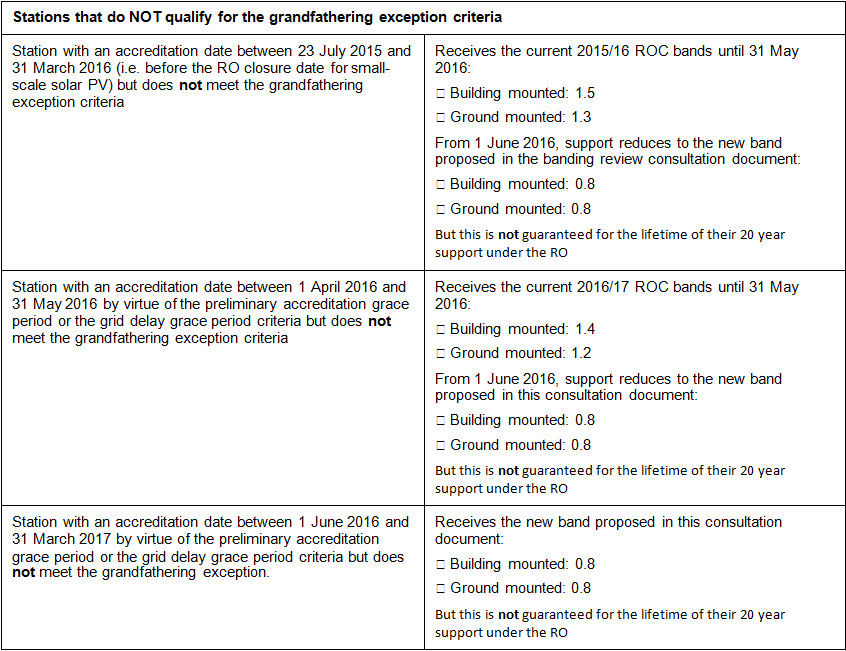
The combined effect of the decisions on early closure and grandfathering, coupled with the proposed banding review changes, is well summed up in the following tables from DECC.
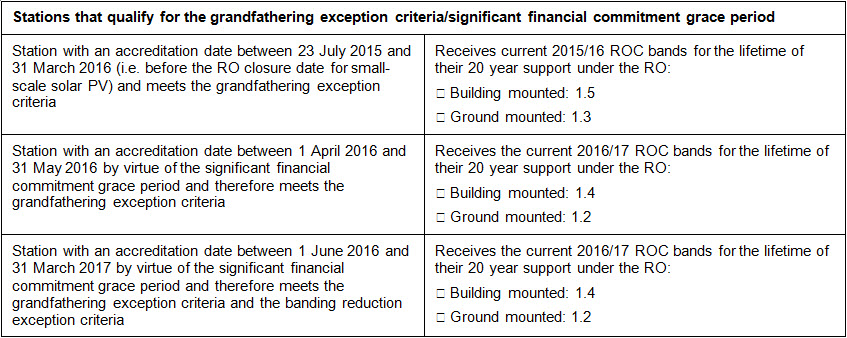
Stations that qualify for the grandfathering exception criteria/significant financial commitment grace period

Stations that do NOT qualify for the grandfathering exception criteria

FIT reforms

The FITs changes affect smaller-scale onshore wind and hydro projects as well as <5 MW solar projects.  The starting point is clear from the first page of the Impact Assessment for the FITs announcement: “The intention is that a maximum of £100m is spent on new-build deployment per year over this FITs review period (from early 2016 to the end of 2018/19).”.

If it achieves this, the Government expects to reduce LCF costs by between £380m and £430m, reduce deployment by between 5.6 GW and 6.2 GW (or between 802,000 and 912,000 fewer installations) and see between 9,700 and 18,700 fewer jobs in the solar industry by 2020/21.

The principal means of securing these results are severe cuts in generation tariff rates.  The DECC table below shows how the new rates for solar PV projects compare with those currently in force, and those proposed in the August 2015 consultation.
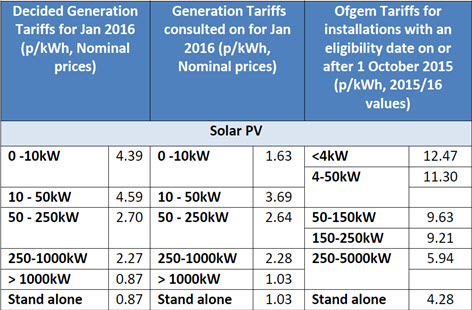
DECC table

It is the smallest installations, representing domestic roof-mounted solar, which have done best out of the consultation process, but it is those in the 250-1000 kW bracket that will see the lowest reductions in subsidy. Good news for commercial and industrial premises with lots of roofspace and a significant daytime electricity demand on-site – even if the consultation process has led to 0.01p/kWh being trimmed from their proposed tariff. (The cuts to wind and hydro tariffs are somewhat less severe, but still swingeing in many cases.)

The Impact Assessment and response to consultation together are more than 150 pages long. Blog posts are meant to be short and pithy, so there is not space here to mention everything that is of interest in the FITs announcement. However, the following points are worth noting.

  • The consultation response confirms that support under each tariff band will be subject to quarterly rationing (“deployment caps”). For the largest bands this may mean that only one or two installations are accredited in each quarter. Everything will depend on the date and time (“to the second”) of an installation’s MCS certificate or ROO-FIT application. Those who miss out in one quarter will be “frozen” in a queue until the next cap opens.
  • There is a lot of detail on the working of the caps and the reformed degression mechanism in the consultation response (see also Ofgem’s draft guidance).
  • Pre-accreditation, removed as long ago as 1 October 2015, is to be re-introduced (for those installations to which it was previously available – i.e. not including those of <50 kW) but in an attenuated form: installations will get the tariff rate that applies on the date of their accreditation, not that of their pre-accreditation.
  • Some of the post-consultation tariff adjustments reflect changes in what the Government considers to be appropriate target hurdle rates (now 4.8% for solar). These may not be enough to motivate those who are thinking of installing domestic rooftop solar.

What happens next?

RO

The early closure of the RO to <5 MW solar will be implemented by amendments to the Renewables Obligation Closure Order 2014. The banding review proposals, if taken forward after the current consultation ends on 27 January 2016, will need to be implemented by amendments to the Renewables Obligation 2015, by 1 June 2016.

The statutory instruments required to make both sets of changes will require the approval of both Houses of Parliament – which, although likely, cannot be guaranteed, particularly in the case of the House of Lords, who recently voted down the proposed early closure of the RO for onshore wind.

FITs

Implementing the policy decisions on FITs requires a combination of modifications to the standard conditions of electricity supply licences and amendments to the Feed-in Tariffs Order 2012.  Differences in Parliamentary procedure mean that the licence modifications take longer to bring into force than the amending Order. Accordingly, Government expects the Order to come into effect on 15 January 2016 and the licence modifications (which include the new tariff rates) to come into effect on 8 February 2016. As mentioned briefly in the FITs consultation, there is to be a pause in the FITs accreditation process between 15 January and 8 February 2016.

As in the case of the RO changes, there is (at least in theory) scope for a negative vote in either House of Parliament to blow the implementation off course. It would also be surprising if there were not some attempts to challenge the changes by way of judicial review, although the litigation process would inevitably play out over a slower time-frame.

And there is more to come…

The Government has expressly flagged or left open a number of areas of possible further reform. For example, the feedback received on possible changes to the FIT export tariff “will be used to frame a detailed consultation on these issues in the future” – Government “may make changes to the structure of the export tariff…for new entrants [including] changes to indexation”.

And just in case anybody should feel too comfortable, the new tariffs, the system of deployment caps and the overall scope of the FITs scheme (i.e. whether it should be more tightly focused in terms of technologies or sizes of installation) are all to be kept under review.

What about CfDs (and everything else)?

The original reason for closure of the RO is its replacement by CfDs, the costs of which, because they are allocated in a competitive process and using defined budgets, can be more easily be controlled. The expectation was that CfD allocation rounds and Capacity Market auctions would be (at least) annual events. However, whilst the Government has held a second Capacity Market auction a year after the first such auction, more than one year on from when the first CfD auction process began, there is no sign yet of the process for a second CfD auction being set in motion. And although one has been announced in general terms as taking place in 2016, there has been no definite pronouncement as to whether it will include a budget for solar.

Is the Government waiting to see how the new ROC band and FIT tariffs play out before deciding whether to include solar in the next CfD auction, and/or how much money to allocate to the part of the auction where solar projects will compete? The rules allow the Secretary of State to decide these points only a very short time before the allocation process begins. For developers considering whether to commit significant sums of money to progress potential solar CfD projects to the stage where they could bid in a 2016 auction, the lack of clarity about such an auction is not helpful.

The FITs consultation response says that it contains measures that “seek to maintain a viable renewables industry which, in the longer-term, can continue to reduce its costs, seeking to achieve grid parity”. By the Government’s own admission, that industry, if still viable, will be considerably smaller once these reforms have been implemented.  It is to be hoped that the industrial and commercial rooftop sector will continue to expand, given the relatively less severe FIT tariff rate reductions that are to be imposed on it. It is likely that some business will be lost to other European jurisdictions which currently enjoy a more benign solar subsidy environment.

Away from the narrow focus on subsidy costs, the hottest strategic topic about the growth of solar deployment is how to manage the system integration costs of low carbon technologies (particularly intermittent wind and solar generation) and encourage the use of storage by renewable generators so as to smooth their export profile and increase system flexibility. (See also Ofgem’s position paper of 30 September 2015 on system flexibility.) These issues were essentially absent from the consultation proposals and decisions. However, the FITs consultation response states that DECC is engaging closely with Ofgem and stakeholders to identify barriers to the deployment of storage and are considering potential remedial actions. The Government plans to consult on this work in “spring 2016”. Perhaps less advantageously for the solar industry, Government is also  “continuing to explore” with National Grid and Ofgem the question of “distributed generation paying for its impact on the whole system”.

Another interesting year ahead for an industry which learnt some time ago that the only certainty is change.

Subscribe and stay updated

Receive our latest blog posts by email.


Source link