Day: October 12, 2024

Biomethane RHI Consultation – Global Energy Blog


1.            Introduction to the RHI

The Renewable Heat Incentive (RHI) is a long-term financial support programme for renewable heat designed to increase the uptake of renewable heat technologies and reduce carbon emissions.

The scheme provides a subsidy per kWhth  of eligible renewable heat generated from accredited installations and a subsidy payable to producers of biomethane for injection into the grid.

It was launched in November 2011 through the Renewable Heat Incentive Scheme Regulations 2011 (RHI Regulation) with a scheme for the non-domestic sector that provides payments to industry, business and public sector organisations.

The following renewable heat technologies are currently supported:

  • solid biomass;
  • ground and water source heat pumps (GSHP);
  • geothermal;
  • solar collector / solar thermal (at capacities of less than 200 kWth);
  • small scale biogas combustion (at capacities of less than 200 kWth); and
  • biomethane injection.

2.            Biomethane

Biomethane injection involves the production of biogas through anaerobic digestion of waste, crop, slurries or sewage feedstock. The biogas is then ‘upgraded’ to remove the carbon dioxide and other impurities in a process know as scrubbing, and propane is added to ensure the calorific value, or energy content, closely matches that of natural gas in the network. The resulting gas can then be odorised and compressed, and the processed biomethane injected into the gas grid.

RHI Payments for biomethane producers are based on the eligible volume of biomethane produced for injection.

3.            Consultation

When the Government first introduced the ‘one size fits all’ biomethane to grid tariff in November 2011 there were no full scale biomethane to grid plants in operation. The tariff was based on a 1MW waste feedstock plant.

The RHI has kick-started the market for biomethane to grid as there are currently three plants registered to the RHI and it is understood many plants of much higher capacities are planned or in the pipeline.

DECC is now concerned that larger biomethane plants will benefit from economies of scale which may not justify RHI support at current levels, i.e. that at current levels large biomethane would be overcompensated.

As a result of DECC’s concerns, on 30 May 2014, DECC published a consultation seeking views from industry on proposed adjustment to the biomethane to grid tariff. The consultation closed on 27 June 2014 and DECC plan to lay any amended regulations as soon as possible after Parliament returns from Recess in Autumn 2014.

The consultation presents two tariff structures: banding and tiering.

Tiering operates by paying a higher tariff for the first designated amount of kilowatt hours of biomethane injected into the grid (the “tier 1” tariff), and a lower tariff for any subsequent biomethane injected (the “tier 2” tariff), over a period of 12 months. All installations would receive the higher tier 1 tariff payments for a set volume of biomethane injected into the grid, regardless of size of plant. This is a ‘2-tier’ tariff structure – tariff structures with higher numbers of tiers could be developed following the same approach.

Tiering provides for a gradual reduction in the average tariff earned as capacity increases – unlike banding where the average tariff falls in large steps. This reduces the likelihood of operators sizing plant for maximum financial benefit.

Banding works by defining capacity bands for the technology and paying an appropriate tariff for each band. In this case, DECC are proposing higher tariffs for the lower capacity bands and lower tariffs for higher capacity bands.

The biomethane industry cannot be overly surprised at the proposed introduction of banding or tiering as these have been implemented for other developing RHI technologies such as biomass and, indeed, in other renewable schemes such as the Feed in Tariff. As ever with tariff reviews, a fine balance needs to be reached between providing value for money for the tax payer while continuing to promote a relatively immature and growing industry.

Subscribe and stay updated

Receive our latest blog posts by email.



Source link

The Offshore Safety Directive (5) – Government consultations


On 28 July 2014, the Government launched two consultations in parallel on the implementation of the Offshore Safety Directive (the OSD). One of the consultations is led by DECC and the HSE (the DECC/HSE Consultation) and the other is led by Defra and the Welsh Government (the Defra Consultation). Both consultations run from 28 July 2014 to 21 September 2014.

The DECC/HSE Consultation concerns the transposition of the OSD and the establishment of an offshore competent authority.  It also seeks comments on HSE’s proposals to update onshore oil and gas health and safety legislation to take account of emerging energy technologies and the review of two Approved Codes of Practice. The DECC/HSE Consultation annexes a suite of draft regulations for comment.

The Defra Consultation is narrower. It concerns the transposition of Article 38 OSD, which extends the scope of environmental liability under the Environmental Liability Directive to Marine Waters. Separate consultation exercises will be taking place later in the year in relation to marine waters off Scotland and Northern Ireland.

The safety and environmental regime which OSD required the UK Government to implement closely resembles the existing offshore regulatory regime in the UK.  Therefore this consultation does not involve proposals to completely dismantle and then reassemble the offshore regime.

However  there are some important issues that this consultation opens up for public comment and debate.  Oil and gas companies would be well advised to give careful consideration to the issues raised.  Key points of interest include:

  • Consolidation of legal duties under one appointed operator.  DECC take the view that as a result of the OSD the same entity must be appointed as both safety duty holder and operator under the Petroleum Act.  This is not consistent with the approach taken by many operators in the North Sea. The OSD requirements on this point need to be considered carefully.
  • Proposed new Competent Authority.  The OSD requires a single authority to be responsible for safety and environmental regulation.  The consultation proposes, as expected, a “competent authority” made up of both HSE and DECC to deliver this – similar to the Competent Authority under the onshore COMAH regime.  However, arguably this complicates rather than simplifies the current regulatory structure.  The new “hybrid” authority will be responsible just for the documentation required under the OSD, whereas operational environmental licences will still be issued by the existing offshore division within DECC.
  • Operator / Licensee Liability for Environmental Damage.  The OSD extends “environmental damage” under the Environmental Liability Directive to include marine waters.  This will have the effect of increasing the potential liability of operators to remediate environmental damage  in the event of a major spill from an offshore installation.  Article 7 of the OSD requires licensees under the Petroleum Act to be “financially liable” for such remediation work.  Defra are consulting on whether any changes need to be made to existing Environmental Damage Regulations to achieve this.

We will be reporting further on these and other points of interest in due course.

Subscribe and stay updated

Receive our latest blog posts by email.

Sam Boileau

About Sam Boileau

Sam focuses on UK and EU environmental and safety law, and has been practicing in these fields for over 15 years. He is one of the few lawyers in the UK to be individually ranked in Chambers & Partners for both environmental and health and safety expertise. His practice area includes waste management, producer responsibility, product liability, pollution liability, environmental permitting, water and drainage, land contamination and health and safety.


Full bio


Source link

Early closure of RO to >5MW solar PV projects confirmed


Following a consultation that ran from 13 May to 7 July 2014, the UK Government has confirmed its intention that, as a general rule, funding under the Renewables Obligation will not be available to larger scale (>5MW solar) PV projects after 31 March 2015.

There will be a “grace period” of a year for projects which were, in effect, in a position to begin development before 13 May 2014.  Perhaps more usefully for projects which may struggle to meet the requirements for RO accreditation before 31 March 2015, further consultation is taking place on a proposal to protect the position of those projects which only fail to meet the 31 March 2015 cut-off date for commissioning because their electricity network operator has not met a pre-31 March 2015 estimated connection date.

Background

For most technologies, the Renewables Obligation will close on 31 March 2017.  After that date, smaller projects will have to rely on the Feed-in Tariffs regime and larger projects must compete for Contracts for Difference (CfDs) under Electricity Market Reform.  In March 2014, the Government set out its overall approach to the two and a half year  transition period when both the RO and CfD regimes are open to new projects: developers are able to choose between the two schemes (subject to certain qualifications). But subsequently DECC has become increasingly concerned that the rapid growth of the UK solar industry, supported by the “demand-led” RO, will breach the Levy Control Framework (LCF) limits on the overall amount of money that the Treasury will permit to be spent on renewable energy subsidies.  In its May 2014 consultation, DECC estimated that large-scale solar PV deployment under the RO could reach “more than 5GW by 2017”; in the response to that consultation, DECC’s “updated assessment” found that “in the absence of intervention”, up to 10GW of solar PV could deploy within this period, costing some £400m more than was allowed for in the EMR Delivery Plan and exceeding the LCF cap.

Proposals and policy decisions

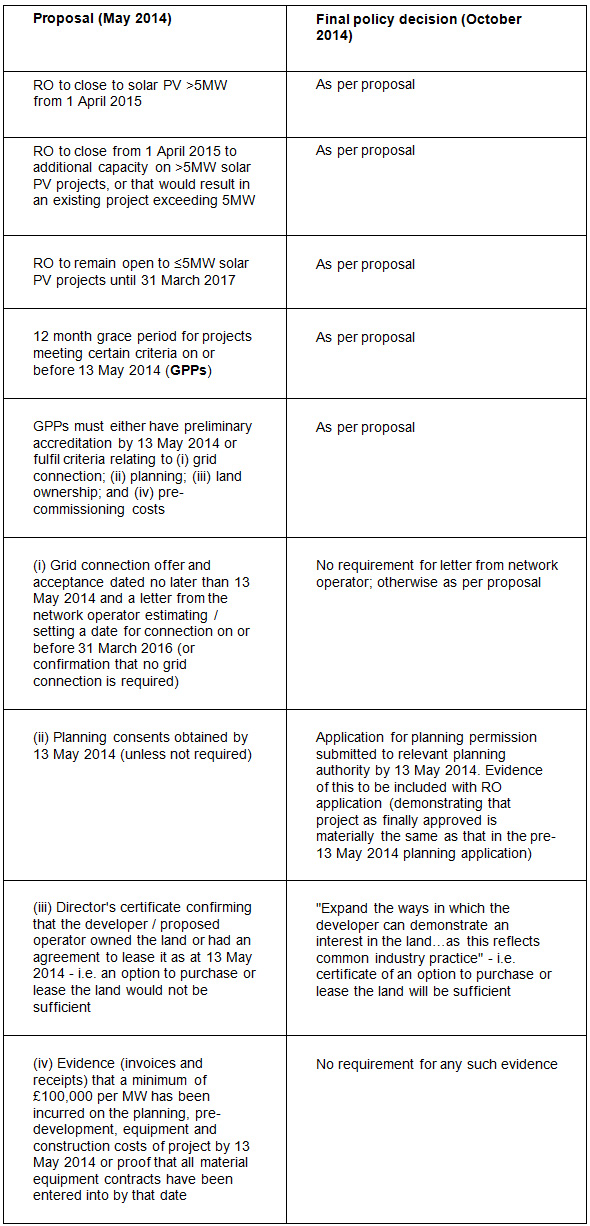
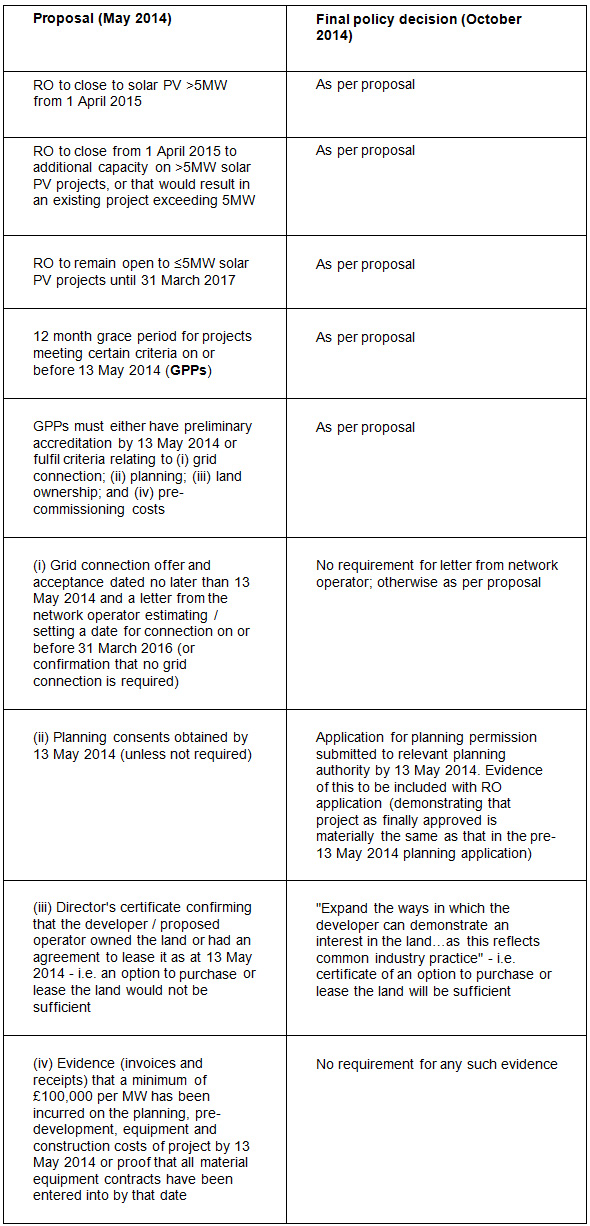
The table below summarises the Government’s main proposals on RO closure for solar PV in the May consultation and the policy decisions announced in the response to consultation.

table-1

DECC has not been persuaded to change the cut-off date or open up the grace period to a wider group of projects.  Responding to “the main criticism…that any projects that can meet the grace period…requirements are unlikely to need the grace period because they will already be sufficiently advanced to secure connection by 31 March 2015”, DECC states that “the grace period will have fulfilled its purpose if it protects eligible projects that subsequently encounter unexpected events which delay their completion beyond the end of March 2015.  However, DECC very clearly has taken on board the industry’s practical objections around the evidence to be provided by those that are eligible for the grace period and has accommodated its evidential requirements to the realities of the industry.

Further consultation

In response to comments from consultees that early closure of the RO to large-scale solar would create a “cliff-edge” effect for some projects, DECC has put out a further consultation (closing on 24 October 2014) on the proposal that there should be a separate 3 month grace period (until 30 June 2015) for projects which are prevented from meeting the 31 March 2015 deadline only because they are not connected to the grid by that date.

The proposal is that such projects would have to include in their RO application:

  • a grid connection offer and acceptance and a letter from the network operator estimating or setting a date for connection of no later to 31 March 2015 (the estimated connection date);
  • a declaration by the developer that to the best of its knowledge, the project would have been commissioned by 31 March 2015 if the connection had been made by the estimated connection date; and
  • a letter from the network operator confirming that in its opinion, the failure to make the grid connection before the estimated connection date was not due to any failure on the part of the developer.

The first of these proposed requirements is open to the same sorts of objections that were made by the industry against the proposed requirement for a letter from the network operator that formed part of the May 2014 proposals.  However, DECC insists that past experience on banding review grace periods suggests that the difficulties associated with it are “not insurmountable”, and the response to consultation is careful to note that the requirement has been removed from the final policy decision on the May proposals because a letter from the network operator was considered unnecessary in that context, rather than that it would be too difficult to obtain.

What next?

DECC intends to implement the policy decisions described above in relation to RO closure through an amendment to the Renewables Obligation Closure Order 2014, to take effect on 1 April 2015.

DECC is evidently determined to do whatever it has to in order to mitigate the risk that the growth in large-scale solar PV will lead to a breach in the Levy Control Framework limits. It wants the sector to switch to the CfD regime, where the auction-based allocation process will drive down the costs of subsidy, acknowledging that the greater complexity of the CfD regime will favour the larger players in the industry.

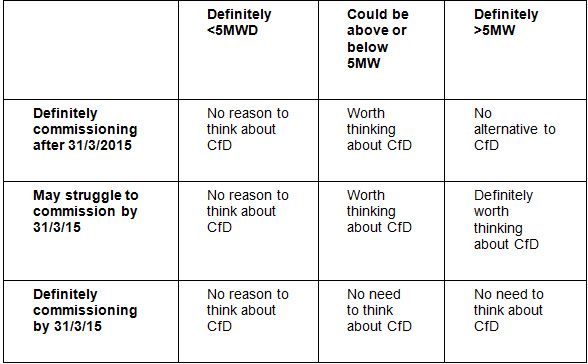
The deadline for applications for the first CfD round is now 30 October 2014, and in recent publications both DECC and National Grid (as EMR Delivery Body) have been doing their best to make the regime user-friendly.  The table below suggests which groups of developers may need to consider making a CfD application.  If onshore wind developers (with whom solar projects must compete) are likely to avoid bidding for CfDs in the first auction since they  have until 31 March 2017 to achieve RO accreditation, it may be that solar projects stand a reasonable chance of success of being allocated CfDs later this year.

table-2

At present, for those who miss out on both the RO and a CfD from the first allocation round, the next opportunity would be a CfD allocation round in Autumn 2015.  DECC has given some indications that it is sympathetic to the proposition that the rapid development cycle of solar projects means that there ought to be solar CfD allocations every 6 months rather than every year, as for other technologies, but it also points out that more frequent auctions would not mean any increase in the overall budget.  And since 2015 is a General Election year, no promises of a further allocation round for solar can be made at present.


Subscribe and stay updated

Receive our latest blog posts by email.



Source link