Blog

Sailing into the wind? Supply chain support versus free trade in global offshore wind markets


The UK and Europe have set highly ambitious targets for developing offshore wind (OSW) over the coming decade, yet the industry is currently suffering supply chain challenges which threaten new projects. Measures that could mitigate these challenges include (i) new criteria for consenting/allocating support to OSW projects which give more weight to supply chain factors rather than simply awarding on price (ii) deeper collaboration/standardisation within the industry. This article examines the competition, subsidies and WTO law issues which these solutions may give rise to.

Executive summary

The decline in wind turbine orders last year, coupled with the rapid expansion in global demand for OSW projects, means that new policy solutions will be required to ensure that OSW projects are incentivised to proceed, and can do so profitably. Competition and subsidies law, and trade law, can limit the levers which are available for governments supporting individual projects and the industry more widely.

This article concludes the following:

  • The use of non-price criteria (such as environmental and supply chain contribution) to allocate support to OSW projects could support domestic supply chains and allow projects of strategic importance to be selected and at acceptable prices. Subsidies and EU state aid law have traditionally favoured competition based purely on price, but this picture looks set to change. The recently published EU proposal for a Net Zero Industry Act[1] imposes specific requirements to take sustainability and resilience into account in renewables auctions.  
  • Trade law complaints are always a risk when a WTO member takes active steps to subsidise and support local supply chains. In the geo-political context of the US and EU taking similar measures to support low carbon technologies, it would appear more likely that complaints about protectionist behaviour are resolved by political rather than legal means.
  • Competition law restrictions must be taken into account when industry collaborates as part of joint projects, or to improve processes. Risks can be mitigated based on careful structuring of projects.

Background: offshore wind targets and industry obstacles

As part of the drive towards net zero, a significant growth in offshore wind capacity is envisaged over the coming decade.

The UK government has ambitious offshore wind energy targets, aiming to secure 50GW by 2030[2].

The EU has a target (from the REPowerEU plan) of 480GW of wind capacity by 2030 (up from about 190GW today).

Offshore wind developers have raised several significant obstacles in this regard. One relates to inability of new projects to connect to the grid. In addition, there are significant supply chain challenges, as global markets grapple with post-Covid recovery which has been exacerbated by geo-political events.

The first key supply chain challenge is the fact that soaring gas prices caused by Russia’s invasion of Ukraine has driven up the cost of industrial production of the materials, such as steel and copper, and components required to build wind turbines and the associated infrastructure. Therefore, costs for developers have sharply increased as suppliers have pushed up prices to deal with the increased cost of making turbines. Consequently, it is increasingly difficult for companies in the supply chain to predict where prices will go.

Furthermore, the industry is facing supply chain delays, started by the Covid-19 pandemic and exacerbated by the war in Ukraine. This has led to increased transportation and logistics costs with companies now at risk of having to pay “liquidated damages” to customers, or compensation payments due to project delays.

Another issue is the unavailability of equipment and vessels. The surge in uptake of offshore wind in the UK and globally has led to increased demand for specialised vessels, which can cause bottleneck delays for offshore wind installations. This is exacerbated by the trend towards larger turbines, as the development of technology and turbine size is exceeding the manufacturing pace of turbine installation vessels.

In the UK, it is reported that several offshore wind developers, which were successful in the most recent auction round for projects due to start generating capacity in 2024 have had to delay due to cost pressures, and are seeking additional subsidies or tax breaks from government[3].

Current relevance of auction processes

In the UK, a developer would typically enter two auction processes as part of developing an offshore wind project. The first is the seabed leasing managed by the Crown Estate or Crown Estate Scotland, which grants the developer options for access to the seabed, with developers historically based on who offers the highest payment for the option.

The second is the Contract for Difference (CfD) auction – a revenue stabilisation mechanism whereby projects compete for contracts which guarantee a market premium per unit of electricity generated through payment of a “strike price” when this is higher than a market reference price for approximately the first 15 years of the project. Projects compete for CfDs due to the revenue certainty they provide which in turn lowers finance costs, with successful projects bidding to bring the strike price down.

Traditionally, the benefit of auctions has tended to be lower prices for consumers (or more revenue for government). Where projects compete on price, this means those projects that are able to minimise their supply chain costs will be more competitive. One downside, however, is that opting for the lowest cost supply chain inputs (which are more likely to be imported) means that it is harder to build a domestic industry with necessary expertise. Another downside is that where projects are in tight competition to obtain CfD support (which tends to happen relatively late in the consenting process) there is less incentive to collaborate – even where such collaboration could improve innovation and ultimately lead to cheaper inputs.

Potential solutions: auction design – non-price criteria

One solution to support supply chains would be to take into account selection criteria other than price in awarding support contracts. Suggestions for such criteria are necessarily generic in nature and would need to be tailored to suit the specific competitive context, and the contract that is being awarded. Options include:

Supporting supply chain stability and resilience

This criterion acknowledges and rewards a project’s contribution to the enhancement of domestic/regional supply chains. This tends to be an important policy aim for host governments, but it is difficult to achieve in a highly cost-competitive environment. Offshore wind in the UK has a number of industry initiatives[4] (often backed by government) to strengthen the supply chain. As noted below, it can be difficult to reconcile supply chain commitments with trade law and subsidies obligations.

System integration and innovation

Systems integration and innovation involves combining offshore wind projects with other technologies and capabilities that help economies decarbonise and produce greater value from the offshore wind project. One example could be pairing offshore wind with electrolysers to produce hydrogen, making offshore wind farm production hubs for green hydrogen. This will be most relevant in markets where the share of renewable resources is high. Another example is the use of multi-purpose interconnectors which would allow clusters of offshore wind farms to plug into an interconnector, enabling offshore wind and interconnection to work together more cost-effectively as a combined asset.

Environmental factors

These can include a lower environmental impact of the project, enhanced coexistence with other marine activities and the optimised use of the sea. More widely, sustainability may also be taken into account in reducing the lifecycle emissions of offshore wind projects, and ensuring the recyclability of materials.

Regulatory structures to support the policy aims underlying these criteria are not new. For example:

  • As part of the process of qualification to participate in CfD auctions, offshore wind developers are required in certain circumstances to submit supply chain plans for approval by government. Failure to comply with those plans can lead to payments being withheld once a CfD is in operation. Whilst the actual auction is based on price, this requirement for a supply chain plan introduces local content considerations. As discussed below, the EU initiated a challenge before the WTO in relation to the UK’s offshore wind supply chain plan requirements.
  • Similar supply chain local content expectations are contained in the requirement to deliver a Supply Chain Development Statement under the recent Scotwind seabed leasing round in Scotland, with the threshold of supply chain commitments that applicants must meet increasing from 10% to 25% (underpinned by an obligation under the Scottish Crown Estate Act 2019 for Crown Estate Scotland to deliver wider benefits such as economic development and environmental well-being). The Crown Estate’s floating offshore wind seabed leasing auction in the Celtic Sea will also require participants to outline a plan for supply chain contribution.
  • The UK is considering adding further non-price criteria as flagged in its consultation document on policy considerations for future rounds of the CfD scheme, although the consultation states that this would have to be balanced against higher costs to consumers.
  • The European Commission adopted new environmental state aid guidelines in January 2022 which update the basis on which the European Commission will approve state aid for projects that contribute to decarbonisation. The guideline states that when allocating aid in a competitive bidding process, it may be appropriate to include (non-price) selection criteria up to 30% of the weighting. This is a departure from the existing approach that the amount of state aid granted must be at the lowest level possible (i.e. the minimum intervention to achieve the outcome). In addition, the Commission is currently consulting EU member states on changes to the “state aid temporary crisis framework” which include amendments to allow support for investments in the production of strategic equipment necessary for the net-zero transition, with wind turbines specifically included in the list of such strategic equipment.
  • Further, the EU’s proposal for a Net Zero Industry Reduction Act (Article 20) includes a specific requirement (subject to the Union’s international commitments and state aid law) for member state authorities to assess the sustainability and resilience contributions of projects, with a target weight of between 15% and 30%, when designing the criteria used for ranking bids in renewables auctions.
  • Further afield, the US Inflation Reduction Act (IRA) includes new and revised tax incentives for clean energy projects, significantly modifying the federal tax credits available for renewable energy projects. The IRA has extended certain tax credits to wind projects, with credits increasing where projects satisfy requirements regarding domestic content, wage and apprenticeship rules. The EU trade commissioner has complained informally about the discriminatory treatment this entails for foreign suppliers.

This demonstrates a wider trend of host governments taking measures to ensure that financial support for renewables projects also results in domestic benefits in terms of supply chains, industrial capability and jobs/skills.

Non-price criteria: trade law and subsidies considerations

International trade law

Measures which give preference to domestic industries risk falling foul of WTO law requirements.

Under the WTO Agreement on Subsidies and Countervailing Measures, two categories of subsidies are prohibited. These are subsidies that are either contingent on export performance (known as export subsidies) or contingent on the use of domestic goods over imported goods (known as local content subsidies). A wider range of subsidies is actionable: not necessarily prohibited, but capable of challenge if they have had, or will have, an adverse effect upon another WTO member. Examples would include a government subsidy for a new project, which would lead to unfair price suppression in the type of products it produced and displace the exports of another WTO member in a market.

Whilst subsidy challenges are some of the most common WTO GATT cases, they are always heavily fact-specific. The risk of challenge is greatest when there is an obvious and severe negative impact on another country’s industry. The IRA has already sparked talk of subsidy challenges. In a November 2022 speech, European commissioner for trade Valdis Dombrovskis referred to the EU’s “serious concerns” about US green subsidies discriminating against EU automotive, renewables, battery and energy-intensive industries and “potential new disputes”. Equally, the EU’s latest “Net Zero Industry Act” may raise concerns of protectionism and preferring EU-based content. The EU and US have established a joint high-level task force to address the issues.

The EU requested WTO consultations to the UK’s green energy subsidy scheme in March 2022, on the basis that criteria used by the UK government in awarding subsidies for offshore wind energy projects favoured UK over imported content. The EU alleged that this violated the WTO’s “core tenet” that imports must be able to compete on an equal footing with domestic products and harmed EU suppliers. The dispute was resolved in July 2022, with clarification from the UK that CfD beneficiaries did not need to achieve any particular level of UK content to receive payments.

It is possible to rely on the security exception under GATT as a defence to any potential challenge. Under Article XXI, a WTO member shall not be required to furnish any information, the disclosure of which it considers to be contrary to its essential security interests. Blocking the disclosure of information about subsidies could effectively mean that any challenge brought by another WTO member could face significant barriers in succeeding due to lack of information on the subject of the challenge.

UK subsidy control regime

The UK regime is still very new and, importantly, operates differently to the EU state aid system. The obvious benefit is its greater flexibility and speed. So long as the relevant public authority is satisfied that the principles set out in the Subsidy Control Act 2022 are met, it can generally award the subsidy unless it, and related subsidies over a three-year period, are above £10 million.

The main risk is of challenge by third parties (most likely competitors) in specialist proceedings before the Competition Appeal Tribunal (details of all awards above £100,000 must be published on a subsidy database). However, there are strict time limits and it is not yet clear whether there will be an appetite to incur the costs of going to court. In addition, if subsidy is given under a scheme, it is the scheme that would be open to challenge. Once the time limit expires, the subsequent individual awards under the scheme would not be capable of challenge (so long as they meet the scheme’s criteria).

Subsidies of more than £10 million (or schemes set up to award individual subsidies above that amount) must be delayed until the CMA’s State Aid Unit issues a non-binding opinion on the public authority’s assessment of compliance with the requirements of the Act and a short cooling-off period has expired. This advice could lead public authorities to reconsider the design of an auction, for example, but only if serious issues are identified with the initial assessment of compliance. The first subsidy scheme reviewed by the CMA’s State Aid Unit was the Contracts for Difference (CfD) for Renewables scheme. In a report published on 28 February 2023, the CMA did not find any serious issues with the assessment carried out in relation to the fifth CfD allocation round (AR5), but it did give some advice as to how the assessment could have been strengthened in certain areas, which will be useful for the future assessment of subsidy schemes.

Although there is no specific guidance dealing with offshore wind, the new regime in the UK means that auctions designed on the basis of price and non-price factors can, in principle, be compliant with the Act, provided there is sufficient evidence that the subsidy/subsidy scheme is in line with the relevant principles (and does not involve prohibited types of subsidy, such as those that are contingent on the use of “local content”, as mentioned above). The principles are not prescriptive about how a competitive process should work, so long as the subsidy is proportionate to the specific policy objective.

EU state aid

As noted above, the guidelines appear to recognise that flexibility is needed, though are now relevant only to the extent that subsidies are awarded to UK recipients by EU member states (or if the Northern Ireland Protocol is engaged, meaning that EU state aid law continues to apply).

Potential solutions: developer collaboration and competition law considerations

Closer industry collaboration can be an important part of the solution in making offshore wind supply chains more sustainable and profitable. This could manifest itself in a number of ways, including standardising design features to allow for economies of scale in construction, and reducing maintenance and equipment costs. In terms of legal structures, the following are of particular interest:

  • Joint projects: These can include collaboration in developing new projects or in relation to service industries – for example, combining project management and engineering expertise to provide services such as subsea surveys, yard services, maintenance and repair etc. This could be relevant to ports that would otherwise be competing to secure offshore wind services such as locations for manufacturing components of OSW projects or assembly and marshalling of components or O&M services.
  • Knowledge sharing: This can include informal or more structured ways of sharing know-how and resources, and of advocating for regulatory changes. Examples include the Scottish Offshore Wind Energy Council (SOWEC) Offshore Wind Collaborative Framework Development where (amongst other outputs) parties share strategic information, explore contractual and procurement mechanisms, and ensure sector-wide communication.
  • Standardisation of legal contracts: For example, FIDIC contracts are commonly used for offshore wind construction projects but with significant amendments. There may be further scope to standardise.

Competition law is often regarded as a barrier to effective industry collaboration, with the risks being too great (financially and reputationally) for anything other than a cautious approach. In the context of offshore wind, there are certainly important risks to navigate, but that does not mean that collaboration cannot be achieved and should not be explored. Competition authorities recognise that a joined-up approach can produce benefits for competition, provided certain criteria are met, and there are tentative signs that environmental benefits might also be taken into account in this assessment.

Certain types of collaboration may not engage competition law. This might be the case, for example, where companies bid jointly for a licence and would not have been able to do so independently (perhaps because they offer complementary services/products or it would be too costly/complex to bid individually).

If prospective JV partners could bid individually, or the collaboration is of a different nature between competitors, the parties will need to weigh up the restrictive effects of the arrangement on competition against the benefits for consumers, but there may be a way to collaborate in a compliant manner.

The odds have recently improved in this respect. The UK competition authority has recently announced that wider environmental benefits to society can be taken into account in this assessment, provided the agreement is aimed at making a substantial and demonstrable contribution to tackling climate change (an argument likely to be available, at least in principle, to many types of collaboration relating to offshore wind). Not only that, but the CMA has indicated that it will operate an “open door” policy and will provide informal advice to businesses about their proposed arrangements, providing comfort that the current self-assessment approach did not. Parties will, however, need to be able to demonstrate and quantify the claimed benefits.

There are examples of successful industry-wide collaboration in the UK, which show it can be done. The oil industry regularly participates in joint ventures to bid for licences. That industry was also encouraged to collaborate to maximise economic recovery (MER) in the North Sea. Whilst the UK competition authority expressed concerns, cautioning against arrangements which would lead to collusion and the exchange of competitively sensitive information, guidance was subsequently produced by the Oil and Gas Authority on how these issues could be managed and the benefits unlocked.


[1] https://single-market-economy.ec.europa.eu/system/files/2023-03/COM_2023_161_1_EN_ACT_part1_v9.pdf

[2] https://www.gov.uk/government/publications/british-energy-security-strategy/british-energy-security-strategy

[3] https://www.ft.com/content/80dee308-a564-4ee4-b1f2-ab7dbed643cd?shareType=nongift

[4] For example, see Catapult here

Subscribe and stay updated

Receive our latest blog posts by email.



Source link

UK regulation of waste batteries


Beyond the immediate concerns of battery project developers (grid connection, revenue stack, finance etc), another key issue looms: the batteries’ future status (and value) as “waste”.

The Waste Batteries and Accumulators Regulations 2009 are aimed at battery “producers” and impose recycling obligations on battery manufacturers/sellers.

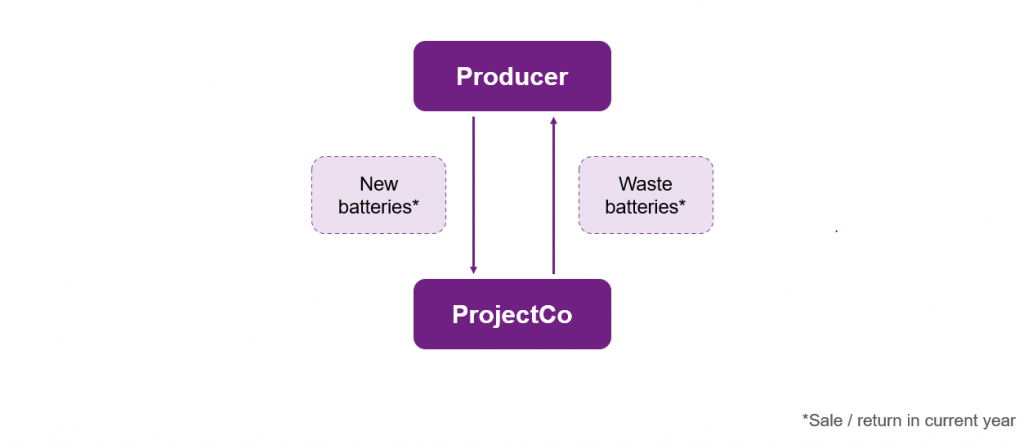
A “producer” is defined as “any person in the UK who, irrespective of the method used, places batteries, including those already in appliances or vehicles, on the UK market for the first time, on a professional basis“. We are seeing that the “producer” is the EPC Contractor as they are bringing the batteries into the UK market.

Producer obligations

Broadly speaking, producers must provide a scheme under which they accept to retrieve waste industrial batteries provided to end-users. This must be free of charge to the end-user and within a reasonable time following request by the end-user. The producer must also publish details of how an end-user can use the scheme.

These obligations only come into effect in certain circumstances, when requested by an end-user, and in the same year that a producer places batteries on the market.

Waste batteries

A “waste battery” means any battery which is waste within the meaning of the 2006 Battery Directive. The definition of waste is broad and includes other substances and objects rather than just batteries – so it needs to be properly considered in the context of a battery. The most relevant category of waste in respect of batteries would be “unusable parts”.

“Unusable” in its literal interpretation would be batteries which have been exhausted and have no further use.

Once the maximum cycle count of the batteries has been reached, there is still use for the batteries in a secondary market. If this is the case, then the batteries may be considered as “used” but not “unusable” and a producer would not be under an obligation to take them back.

Producer responsibilities

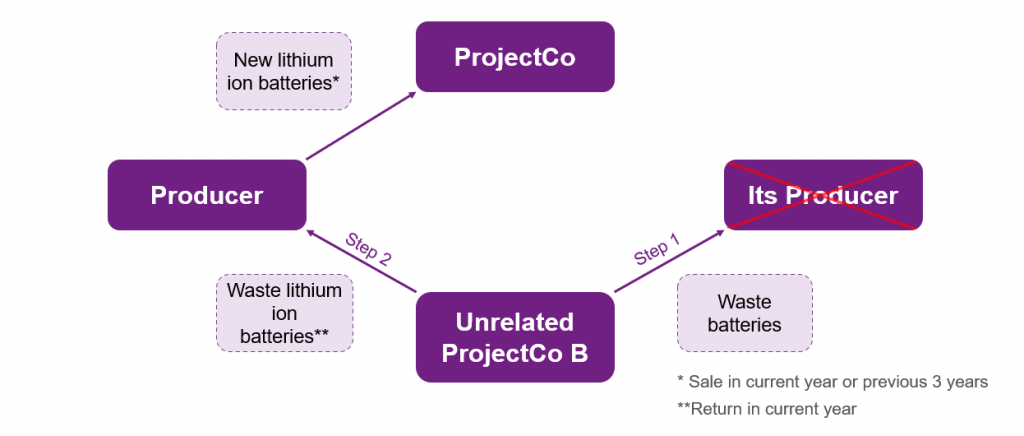
Based on the regulations, there are three distinct scenarios in which producers have a responsibility to collect batteries.

Scenario 1

The producer must take back waste batteries free of charge from its customer where such customer is supplied with new industrial batteries in the same calendar year.

Scenario 2

The producer must take back third party waste batteries free of charge where:

  1. the third party end-user cannot return their waste batteries to their relevant producer; and
  2. their waste batteries are the same chemistry type as the batteries which a producer sold on the UK market in that or the previous three calendar years.

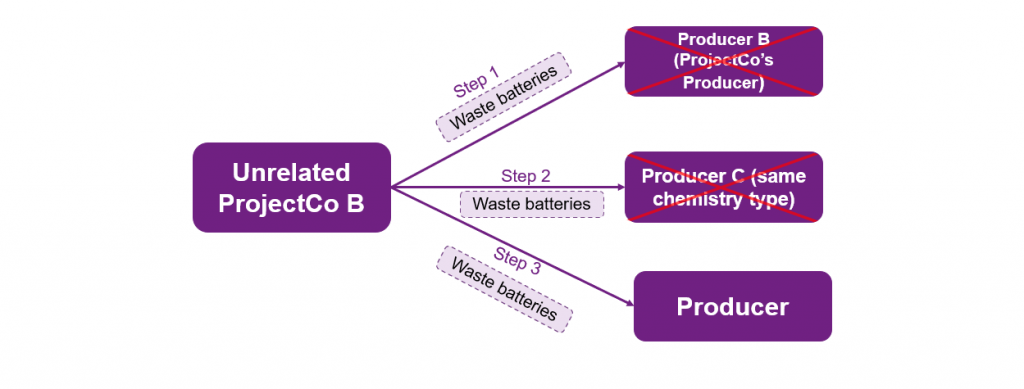
Scenario 3

The producer must take back waste industrial batteries free of charge from an end-user, where the end-user cannot return the batteries to another producer under scenarios 1 and 2 above. This is considered a catch-all to ensure that all waste batteries are collected.

It is clear that there is an unknown element of risk to which producers are exposed through having to accept the waste batteries from third parties.

The Regulations state that battery producers can agree to make alternative arrangements to finance the net costs of the collection, treatment and recycling which differ from the arrangements provided for under the Regulations. This means that any producer could in its battery supply arrangements agree to share these costs, or alternatively push them on to developers.

Depending on your side of the fence – developer or EPC contractor – you may wish a contract to remain silent, or expressly agree to share costs.

Further obligations

There are various other obligations including registration, record keeping, reporting requirements and ensuring that any batteries taken back are delivered to and accepted by an approved battery treatment operator for treatment and recycling, or an approved battery exporter for export for treatment and recycling outside the UK.

Battery project developers as “producer”?

We anticipate that over time, as the solar market did with modules, developers will become more comfortable in establishing themselves as producer – entering into BESS supply contracts directly with the manufacturer, which means that it is the developer placing the batteries on the market.

Whilst this could be seen as daunting, in our view, it does not need to be. Solar PV has comparative obligations under the Waste Electrical and Electronic Equipment Regulations. There is a similar definition of “producer”, take-back obligations, registration and reporting requirements as well as the process for recycling these components. Developers have managed to get comfortable with obligations regarding solar PV, so we think that it is reasonable to say that developers could also get comfortable with comparative obligations for battery recycling.

Our next blog post will look at the potential second-life application of batteries and how battery project developers can capitalise on this emerging market.

Subscribe and stay updated

Receive our latest blog posts by email.


Source link

Second-life application of batteries in the EU and UK


Are the current regulations fit for purpose?

Looking at the current regulatory regime, whilst a UK battery recycling regime exists, it focuses more on waste management, it is thin on detail and does not adequately address considerations of a circular economy and the exponential growth in industrial battery use. In particular, there is no distinction made between recycling and repurposing, nor an accompanying framework for repurposing.

Future policy developments

Industrial batteries do not just die once, but twice. Once, when they can no longer power a BESS project, and again when they can no longer power anything else. The definition of “waste” battery as mentioned in my last blog post has a high threshold and is unlikely to apply in the context of the end of its usable life in a BESS project. There is of course a possible second life for these batteries, depending on how their use case develops.

There will be residual value in these batteries on a secondary market, whether that is for use in respect of street lighting, home energy storage, back-up storage for co-location, or use in EV charging infrastructure.

Future policy developments – EU

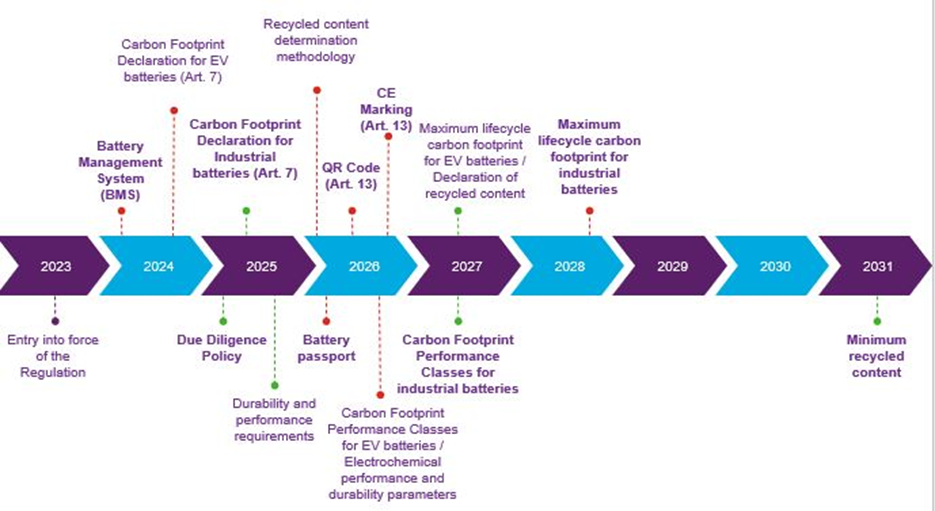
Here is a snapshot of the newly adopted EU regulations.

Timeline of planned EU legislation in relation to batteries.

Looking at our neighbours who are much more advanced in their thinking, there are some interesting elements to the regulations like a battery “passport” for each battery with a capacity above 2kWh.

The operator who places the battery on the EU market is responsible for updating the battery passport, which is designed to help to trace batteries and their management throughout their lifecycle.

The battery passport should help second-life stakeholders to make more informed decisions and allow recyclers to better plan their operations and increase recycling efficiency, whilst making used batteries more marketable.

The EU Regulation also proposes that second-life batteries must fulfil specific end-of-life criteria, including passing a “health check” before being sent for repurposing.

You can find more detail on the EU regulations here.

Future policy developments – UK

In 2018, the UK government published “Our Waste, Our Resources, A Strategy for England (Resources and Waste Strategy)”. This report indicated that the government will consult on reviewing the end-of-life battery regime in England as part of its extended producer responsibility framework. This is currently scheduled for later in 2023.

More recently, the UK government this year published “A Study on the Safety of Second-life Batteries” – where two very conflicting views formed with stakeholders. One was that a safety framework can be put in place to allow the use of second-life batteries, so long as the full history of the batteries in their first life applications is known. A second, more radical view shared by some respondents is simply that the safety of such cells can never be guaranteed, and hence that second-life batteries should not be employed under any circumstances.

The question is whether we think the UK will take a similar approach to the EU.

We think that this is likely to be the case. The UK government may be conscious that the framework established by the EU Regulation could provide regulatory clarity that attracts investment in battery development within the EU in preference to the UK.

Regulation of second-life batteries and the market for it will develop rapidly over the coming years and, if you are a project developer, you should put yourself in the best position to capitalise on this residual value.

Based on where we see the direction of travel going, keeping contemporaneous records of the operations and maintenance of your batteries will be paramount – noting how and when the batteries were cycled, whether they have been overcycled at any point and how have they been maintained. It will also be important to ensure that they are regularly tested and that the best safety practices are adhered to during their first life.

We have already seen companies preparing for this market in transactions on which we have worked. If you would like to hear more, please get in touch.

Subscribe and stay updated

Receive our latest blog posts by email.


Source link

Ecuador votes to leave some of its hydrocarbons in the ground


On 20 August 2023, Ecuadorians were asked in a referendum whether they agreed with the government keeping the oil in the project known as Block 43, indefinitely underground. The majority voted in favour. In this post, we explore the background to the referendum and its implications.

The long road to the referendum

Block 43 is located in Ishpingo, Tambococha and Tiputini, areas inside the Yasuní National Park, in Orellana Province. In 2013, the environmental collective Yasunidos raised the possibility of leaving oil in the Yasuní National Park underground and received strong national support.

Yasunidos collected signatures of citizens to promote the referendum – one of the first examples of a referendum being proposed without the support of any governmental entity.

The collective had to present at least 583,000 signatures (i.e. 5% of the national electorate at the time). They presented 756,000 signatures. However, the National Electoral Council dismissed at least 400,000 signatures within 14 days of analysis, which was seen by Yasunidos as an arbitrary decision.

By these means, the government of former President Rafael Correa blocked the referendum and gave way to intervention in the area, which led to establishing production facilities. Since then, Petroecuador, the State Oil Company, has been in charge of the operation: no private entity has ever been granted any right to exploit the oil in the area.

Between 2014 and 2019, there were a series of additional judgments and acknowledgments that did not allow the process to go forward. A first appeal ruling in the Contentious Electoral Court was issued against Yasunidos. In 2018, an internal audit at the National Electoral Council recognised irregularities in the process and requested that the process return to the National Electoral Council. However, both the National Electoral Council and the Contentious Electoral Court again denied the process, arguing that Yasunidos did not have the appropriate recognition as a collective.

In 2019, once Yasunidos had been recognised as a collective and had active legitimacy, the consultation was again denied by arguing that the process was closed in 2014.

Having presented more than a dozen judicial processes and continued promoting the referendum without success for so many years, Yasunidos filed a constitutional claim (“acción extraordinaria de protección”) that was resolved on November 2021. The Constitutional Court held that there had been a violation of the right to due process and ordered that a new composition of the Contentious Electoral Tribunal be designated, to resolve the appeal filed by the plaintiffs.

On 6 September 2022, the Contentious Electoral Tribunal required the National Electoral Council to:

• attend to the request presented by the citizen Pedro Bermeo Guarderas on behalf of the Yasunidos Collective within 15 days from the execution of the judgment;
• grant the certificate of democratic legitimacy to Yasunidos; and
• submit to the Constitutional Court of Ecuador and hold a referendum on the question proposed by the group..

The result

The official results displayed by the National Electoral Council reveal that, nationally, 58.95% voted in favour of keeping the Block 43 oil indefinitely underground, with 41.05% voting against it.

However, in provinces like Orellana and Sucumbíos, where the operation of Block 43 takes place, the outcome of the referendum was in favour of continuing the exploitation of the oil field.

What are the legal consequences of the referendum?

The referendum becomes a direct instruction to the government to cease operations in the area. No legislative steps are required to give effect to it. Petroecuador must start actions to present the plan to close operations in Block 43 immediately.

All construction, equipment, surface assets etc will have to be removed and Petroecuador must present a decommissioning plan immediately. The process for this remains to be determined. Petroecuador must update the plan to close operations and present it before the Ministry of Environment to coordinate actions.

Petroecuador must coordinate the removal of the infrastructure, the dismantling of pipes and the termination of contracts with workers and sub-contractors. Assets located in Block 43 will return to the state earlier than expected. The government estimates that this would cost the state around US$600 million.

There will be a high cost for Petroecuador and it is not certain how this will be financed, but no private company will be affected other than sub-contractors whose contracts will be terminated (without compensation, since the termination of sub-contracts will fall under a force majeure clause).

Could further legal or political action get in the way?

For now, we do not think the outcome of the ongoing presidential election will impact the implementation of the referendum. Interfering with the outcome of the referendum would likely cause great social unrest and we do not believe either of the candidates is willing to go against the referendum result.

Implementation of the referendum result is more a matter of technical decisions as well as financial budgeting, since pumps and piping need to be removed, which is a very costly process.

Equally, we do not foresee that any other actors or parties will challenge the results of the referendum in the immediate future.

Wider implications of the referendum: is it a one-off, or part of a trend?

In Ecuador, the Constitution grants specific substantive rights to nature, as well as to persons. These include the rights to be protected and to be restored, and are enforceable. This constitutional provision underpinned the referendum and the legal actions in support of it. This is not the only occasion in recent years that the Constitutional Court of Ecuador has played an important role in the protection of the environment, as well as in the protection of the rights of communities that are affected by the exploitation of natural resources. However, not all jurisdictions give the same kind of legal rights, or level of protection, to nature as such.

Also central to the case for the referendum and its conclusion is the status of Yasuní as a National Park and a protected area that is home to exceptionally rich biodiversity and isolated indigenous communities. It is certainly possible that in Ecuador itself, if not elsewhere, further legal action may be taken to curtail economic activity in other National Park areas.

More generally, it is clear that popular concern about the related issues of biodiversity and climate change were important factors in the referendum result. Ecuadorians are increasingly taking a more environmental approach and promoting the preservation of the environment over what might traditionally have been considered “economic” interests.

Other factors influencing the result include that the present government did not provide strong reasons to keep the exploitation of Block 43. Indeed, it is debated whether its very high-cost output of 53,000 barrels per day is really profitable for the country, and some experts claim that only Petroecuador and the service providers benefit from this exploitation.

It may be that the real negative impact to the economy from discontinuing extraction in Block 43 will not be significant. This in turn leads one to question why the previous government insisted on conducting prohibited activities in a National Park, especially one with the characteristics of Yasuní which is so sensitive, including the people (uncontacted by civilisation) that live in the area.

Like many other countries, Ecuador is taking a more environmentally-focused approach when it comes to the exploration and exploitation of natural resources. Most likely the country will continue to take actions and steps towards renewable energy, but the referendum result may not make a great deal of difference to the country’s wider energy policy. As in many other countries, Ecuador faces a long process to complete the energy transition, as well as other problems from an economic perspective.

A number of particular factors are in play in the Block 43 context that mean that it is not necessarily part of a wider trend. At the same time, the impact (and potential legal repercussions) of the referendum result is perhaps less than it might have been if international oil and gas companies had interests in Block 43.

On the other hand, within days of the Block 43 referendum, another Latin American oil-producing country, Colombia, joined the Beyond Oil and Gas Alliance initiated by Costa Rica and Denmark and, further North, the US Secretary of the Interior cancelled seven oil and gas leases in Alaska as part of a package of measures to protect the Arctic National Wildlife Refuge. The chances are that Block 43 will not be the last area to be the subject of political and legal battles in the conflict between oil and gas (and local employment) and nature conservation interests in Latin America or elsewhere.

Subscribe and stay updated

Receive our latest blog posts by email.


Source link

When is H2 = RFNBO? Renewable hydrogen and “green” e-fuels in the EU (Part 1)


1. Rise of the RFNBOs
Direct use of electricity from renewable or other zero carbon sources may be the ideal way to decarbonise, but if you turn zero-carbon electricity into a liquid or gaseous energy source, you can decarbonise some hard-to-abate applications faster, particularly in the transport and heavy industry sectors. This is one of the attractions of making hydrogen with renewable electricity, and the key selling point of electrofuels or “e-fuels” that combine low carbon hydrogen (or its derivates, such as ammonia) with recycled or sustainably produced carbon molecules to provide “drop-in” replacements for conventional petroleum-derived fuels.

The significance of e-fuels in the energy transition has been underpinned by the carbon reduction regulatory regime that has emerged from the EU. In particular:

a) the Renewable Energy Directive1 (RED) set targets for the use of renewable energy in each member state (each a National Target) and mandated that 20% of the EU’s collective gross final energy consumption should come from renewable sources (EU Target) by 2020. More than one member state has been helped to meet its National Target by requiring the blending of a certain proportion of bioethanol, for example, into transport fuels;

b) the Revised Renewable Energy Directive (RED II)2 raised the EU Target to 32% to be achieved by 2030 and refined the framework for each member state to develop support schemes to encourage the development of renewable energy sources. RED II specifies that renewable liquid and gaseous transport fuels of non-biological origin (RTFNBOs) would be “important to increase the share of renewable energy in sectors that are expected to rely on liquid fuels in the long term”;3 and

c) Fit for 55 (a 2021 package of proposals to reduce EU greenhouse gas emissions by 55% by 2030) includes amendments to RED II, aiming, amongst other things, at stronger promotion of renewable fuels of RFNBOs, in particular hydrogen, through new targets and other measures. It is proposed that RTFNBOs would no longer be thought of as limited to the transport sector (therefore becoming RFNBOs), recognising their wider relevance to achieving decarbonisation targets. It would increase the EU 2030 renewables target from 32% to 40% and targets for the proportion of RFNBOs to be used in the transport sector and as hydrogen in industry. Other elements of the package create further demand for RFNBOs by setting targets to reduce the carbon intensity of the maritime sector and requiring fuel suppliers to distribute sustainable aviation fuels to decarbonise the aviation industry.4

In light of the above, much focus has been placed on understanding what is required for an e-fuel to qualify as an RFNBO in order to be sold as such in the EU and count towards achieving the carbon reduction targets.

Within the wider EU regulatory framework, there are a number of pieces or groups of legislation that those developing renewable hydrogen or e-fuel projects will want to bear in mind:

(i) RED II and the RFNBO-specific regulations made under it (see further below);

(ii) the proposed hydrogen and decarbonised gas market package – covering the integration of renewable and low-carbon gases into the existing gas network;

(iii) the EU Taxonomy – defining environmentally sustainable activities for the purpose of sustainable investments;5 and

(iv) the EU Carbon Border Adjustment Mechanism, which extends carbon pricing based on what EU-based producers of some potentially emissions-intensive products (such as steel, hydrogen and ammonia) pay under the EU Emissions Trading System to importers into the EU of the same products manufactured elsewhere.6

To date, the primary focus of RFNBO producers and buyers seeking to sell into Europe has been satisfying the criteria under RED II, given (i) the mandatory National Targets set down by RED II and (ii) that fuels qualifying as “renewable” under RED II will benefit from the various types of public support at both EU and national levels, such as the European Hydrogen Bank, with a pot of €800 million to provide production subsidies of up to €4.5/kg from the ETS Innovation Fund.

Under RED II, RFNBO is defined as “liquid or gaseous fuels which are used in the transport sector other than biofuels or biogas, the energy content of which is derived from renewable sources other than biomass”. In addition, “the greenhouse gas emissions savings from the use of [RFNBOs] shall be at least 70%”.7

RED II delegated the establishment of the detail as to how the above-mentioned criteria could be achieved and such detail has now been published and adopted by the European Commission in the following RED II “Delegated Acts”:

a) the First Delegated Act8 which sets out the requirements for the electricity used in water-to-hydrogen electrolysis and other processes involved in RFNBO production to be considered fully renewable; and

b) the Second Delegated Act9 which provides a detailed methodology for RFNBO producers to calculate the greenhouse gas (GHG) emissions used in the entire production process and sets requirements for the overall GHG emissions savings to be achieved by an RFNBO.

2. Key requirements under the First Delegated Act

The terms of the First Delegated Act were subject to considerable back and forth between the various organs of the EU. Ultimately, a balance needed to be struck between the interests of industry, to broaden the scope of electricity considered renewable (and lower the production cost), and environmental considerations, seeking to ensure there is enough renewable energy for RFNBO production without cannibalising the renewable energy required to decarbonise the grid.

This First Delegated Act recognises three “production pathways” through which electricity used in RFNBO production can be considered fully renewable electricity (RE):

a) direct connection between RE generation source and the RFNBO production (an islanded, off-grid solution);

b) electricity from grid (using the average renewable electricity share methodology); or

c) electricity from grid sold under a PPA.

(i) Direct connection

RFNBOs made using RE transmitted directly from the source of generation to the electrolyser will be considered fully renewable provided that:

• the RE generator is not connected to the grid, or is connected to the grid but a smart metering system that measures all electricity flows from the grid shows that no electricity has been taken from the grid to produce RFNBO; and

• the RE generation plant (e.g., the wind farm or solar PV plant) came into operation10 no earlier than 36 months prior to the RFNBO production plant (i.e. the electrolyser).

However, for electrolysers that come into operation before 1 January 2028, the 36-month time requirement will not apply until 1 January 2038. For some projects, for instance those with access to renewable electricity generated by existing plants whose original RE subsidy has expired, and a strong route to market in the short term, this is a potentially significant grace period.11

(ii) Electricity from the grid

RFNBO producers using electricity from the grid shall be deemed to satisfy the use of renewable energy requirement if:

• the RFNBO producer is in a “bidding zone”12 where the average share of renewable electricity in the grid in the previous calendar year exceeds 90%; or

• if electricity is taken from the grid during a period where electricity generation was curtailed (re-dispatched) and production of the RFNBO reduced the need for curtailment.

The only European grids that currently have a sufficiently high penetration of low carbon energy in their electricity mix are in Sweden13 and France.14

(iii) Electricity from the grid (with PPA)

Where the grid does not satisfy the conditions above, power taken from the grid can nevertheless be considered renewable provided that certain conditions are met demonstrating the linkage between the RE generated and RFNBO produced.

In the first instance, the RFNBO producer must enter a power purchase agreement (PPA) with an RE generator (such as a wind farm),15 both of them being connected to the grid, but with no direct connection between them. The following additional criteria are required to be satisfied to correlate the RE with the RFNBO:

a) Additionality:

• As per the direct connection production pathway above, the RE source must not come into operation any earlier than 36 months prior to the electrolyser; and

• the RE generation source must not have received any state aid or investment aid (e.g., through feed-in tariffs). Note this does not apply to state aid provided to the RFNBO production plant (i.e. electrolyser).

b) Temporal correlation:

• Until 2030, the RFNBO must be produced within the same calendar month as the renewable electricity was generated (monthly matching).16

• From 1 January 2030, the temporal matching requirement will be tightened to require the power generated and RFNBO to be matched on an hourly basis.

• An RFNBO will always be counted as temporally correlated if produced during a one-hour period where the clearing price of electricity in the day-ahead market is lower or equal to €20 per MWh or lower than 0.36 times the price of an allowance to emit one tonne of carbon dioxide equivalent during the relevant period.

The run-up period to an hourly based temporal matching is key to help flatten the intermittency curve pending further advancements in battery technology, and reductions in production costs.

c) Geographic correlation:

• The RFNBO plant must be located within the same “bidding zone” as the RE source; or

• the RFNBO plant must be located within an interconnected bidding zone (including if that is in another EU member state), and the day-ahead market price in this zone must be equal or higher than where the RFNBO is produced.

(iv) Certification

As is common in EU single market legislation, after setting out all the detailed requirements from scratch, the First Delegated Act offers producers a short cut: find a body that has established a standard that the Commission recognises as incorporating all the criteria set out in the legislation, follow its rules, and get them to certify your output as compliant. There may be no substantive difference in the ultimate requirements, but this route can have practical and procedural advantages and will be explored further in our next post on this subject.

3. Key Requirements under the Second Delegated Act

a) GHG savings

The Second Delegated Act defines the thresholds for GHG emissions savings that must be made for the relevant e-fuel to qualify as an RFNBO. Although some aspects of its provisions are more obviously relevant to the carbon components of e-fuels (just as it is easy to focus on hydrogen electrolysis when considering the First Delegated Act), both delegated acts need to be taken into account in considering the hydrogen and carbon elements of an e-fuel production chain.

In short, the following need to be satisfied:

• the GHG savings from the use of RFNBOs must be at least 70% when compared to the fossil fuels which are being displaced; and

• the overall GHG emissions intensity of the RFNBO must be no greater than 3.4kg of CO2e per kg of H2 (in volumetric terms) or 28.2g CO2e per MJ (in energy terms).

In calculating the GHG emission savings, the Second Delegated Act provides guidance, which considers the full life cycle of the production process from the upstream feedstock supply (electricity and water), through to energy used in the production process and the downstream transportation to the end customer including the end customer’s use of the fuel (including combustion). This lifecycle scope is referred to as a “well-to-wheel” analysis, which should be calculated on at least a monthly basis. It is likely that there will be some ambiguities in how the guidance should be applied to the full lifecycle of a production process, for example how data collected over different time periods should be reconciled.

Any RE used in the process which satisfies the First Delegated Act will be attributed zero GHG emissions under the Second Delegated Act.

b) Carbon sources and carbon capture

The Second Delegated Act also examines the permitted sources of carbon for production of RFNBOs and recycled carbon fuels as well as the usage of carbon capture as a means of reducing the overall emissions intensity of the fuel. A Recital notes that capturing CO2 from emissions of non-sustainable fuel sources for the production of electricity is considered “avoided” until 2035, whilst captured emissions from uses of other non-sustainable fuels is considered “avoided” until 2040, at least for the moment.17

The long-term goal here is to prevent RFNBOs from dependence on carbon generated from non-sustainable feedstock and therefore reduce the combustion of non-sustainable fuels and any associated carbon capture.

c) Mixing

The Second Delegated Act recognises that RFNBOs can be produced using electricity, and through processes which use a mixture of fuels. Where this is the case, the above-mentioned rules will still apply i.e., if an electrolyser is fed with 50% electricity that counts as fully renewable and 50% electricity that is only 40% renewable, 70% of the total hydrogen produced will be renewable.

4. Conclusion: Key takeaways

Given the strict decarbonisation targets that apply to the EU member states, such countries are forecast to be significant developers and importers of e-fuels, in particular, hydrogen, and this creates significant opportunity for e-fuel producers around the world. The Delegated Acts discussed in this article therefore provide much needed and awaited clarity on what constitutes “renewable” or “green” fuel in the EU, a key target market for many of the first mover projects.

However, these fuels face a significant competitive disadvantage in displacing fossil-fuels from the energy mix as they are currently significantly more expensive, dissuading industries which are already operating on thin margins to “fuel-switch” to a cleaner alternative. On the other hand, compliance with the rules set out here is likely to be a pre-requisite for eligibility to receive any of the forms of financial assistance that are emerging for renewable hydrogen and e-fuels, whether made available by the EU or individual member states.

Meanwhile, the fact that the additionality requirements under the RFNBO Delegated Act specify that, where there is no “direct connection”, the RE generation source must not have benefited from state or investment aid, could preclude, for example, hydrogen produced in the United States which has used, in its production, electricity from an asset that benefited from tax credits under the recent Inflation Reduction Act, from qualifying as an RFNBO for sale into the EU.

Such nuances of the European regulatory regime may ultimately make the European market too difficult and too expensive to sell into and producers, perhaps particularly those with an eye to international markets and looking to reach them by ship rather than by pipeline, may simply look to sell into other markets instead. This could leave the EU: (a) more dependent on those producers who have a direct connection between the RE source and the electrolyser; which requires vast amounts of land and funds; and (b) struggling to meet its decarbonisation targets as a result. It remains to be seen whether the European e-fuel/hydrogen market will sink or swim.

Footnotes:

Subscribe and stay updated

Receive our latest blog posts by email.



Source link

Certification – Roadmap to RFNBO status Renewable hydrogen and “green” e-fuels in the EU (Part 2)


1. Certification overview

Our previous article, When is H2 = RFNBO? Renewable hydrogen and “green” e-fuels in the EU (Part 1), provided an overview of the requirements to be met under RED II1 and the Delegated Acts2 to enable e-fuels, particularly hydrogen and its derivatives, to qualify as a renewable fuel of non-biological origin (RFNBO) in the regulatory regimes of the European Union (EU) and therefore count towards the EU’s decarbonisation targets (among other things).

The RED II/Delegated Acts requirements are there to ensure that what is marketed as renewable hydrogen meets objectives (such as additionality) which are important if the “hydrogen revolution” is to live up to its promise from a climate policy perspective. However, the mere existence of such requirements is not enough by itself. Producers need a robust means of demonstrating and evidencing compliance with those requirements, whether to potential buyers or to those investing in or providing publicly funded financial support for their projects.

This is where certification comes in. RED II contemplates processes through which biofuels, bioliquids and biomass fuels can receive certification of compliance through either:

• national schemes (developed by member states); or

• international voluntary schemes (approved by the EU pursuant to Article 30(4) of RED II).

The Delegated Acts contemplate extending such certification schemes to RFNBOs and, whilst RFNBO certification remains in its infancy (we are still waiting for the first RFNBO schemes to be approved by the European Commission (EC)), it is expected that: (i) existing schemes3 may expand to cover RFNBO certification; and (ii) such schemes (and any new schemes) will likely operate in a similar manner to the existing certification schemes used for biofuels, bioliquids and biomass fuels, which we consider in section 5 below.

2. National schemes

RED II states that member states may set up national schemes through which compliance of a product with the RED II requirements is verified by competent national authorities. A member state may notify its national scheme to the EC and the EC will determine whether such scheme will be accredited by it (as discussed further in section 4 below), in which case the certification produced by such accredited scheme will be accepted across the EU.

More generally, in support of establishing certification schemes, member states are required to take measures to ensure that:

• reliable information is submitted regarding a product’s compliance with RED II requirements;

• data used to develop the information is available on request;

• there is an adequate standard of independent auditing of the information submitted; and

• evidence of audits can be provided.

3. International voluntary schemes

The so called “voluntary schemes” allow private organisations in member states, as well as third countries, to develop certification schemes that will be recognised across the EU if they are approved by the EC. Voluntary schemes can have global coverage (i.e. they will assess and certify fuels produced in any jurisdiction).

Voluntary schemes will be subject to the same recognition criteria as national schemes, as discussed below.

4. EC recognition of schemes

The EC will approve a scheme if it evidences, amongst other things, “adequate standards of reliability, transparency and independent auditing”. More specifically, the EC will consider certain criteria, such as:

• whether producers comply with the applicable production criteria as set out in RED II and, in respect of RFNBOs, the Delegated Acts;

• whether sustainability characteristics can be traced to the origin of the feedstock;

• whether all information is well documented; and

• the results of audits conducted before participation and ongoing audits.

For producers wishing to sell into more than one market, EC recognition of a certification scheme will be preferable given that this ensures the certification will be accepted in all member states (thereby reducing the administrative burden of multiple approval processes). Individual member states may also accept evidence from voluntary or national schemes which are not recognised by the EC if the competent authorities in those member states are confident about the quality of the certification services provided by such schemes.

However, it seems likely that most producers would opt for an EC-recognised standard. In a sector where a large amount of cross-border trade is expected (whether in the basic product, hydrogen or derivatives of it), there may be EU single market law risks associated with tying, for example, national rules about the marketing of products or eligibility for financial support to purely national schemes of certification.4

5. Certification process

As noted above, whilst we are waiting for the first RFNBO certification schemes to be approved by the EC5, we can look at the process for certification of biofuels, bioliquids and biomass fuels for guidance and indication of how RFNBO certification might operate.

This process is generally outlined below:

Understanding compliance criteria: before initiating the certification process, the producer needs to thoroughly understand the compliance criteria set out in RED II. These criteria encompass sustainability and greenhouse gas emissions savings, land use requirements and other environmental considerations.

Selecting a recognised certification scheme: the next step involves choosing a recognised voluntary scheme (or national scheme) that has been approved by the EC or is otherwise accepted by the member state(s) in which the product is to be sold.

Conducting an initial assessment: the producer should then carry out an initial assessment to evaluate current practices against the standards outlined in the chosen scheme.

Implementing necessary changes: based on this assessment, necessary changes should be implemented within the producer’s processes to ensure compliance with all requirements of the scheme.

Third party auditing: once all required changes have been made, a third party auditor will verify adherence to all regulations stipulated in the chosen scheme and under RED II as part of an independent audit process.

Submitting documentation for review: following successful verification by an auditor, the producer will submit documentation evidencing compliance with relevant standards for review by the certifying body of the chosen scheme.

Obtaining certification: if all documentation is deemed satisfactory by this body, the producer will receive certification confirming that the biofuels meet the EU’s stringent sustainability criteria under RED II.

A fascinating glimpse of where the certification process may end up is offered in the H2Global/Hydrogen Europe policy paper of 4 October 2023, Standardizing Hydrogen Certification. As has been proposed in other markets, the authors advocate a system of digital passports that would travel with hydrogen molecules as they move through international supply chains.

6. A note on renewable energy certificates

RED II also refers to a “Guarantee of Origin” (GO), that is “an electronic document which has the sole function of providing evidence to a final customer that a given share or quantity of energy was produced from renewable sources”. GO is the EU term for a renewable energy certificate (REC). Outside the EU, RECs that are used are largely International Renewable Energy Certificates (I-RECs).

RECs have been used in relation to the sale of renewable electricity for some time. They enable companies to track energy sources and claim ownership of renewable energy produced by them, therefore enabling them to meet decarbonisation goals.

RED II prohibits member states from recognising REC certificates issued by third countries unless the EU has concluded an agreement with that third country on mutual recognition of GOs issued in the EU and compatible GO systems established in that third country, and only where there is direct import or export of energy.6 The EU has a European Energy Certificate System (EECS) which is administered by the Association of Issuing Bodies, AIB.

AIB facilitates a trading hub which acts as the central point for members to transfer certificates between member registries. The EU therefore recognises GOs issued by the applicable bodies of each of the AIB members.7 Similarly, I-RECs are transferred through a global registry administered by Evident. To transfer I-RECs within the registry, the issuers and participants must be members of the Evident registry. Evident members are largely non-European countries (such as the GCC, the US, Japan and Mexico).

RECs are therefore separate to the certification process discussed in this article. However, they may (though are not strictly required to) be used in the process for demonstrating compliance with the First Delegated Act and therefore in obtaining RFNBO certification. It is assumed, however, that the REC used would need to be recognised by the EU (i.e. the REC would likely need to be a GO).

7. Conclusion: key takeaways

No certification?

Compliance with RED II standards (and certification of it) is only required for the hydrogen/RFNBO to be counted towards the mandatory targets set under RED II as well as the targets enshrined under related schemes, such as FuelEU Maritime and FuelEU Aviation. However, it is also likely to become the default sustainability criterion for funding under public support schemes, such as the EU Hydrogen Bank.

It should be noted that RED II does not prohibit or restrict the placing of non-RED II compliant hydrogen on the market in the EU and such hydrogen may have residual value, even though not considered an RFNBO (for example, purchasers may still be able to use it in industrial processes and claim a reduction on their reported emissions).

Early offtake agreements requiring certified RFNBO products

A key negotiating point for discussions in the early RFNBO offtake agreements will be around compliance of the product supplied with sustainability requirements, including providing certification from an agreed scheme on delivery. How any non-compliant or “off-spec” product is then treated will be a commercial issue between the parties. Clearly the product will still have some residual use as described above and the offtaker may therefore still buy and on-sell such product, albeit with a refund from the seller of all or part of the green premium and any additional costs incurred by the offtaker in arranging the sale of such off-spec product.

Change in law risk

A bigger challenge facing the early offtake negotiations is how the risk of a change in the RED II requirements is allocated between the buyer and the seller (i.e. a regulatory change which results in the product no longer receiving RFNBO certification). Such a change could result in increased production costs for the seller to ensure that the product can continue to get certified by meeting the new requirements. If the buyer strictly requires RFNBO-certified products, then the buyer will require the seller to modify the production process to conform, in which case it may be reasonable for the seller to pass such increased cost through to the buyer through an increase to the green premium paid for the product.

Third country certification

If GOs are to be used to verify the renewable energy source used in the production of RFNBOs, and therefore as part of the RFNBO certification process, there may be an additional certification hurdle for producers outside the EU to satisfy, given that such producers will not have GOs (which are recognised in the EU), rather they will likely have I-RECs. Producers outside the EU seeking to have their product certified as an RFNBO may therefore face a more challenging certification process. This, however, remains to be seen.

Footnotes:

Subscribe and stay updated

Receive our latest blog posts by email.


Source link

A draft plan to reduce oil and gas upstream GHG emissions: what’s new in UK North Sea Net Zero?


How do you regulate the greenhouse gas (GHG) emissions associated with upstream oil and gas activity? Which of those emissions should you target? In this post, we look at a consultation that touches on these questions, published by the UK’s upstream regulator, the Oil and Gas Authority (OGA) on 5 October 2023, and reflect on some issues it raises.

Background: the OGA, its Strategy and Net Zero

First, a quick recap (keen observers of UK upstream regulation may wish to skip to the next section).

The OGA (which now tends to style itself as the North Sea Transition Authority, or NSTA) was formally established by the Energy Act 2016. As we reported at the time (see here, here, here, here, and here), it has been, from the outset, a regulator with a particular mission:

• to determine what the statutory objective of “maximising the economic recovery of UK petroleum” (MER UK) means, and to articulate, in a strategy with which they must comply, how those it regulates (“relevant persons” – very broadly, licence holders and operators, and infrastructure owners) must collaborate to achieve it;

• to use the tools provided in the Petroleum Act 1998 (as amended and supplemented by later legislation and the provisions of licences granted under it) to ensure that that objective is achieved, at a basin-wide level – which is, of course, not necessarily the same as enabling each asset to maximise its individual output or revenues.

It was clear from the outset that the OGA would prefer to pursue its goals by influencing and collaborating with the industry rather than using the more coercive elements of its toolkit.

In 2020, the OGA consulted on a revised version of its Strategy, in which its Central Obligation of MER UK acquired a second limb of “tak[ing] appropriate steps to assist the Secretary of State in meeting the net zero target, including by reducing as far as reasonable in the circumstances greenhouse gas emissions from sources such as flaring and venting and power generation, and supporting carbon capture and storage projects” (the Net Zero limb).

The Net Zero limb is not simply an add-on to the original MER UK concept.

• At the same time, the Strategy’s definition of “economically recoverable” was subtly amended to make it clear that the “capital and operating costs” to be taken into account in determining economic recoverability include “carbon costs”.

• In the words of the OGA’s subsequent Field Development Plan guidance, assessing “economically recoverable” resources “requires the inclusion of societal carbon costs which are accounted for through the use of central government GHG emissions values (carbon appraisal values) applied to all production-related GHG emissions”.

• These are a monetary value that “[placed] on 1 tonne of carbon dioxide equivalent [emissions]…based on the estimated marginal abatement costs consistent with the UK’s national and international climate commitments, including net zero and a series of interim carbon budgets”.

We explored the basis for and implications of this change in a series of articles at the time (see here, here, here, here and here). The new Strategy came into force in February 2021 and in January 2022 a legal challenge to its adoption was dismissed by the High Court. More recently, we looked again at one key element of the Net Zero limb – “platform electrification” – in the context of the INTOG offshore wind seabed leasing round and the Energy Profits Levy.

2021 also saw the North Sea Transition Deal (NSTD) struck: a non-legally binding declaration of intent by the industry and government which included, among the industry commitments, “an absolute reduction in production [i.e. upstream platform GHG] emissions of 10% in 2025, 25% in 2027, and 50% in 2030 on the pathway to net-zero by 2050”. Another significant development in that year was the OGA’s publication of its expectations as to how relevant persons should implement the Net Zero limb at each stage in the life of an upstream asset.

The UK government and the OGA have consistently taken the view that, in terms of the GHG emissions associated with activity in the UK Continental Shelf (UKCS), their focus should be on the emissions that arise either directly from upstream processes (e.g. flaring and venting) or from the production (often by gas- or diesel-fired gensets) of energy required to power upstream platforms (in other words, a focus on Scope 1 and 2, rather than Scope 3 emissions in GHG Protocol terms).

The emissions from end-use of products derived from UKCS petroleum are not the UK upstream authorities’ concern.

• If they are used in the UK, they may be subject to carbon pricing under the UK Emissions Trading Scheme (UK ETS) or the climate change levy (CCL), or other fiscal and policy measures that may serve to focus the consumer’s mind on its GHG emissions.

• If they are used elsewhere, it is for other states’ authorities to decide what action to take, as GHG emissions are assessed on the basis of where they are emitted, not where the economic demand that gave rise to their production arose (at least until carbon border levies apply under the EU’s Carbon Border Adjustment Mechanism).

• The argument that increasing the supply of fossil fuels stimulates demand for them, and therefore GHG emissions, and that this should be taken into account when, for example, granting new upstream licences, has so far been rejected by the UK government and courts.

More positively, the NSTA has sought to differentiate gas produced in the UKCS from LNG imported into the UK from elsewhere in terms of its lifecycle carbon footprint (here and here), claiming that it is up to four times “cleaner”, by this measure, than imported LNG.

However, upstream emissions remain a concern. They account for some 3% of total UK GHG emissions. Almost 80% of platform emissions in 2022 came from power generation, the rest being mostly from flaring and venting. (Note that although “platform electrification” is often used as a blanket term in this context, the technological changes that the OGA wants to see are often about producing the electricity that is used to power platforms by low(er) carbon means, rather than using electricity as a substitute for other forms of energy.)

Progress has been made in some areas. However, the NSTA’s latest production projections suggest that, even as the UKCS’s output of gas (in particular) is set to fall quite sharply over the remainder of the 2020s, the proportion of gas extracted that is consumed in the production process will increase by more than 50%. That feels as if it would be potential failure on all three limbs of the energy trilemma (security of supply, affordability and sustainability).

What is in the draft plan?

Following on from the Net Zero limb, paragraphs 18 and 19 of the Strategy provide that the OGA “may produce or adopt a plan or plans which set out its view of how any of the obligations in this Strategy may be met” and that “[w]here any relevant person intends to carry out activities in a manner which is inconsistent with any [such plan] that person must first demonstrate to the satisfaction of the OGA how their alternative meets the obligations of this Strategy”. As the OGA points out, although “non-compliance with a plan is not of itself directly sanctionable, it can evidence that the Strategy is not being complied with”, and failure to act in compliance with the Strategy is sanctionable.

The draft plan sets out “principles” rather than “targets” for emissions reductions. It is only interested in actual reductions, not “offsetting” of emissions.

Investment and efficiency: Relevant persons are expected “to make investments to reduce GHG emissions across their oil and gas extraction operations”.

• For each asset, relevant persons are to produce an Emissions Reduction Action Plan (ERAP) setting out the “applicability of available emissions abatement and emissions monitoring opportunities and technologies”, as well as “planned emissions reduction initiatives, including for logistics emissions”. The ERAP should be accompanied by a Supply Chain Action Plan (SCAP).

• Based on the ERAP, relevant persons are to “select, plan and execute…initiatives…aimed at reducing the [asset’s] emissions intensity…over a reasonable timescale”. These reductions are to be “substantially consistent”. Any proposal to recover new resources is to be accompanied by a commitment to deliver an appropriate emissions reduction opportunity from the ERAP, “including, where possible, through participation in regional electrification projects”. Further detail on reporting requirements in relation to ERAPs is promised.

Platform electrification and low carbon power: All infrastructure is to be “designed considering low carbon power options”. More specifically:

• “New developments with a first oil or gas date after 1 January 2030 must be fully electrified”, or, in the case of tie-backs, tied back only to fully electrified hosts. Those with an earlier first oil or gas date should “at a minimum come electrification ready”.

• “Financial investments must be made to electrify all assets where it is reasonable to do so”, weighing “the total remaining value of reserves and resources (risked) that will or may be developed through that asset and the expected emissions reductions from electrification against the expected cost of electrification”.

• ERAPs are to set out “comprehensive technical economic assessment[s] of…full and partial electrification options”. If the NSTA thinks that electrification is appropriate and relevant persons do not, they “should have no expectation that the NSTA will approve FDPs or FDPAs, or issue any further consents on that asset”.

Inventory: This part of the draft plan takes us back to the collectivist essence of MER UK.

• It begins with the observation that “closing some low producing installations could allow more and cleaner new production to come online while still reducing overall UKCS level emissions”.

• It goes on to point out that “locking in” cessation of production (CoP) “supports orderly phasing out of installations, and minimising emissions through efficient management of the transition from late life asset, through to CoP, into decommissioning or repurposing”.

• For assets with a GHG emissions intensity that is 50% over the basin average, relevant persons must set their appropriate company CoP dates using societal carbon values.

• If an asset is within six years of its fixed company CoP date, relevant persons should not generally expect the NSTA to grant a production consent beyond that date.

• Declaring and provisioning for a company CoP date must be accompanied by early and fit-for-purpose decommissioning planning. In each case, “early CoP, company CoP and late CoP” dates must be declared to the NSTA.

Flaring and venting: The starting point is the World Bank zero routine flaring by 2030 initiative, referenced in the NSTD. This requires that operators “provide a documented method of the split of projected flaring and venting figures” into categories: A (routine), B (non-routine) and C (emergency).

• From June 2024, relevant persons must provide such a documented method with their flare and vent consent applications, and plan (and budget) for, and secure, continuous improvements in flaring and venting GHG emissions reductions at the basin level.

• Assets consented to on a zero routine flare and vent basis must operate as such. All new developments (including tie-backs to existing hosts) must be carried out on this basis, and all assets must deliver zero routine flaring and venting by 2030.

So what’s new?

The draft plan is a logical development of previous OGA policy statements.

It could be argued that it breaks relatively little new ground in substantive terms. For example:

• Although it makes some more unequivocal statements in certain areas, these tend to be either about procedural rather than substantive requirements, or (where they are substantive) to be couched in terms that appear to leave some room for argument.

• In most of the areas that it covers, it concludes by indicating either that further details will be forthcoming on particular points, or an openness to further discussion about individual assets.
On the other hand:

• It puts down what appear to be some fairly firm markers, particularly in terms of dates by which things must be done (or, after which, they should not continue to be done).

• Electrification is a case in point. The draft plan certainly builds on existing OGA publications such as its industry letter of 5 April 2023, as well as on the practical work done by the OGA itself and the Net Zero Technology Centre (NZTC) to explore a range of possible options, but those planning assets that would come onstream after 2029 are on notice: they must electrify.

•From the outset, the OGA was explicit that MER UK might mean keeping things open for the sake of others. Now it makes clear that it may also sometimes be about closing for the sake of others.

•In its characteristic way, the OGA alludes to the potential that its regulatory arsenal gives it to compel relevant persons in the direction of desired policy outcomes, while also giving the strong impression that it would very much prefer to achieve a satisfactory result more consensually.

At the end of the day, the Net Zero limb is only part of the Central Obligation. With the best of intentions, there will be tensions around, for example, electrification and MER UK. The Environmental Statement submitted in support of the recent FDP consent for Rosebank provides a case study.

Section 2.7 of the Environmental Statement shows the licence holders having given a great deal of thought to a range of electrification solutions, only to conclude that none is certainly deliverable by the proposed date of first production in 2026, and to opt instead for conventional generation and being “electrification ready” (a choice that evidently helped shape the selection of FPSO design).

If the OGA is to stick to its policy that any asset starting production after 2029 must be fully electrified, one or more of the following outcomes seem likely:

• licence holders will do their best to accelerate development of assets that can be brought onstream before 1 January 2030, and thus only have to be electrification ready;

• some assets that are not amenable to this timetable may not be developed;

• significant progress will need to have been made in relation to the expansion of UKCS offshore (or onshore Scottish islands) windpower capacity in areas near upstream assets and/or the development of commercial and regulatory models that facilitate offtake from other such capacity;

• significant progress will need to have been made in respect of other technologies that could provide or support electrification (low carbon hydrogen, ammonia or methanol – already identified by NZTC as a promising option (see also here) – or batteries, for example) to the point where the current barriers to their deployment (in terms of cost, or modifications to or development of other equipment or infrastructure) no longer hinder their deployment.

The bigger picture

The OGA’s comments about assets with perhaps relatively low productivity but (for related reasons) high levels of production emissions stepping aside to make way for those with higher productivity and lower associated emissions is obviously of potential relevance beyond the UKCS.

However, in the absence of any global upstream regulator endowed with an NSTA-like remit, and because assets that require a lot of (or only a little) energy to extract are not evenly spread around the world’s hydrocarbon basins, it is clear that there are likely to be formidable geopolitical obstacles in the way of this becoming an organising principle for the industry globally.

Then again, things may change, at least in Europe, with the adoption of the EU’s Carbon Border Adjustment Mechanism (CBAM) and its application in due course (possibly around 2030?) to crude oil and refined products. In broad terms, CBAM will impose a cost on those importing certain emissions-intensive goods into the customs territory of the EU (or its member states’ offshore installations) based on the emissions associated with their production (including electricity used to power that production). That cost will be, roughly, what would have been the carbon price per tonne of GHG emissions payable in respect of an equivalently “dirty” production process under the EU Emissions Trading System (ETS) had the goods been made in the EU, less any carbon price in fact paid for producing the goods in the exporting country. Oil and refinery products are not in the first wave of goods subject to CBAM, but they are on the “carbon leakage list” of potential future CBAM targets.

This opens up the possibility that, notwithstanding “global oil prices”, and leaving aside the effect of any broader ESG-inspired corporate targets, lower-emissions oil and oil products could be materially cheaper, at least for EU importers, than those of higher-emissions upstream assets or refineries.

Which bring us back to the UKCS. At one point in the draft plan consultation document, the OGA refers to the importance of the industry recognising “that the full societal costs of GHG emissions are markedly larger than those that they incur directly through market-based carbon prices”. The UK ETS, and the EU ETS on which it (and CBAM) are based, are such “market-based carbon prices”. However, they are prices to which the fossil-fuelled generating equipment on upstream oil platforms are not exposed. For the moment, they benefit, like other installations on the “carbon leakage list”, from “free allocations” of emissions trading allowances and so (unlike gas platforms) do not pay a carbon price.

As CBAM begins to bite, and extends across the range of products on the carbon leakage list, oil platforms will cease to benefit from free allocations. For UKCS oil producers, that means one of two things:

• moving in step with the EU ETS, the UK ETS will withdraw free allocations from those installations that currently benefit from them – causing oil platforms to pay the UK ETS carbon price;

• to the extent that the UK ETS does not follow the pattern of the EU ETS/CBAM in this respect, unless UK ETS prices are above the level of EU ETS prices, the output of UKCS oil platforms will be at a competitive disadvantage against lower-emissions producers when imported into the EU.

This may provide a further, compelling economic reason to comply with the OGA’s draft plan.

Subscribe and stay updated

Receive our latest blog posts by email.



Source link

The Energy Act 2023: what does it do?


The Energy Act 2023 (the Act) received Royal Assent on 26 October 2023. This post provides some general comments and a very brief overview of the Act’s contents.

Context

A lot has happened in UK energy policy since we first wrote about the Bill which has now become the Act on its introduction into Parliament in July 2022. Some of this has involved the development of policies legislated for in the Act. However, arguably the most conspicuous and dramatic regulatory developments have had no direct link to what is in the Act. In particular, the UK government:

  • responded to last year’s energy affordability crisis with the very rapidly passed Energy Prices Act 2022 and a raft of related secondary legislation and other instruments, together comprising probably the largest ever short-term intervention in UK energy markets;
  • introduced a five-year “windfall tax” (the “electricity generator levy”) on those electricity generators considered to be benefiting unduly from the influence of high wholesale gas market prices on the wholesale price of electricity (in Part 5 of the Finance (No. 2) Act 2023); and
  • launched a wide-ranging Review of Electricity Market Arrangements (REMA). This aims to ensure that, in the longer term, the framework of revenue support and other incentives that shape the wholesale electricity sector and its operation deliver the power sector’s contribution to the attainment of net zero goals in a secure and cost-effective way.

The challenges that the Act seeks to address remain untouched by any of this. However, like REMA, the Act is firmly focused on the decarbonisation of the UK economy: a goal whose attainment gets no easier overall, even as it becomes both inexorably more urgent and more readily achievable in technical terms. Much of the Act puts in place frameworks to support, incentivise or regulate new technologies whose adoption has the potential to reduce UK greenhouse gas emissions.

What does the Act cover?

It is not easy to get an overview of what the Act covers just by looking at it. The table of contents alone is 18 pages long and provisions on related topics are not always located next to each other.

We have therefore included a very simple and high-level summary of the subject-matter of the Act below, dividing the Act’s contents into six main areas.

Carbon capture, usage and storage Hydrogen
  • Licence-based regulation of transport and storage (T&S) by Ofgem, with special administration insolvency regime
  • Revenue support contracts for CO2 capture, T&S
  • CO2 storage decommissioning: funding, tax relief
  • Tweaks to regulation of CO2 storage, including in relation to samples/data, access to T&S infrastructure
  • Revenue support contracts for H2 production, transport, storage
  • Licensing regime for H2 transport (based on Gas Act 1986)Provision for H2 grid conversion trials
  • Provision to modify Gas Act 1986 for H2 purposes
Electricity and gas sector governance Heat and energy efficiency
  • FSO combines National Grid ESO roles with long-term gas system planning (more roles to follow)
  • Industry codes: more power to Ofgem, new “code manager” licensed function
  • Ofgem’s statutory principal objectives refer to net zero goals
  • FSO to run competitive tender for electricity “network projects”
  • New licence category: multi-purpose interconnectors
  • Merger control regime for energy network companies amended
  • Economic regulation (by Ofgem) of heat network operation, via “authorisations” that are similar to energy utility licences
  • Separate category of “licences” governing installation and maintenance (compulsory purchase powers etc)
  • Heat Network Zones Authority to identify areas appropriate for district heating (triggers requirements for buildings in zone)
  • Market-based mechanism for low carbon heat
  • New power to make energy performance (buildings) regulations
  • Reform of ESOS; ECO buy-out mechanism
Nuclear Other technologies and subsectors
  • Great British Nuclear: a new vehicle for HMG assistance for/investment in new nuclear projects
  • Fusion: no nuclear site licence needed
  • UK accession to Convention on Supplementary Compensation for Nuclear Damage
  • Reforms to civil nuclear constabulary and pension schemes
  • Greenhouse gas removals to count towards Climate Change Act targets
  • Smart appliances and load control
  • Changes to offshore wind and upstream oil and gas environmental regulation
  • Upstream oil and gas: change of control, decommissioning costs
  • Core fuel sector resilience (regulating for security of supply)

Some key features

Sheer scale: At more than 450 pages, the Act is by some distance the longest piece of primary legislation on energy topics in UK history. None of its predecessors have covered such a wide range.

Breaking new ground: Earlier consultations about some of the policies legislated for in the Act have made them familiar, but this should not lead us to underestimate its novelty. In many cases, the Act’s provisions are the first-ever UK legislation on the topics it covers. Other “firsts” include providing for the taking back into public ownership of a strategic part of the privatised electricity sector.

New technologies: Facilitating the deployment of new, or newly commercialised, technologies has been a recurrent theme in UK energy legislation for more than 200 years, but usually only one at a time. The Act goes a long way towards legislating for two completely new industries (CCS and low-carbon hydrogen), as well as facilitating major technological shifts in relation to both the generation of (particularly nuclear) power and its consumption (the provisions on smart appliances and load control).

Regulating our way to net zero: Technologies come and go, but the enduring feature of energy markets (other than the commodity trade in fossil fuels) is how they depend on and are shaped by regulation. The strong preference of UK energy policymakers is still for market-based solutions, but the Act also reflects an assumption that all significant progress towards the ultimate goals of UK energy and climate policy depends on the creation of new, or changes to existing, regulatory frameworks (often including the provision of publicly funded financial support).

A “whole UK” Energy Act: The majority of provisions of most UK Energy Acts relate to subjects such as the regulation of the electricity system, that is “reserved” to the UK Parliament in Westminster. The Act bucks that trend. It reflects an expansion of “energy policy” (as embodied in primary legislation) into areas within the competence of the UK’s devolved administrations, beyond what were seen as the areas of strategic national importance from an energy sector perspective (and thus “reserved”) when the devolution Acts for Northern Ireland, Scotland and Wales were passed 25 years ago. As a result, the Act contains a lot of procedural provisions governing the interaction between the UK government and devolved administrations in relation to the exercise of powers that the Act gives to UK Ministers’ powers in these areas. It will be interesting to see how these work in practice.

A “skeleton Act”/work in progress? Though lengthy, the Act is just the start of its own agenda. The detail of most of its policies remains to be worked out under the hundreds of individual provisions conferring on Ministers or others power to make regulations, rules schemes and frameworks.

Want to know more?

Our Energy team worked with the UK government’s Department for Energy Security and Net Zero (and its predecessor, BEIS) on parts of the Act and has market-leading expertise in most of the areas that it covers. Please get in touch if you would like to know more.

Subscribe and stay updated

Receive our latest blog posts by email.



Source link

GB grid connection crisis Part 1: What is the problem and where did it come from?


This is the first in a series of posts about one of the key issues in current GB energy and climate policy: the problems associated with connecting to the electricity grid. Connections reform took centre stage in a string of government announcements about energy and infrastructure topics in the Chancellor’s Autumn Statement of 22 November 2023 (see further here, here and here).

We will examine the steps being taken or proposed to remedy the current problems with connections in later posts, but it seems worth beginning by looking at why we have a problem in the first place.

Introduction

Once upon a time, developers of new electricity generation projects in GB looked on with a touch of smugness when colleagues working in other jurisdictions complained about the difficulty of achieving timely grid connections. Those days are long gone. For some time now, GB grid connection difficulties have been firmly in the spotlight as an obstacle both to individual projects and wider policy goals.

Scale

The scale of the problem is readily apparent from National Grid ESO’s connections registers. The register of projects with contracts for Transmission Entry Capacity (TEC) (including both “directly connected” and “embedded” projects) as of 19 November 2023 showed the following.

  • Some 73GW of capacity already “built” was listed as having TEC. This was spread across approximately 300 projects, about half of this capacity being fossil-fuelled generation.
  • Alongside this existing capacity, there appeared to be more than 1,200 new or proposed projects (some in the same location as each other), with a total capacity of some 405GW. Most of these involved renewable generation, storage or a mixture of the two.
  • Only 8.5GW of the new or proposed projects were listed as “under construction/commissioning”; 27GW were said to have “consents approved”; 55GW to be “awaiting consents”; but more than 75% (314GW) were said to be only at the “scoping” stage.

The vast majority of new capacity represented by the figures in the TEC table is for new generation or storage. From the perspective of a GB electricity system that currently has an installed generating capacity of just over 100GW, it is tempting to think that proposals for more than 400GW of new capacity are no more than overheated speculation. No doubt, not all the projects on the TEC register will ultimately be built, but bear in mind that many have connection dates in the 2030s and that, under the most progressive of the scenarios in the 2023 edition of NG ESO’s Future Energy Scenarios, the amount of new installed capacity required by 2035 is probably at least 200GW.

Symptoms

The GB transmission system operator, National Grid ESO (NG ESO), provided a useful statement of the challenges that new capacity faces in its December 2022 report, GB Connections Reform: Case for Change. This begins by acknowledging a “common consensus…that the current connections process is no longer fit for purpose”. The statistics that highlight a system in crisis include:

  • a tenfold growth in the number of new application offers from 2018 to 2022, with the volume of offers for Q1 2023 exceeding that for the whole of 2022;
  • more than 40% of new applications being withdrawn, rejected or terminated, and almost 60% of contracted applications undergoing modification (often more than once);
  • of those offered connections over the 12 months to May 2023, 70% were given connection dates at least five years in the future and more than 25% received dates after 2032 – dates that, in most cases, are significantly later than those that the developers would have chosen.

These figures relate to the transmission system, to which, at the end of 2021, just over 66% of GB electricity generation capacity that was directly connected to public networks was connected. However, it is not just many of the projects with transmission connection agreements that are unable to connect as soon as they would like. Many of those seeking to connect to one of the 14 regional networks operated and owned by a licensed distribution network operator (DNO) face similar issues.

In addition to NG ESO’s December 2022 report, these problems have been highlighted by a recent Parliamentary Select Committee report on Decarbonisation of the power sector, by a very useful Regen report and by the Independent Report of the Offshore Wind Champion, Tim Pick.

Most recently, NG ESO’s June 2023 Connections Reform Consultation has provided the following graphic, which speaks for itself.

It is also worth noting that the problems of insufficient network capacity inhibit both sides of the market: demand, as well as supply. Developers of commercial and industrial property, even those who are trying to “do the right thing” by installing onsite generation (which will sometimes export), find that the absence of available grid connection capacity is holding back their projects.

Causes

How did we get here? Partly, it is just a question of a system struggling to deal with a massive increase in requests for connection, often to serve large amounts of generation in areas where little or no electricity has previously been generated. Another graphic from NG ESO’s June 2023 consultation, below, shows the increasing height of this wave.

However, it is also true that the systems that are having to deal with the current huge volume of connection requests are not well adapted to handle it.

The processes for obtaining a connection offer at either transmission or distribution level are distinct but inter-related. They are highly standardised, and operate within parameters laid down by a mixture of primary legislation, licence conditions and industry codes established under those conditions. (NG ESO has an extremely helpful webpage that summarises the key documents and how they interact, as well as providing access to them. The DNOs also publish useful guidance about their processes.)

Below, we look at some of the systemic factors that have contributed to the connections crisis.

A generator-led system

  • Broadly speaking, and subject to various qualifications, developers of generation or storage projects are entitled to request a connection for as much capacity as they want, where they want it and the network operators are obliged to plan their development around those requests. They have little or no ability to “just say no” – although they can, and often do, say “not for a while”.
  • Historically, Ofgem, in controlling the amounts that networks can charge users (and therefore spend on investment in strategic development of the network), has been reluctant to let them build significantly in anticipation of generators’ specific requests and needs. The general approach has been closer to “build it when they come”, than “build it and they will come”, or even “built it where they are likely to come”. The “it” in question may be significant upgrading of the grid in an area where, because of the availability of renewable resources, it is likely that a significant amount of new capacity will, sooner or later, need to be connected. An example of this is the 180km of new transmission line proposed in the East Anglia GREEN project.
  • The system’s historic ability to cope with the increase in connected capacity arising from the growth of renewables, at least at transmission level, has depended to a large extent on the “Connect and Manage” policy. This was first introduced in 2009 and has allowed much new generation capacity (particularly Scottish onshore wind) to connect before the network had the capacity to cope with its output all of the time (in effect, “build some of it after they’ve come”).
  • Connect and Manage enabled renewable capacity to expand rapidly and may have reduced the immediate burden on consumers of paying for new infrastructure. However, it comes with a cost – most obviously, in the form of increasingly sharp increases in the Balancing Services Use of System (BSUoS) charges that users pay NG ESO for keeping the system in balance. These reflect (amongst other things) its costs of paying those whose projects sit in areas behind “constraint boundaries” on the transmission system not to generate/export power at times when the network cannot handle the output of all those who would like to export power in such an area (e.g. when the wind is blowing or sun is shining strongly). The more generation is “constrained off” the system, the higher the BSUoS charges.
  • Striking a balance between the desire not to burden consumers with what may not be immediately necessary infrastructure costs and enabling the energy transition to play out as quickly and efficiently as possible over the system as a whole is not easy. There may be room for debate as to whether the right choices were made in 2009 and subsequently, but now Ofgem itself is calling time on Connect and Manage. In a paper published in March 2023, it states a preference for “programmatic grid expansion…in line with top-down system plans prepared by the Future System Operator (FSO), in anticipation of generation and demand”. This would make future grid expansion more similar to what happened in the previous periods of major GB network and generation expansion during the 20th century (e.g. the construction of the Supergrid after 1950).

A fragmented system?

  • The process of providing new projects with connection capacity, whether “generator-led” or “top-down”, is to some extent complicated by the structure of the GB transmission sector.
  • The “onshore network” infrastructure assets are owned by Scottish and Southern Electricity Networks (SSEN) in the north of Scotland, Scottish Power Transmission (SPT) in the south of Scotland and National Grid Electricity Transmission (NGET) in England and Wales.
  • Connections to individual offshore wind farms are owned (so far, invariably acquired post-construction) by individual offshore transmission owners (OFTOs). (Some of the “onshore network” is partly offshore, in the form of submarine cable “bootstraps”, providing additional connectivity between generators in Scotland and electricity consumers in England and Wales.)
  • Co-ordinating the efforts that owners of different parts of the onshore network may need to make to enable projects to connect, NG ESO provides the interface between transmission owners and project developers. The processes by which it does this are governed by the System Operator Transmission Owner Code (STC) (as regards NG ESO/transmission owner relations) and the Connection and Use of System Code (CUSC) (as between NG ESO and project developer).
  • Like most GB energy industry codes, the CUSC and STC are the product of many years’ logical thought by highly expert practitioners. They can seem fairly impenetrable to the uninitiated. Some readers may feel they have a tendency to hide key points in unexpected places or subsidiary documents. In many ways, they work very well, but the system is not without in-built frictions.

First come, first served

  • Again, this is not an absolute rule, but applications for connection are generally processed in the order in which they are received and, where capacity for connecting new generation is constrained, there is limited scope to re-assign it from an earlier to a later applicant.
  • One consequence of this is that later projects with a greater potential to be built out in the short term may find themselves assigned far-off connection dates because existing capacity (or new capacity that will become available sooner) is reserved for the use of applicants who applied for and received their connection offers earlier. This is so even if they are much less likely to be built, having become, more or less, “paper projects” (e.g. because the original application was highly speculative, or market conditions or the project’s individual circumstances have changed).
  • At best, there are limited incentives for developers that hold connection offers to relinquish those that they are unlikely to use – indeed, they often face a significant penalty if they do so.

Elements of uncertainty

  • The process of initially obtaining an offer can often be complicated by the so-called Statement of Works process – where the requirements of one project, in combination with others, trigger a need to reinforce the transmission network, introducing further costs and delays.
  • Although such an arrangement is at some level inevitable, its practical application in individual cases often catches projects by surprise. This is particularly true for projects whose immediate connection is with the distribution, rather than the transmission network, but whose operation is nevertheless likely to have impacts on transmission network capacity (with the DNO, rather than the developer, managing the interface with NG ESO). In some cases, it appears that the Statement of Works process is triggered after the project has received a connection offer.
  • To cover for such eventualities, the standard terms of DNO connection offers always include some important caveats. Clause 4 of the standard terms used by UKPN, the London and South-East England DNO, is typical: it includes a right for the DNO to vary the connection offer (including the connection date) if “at any time before or during the carrying out of the distribution network operator’s (DNO) works, any part of the DNO’s works or their means of execution is affected by…reinforcement works required to the Transmission System“.

Conclusions

The current system has been overwhelmed and is no longer fit for purpose. Its operation can hamper both the efficient development of the network and growth in new capacity by undermining the value of their connection offers. This is holding back new renewable/other low carbon generation, as well as storage and other projects that can enhance system security and flexibility.

Necessary as it may be for the network operator to have some ability to introduce variations, too much flexibility can mean that the connection offer, a document that is typically used to underpin financing and other aspects of project development, starts to lose legal certainty, with obvious implications for the developer’s ability to progress the project. This, in turn, may lead to the project becoming one of the “paper projects” clogging up the system.

The good news is that these problems are now well understood and being addressed. We will look at what is being done to relieve the connections crisis in subsequent posts.

Subscribe and stay updated

Receive our latest blog posts by email.



Source link

Full charge ahead: DESNZ releases consultation on long duration energy storage


The Department for Energy Security and Net Zero (DESNZ) has published an industry consultation proposing a cap-and-floor mechanism for long duration energy storage (LDES) technologies. This is designed to overcome the barriers to LDES deployment which exist today. The main barrier is a lack of available revenue streams for LDES applications that can cover the high investment needed. Whilst novel technologies are included in this consultation, the technology readiness level (TRL) rating is fairly mature, hence why a revenue support model is being proposed. This would provide revenue certainty for investors by guaranteeing revenues above an agreed floor and offering protection to consumers by limiting revenues to an agreed cap.

Before going into the detail of the consultation, and the possible responses to DESNZ, let’s look at what LDES is and its benefits.

What is LDES?

LDES is energy storage with a longer discharge rate (6h+) than conventional storage e.g. lithium ion (which is typically 1-2h). LDES can be deployed to store energy for prolonged periods, similar to conventional storage, by charging when prices are low and renewable generation is high, and discharging when there are low periods of electricity supply and high prices.

What are examples of LDES?

LDES has both conventional and novel technologies. It can store and release energy through mechanical, thermal, electrochemical, and chemical means. Most LDES technologies are still in their infancy in terms of development and deployment, with pumped storage hydropower currently the only mature technology. Other novel technologies such as compressed air storage, liquid air energy storage, vanadium flow batteries and ion batteries are more novel and are undergoing research and development.

Why do we need LDES?

Intermittent renewable generation such as offshore and onshore wind, as well as solar, is growing massively in the UK, alongside demand through electrification. These types of generation can have anything from seasonal to multi-day intermittency. With increased reliance on intermittent generation, we introduce more volatility in being able to meet demand where these technologies are not generating. Therefore, we need new storage technology to balance this over longer durations.

On which technologies is DESNZ’s consultation seeking views?

DESNZ is proposing two streams through which projects can apply for the scheme:

  • Stream 1 – established technologies with a TRL of 9 for projects at least 100MW/600MWh;
  • Stream 2 – novel technologies with a TRL of 8, with a minimum size of 50MW/300MWh.

 What could the cap and floor look like?

This could be in the form of a contract for difference (CfD) auction process including a supplier obligation levy, or payments under the existing Transmission Network Use of System (TNUoS) charges (similar to interconnectors).

Is the cap and floor enough?

Will this provide enough certainty to the market to be able to build out these projects? Is there anything else the market could look to include as a policy objective? We will continue to grapple with issues like grid connection, TNUoS charges not recognising the value of storage, and limited manufacturing capacity. Perhaps developers should consider raising these concerns in their consultation response.

Should TNUoS charging be reformed to allow demand credits for LDES? This could provide more incentive to locate in areas with excess renewable generation (not just excess demand) and reduce constraint payments. The main beneficiaries of this would be Scotland (excess wind) and the South West (excess solar).

In terms of the cap and floor, there are tweaks to the model on which the storage market could seek to express its views. For example:

  • A hard floor and soft cap? a soft cap would incentivise additional generation when needed by the grid if the cap is reached, allowing continuous generation.
  • Floor and cap pricing – should the cap and floor be technology-agnostic and based on revenue/market signals only? Or should they be set locationally with their local benefit measured? If one technology clearly has a cost advantage per MW, this may be a valid point and, to make sure all technologies get to market, this should be highlighted.
  • Contract duration – should the cap and floor reflect the respective lifespans of each technology?
  • How should revenues be assessed for the cap and floor?
  • Could contracts at this stage be awarded through competitive auctions or should they be case-by-case? Could price in an auction be competitive and is there a decreasing cost curve for the technology?
  • What other market reforms are needed to improve market signals?
  • Is this the right model for investors at all and will the economics of the cap and floor work for large projects? Other models include the:
    • regulated asset base (nuclear model), which could be appropriate given the capital outlay in building out large capacity projects such as pumped storage hydropower together with the current cost of capital. This model could allow the cost to be clawed back through a surcharge on energy bills even while the project is being built; and
    • dispatchable power agreement (CCUS model), which is similar to a CfD, but developers are paid a fixed availability payment based on their capacity as well as a variable payment to incentivise dispatch.

DESNZ is seeking views from interested parties on its proposed approach until 5 March 2024. Please do get in touch if you have questions about anything in this article or if you wish to discuss possible consultation response strategies.

Subscribe and stay updated

Receive our latest blog posts by email.



Source link