Blog

A strategy for the UK North Sea oil and gas industry: work in progress


Following the recommendations of the Wood Review of the UK’s offshore oil and gas industry, and an initial debate in the House of Lords, clauses have been inserted into the Infrastructure Bill currently before Parliament to legislate for the key principle in Sir Ian Wood’s report, that of “maximising economic recovery of oil and gas for the UK” (MER UK). So far, though, the legislative provisions that have been put forward leave a number of questions unanswered about the new world of regulation according to the principle of MER UK.

Central to Wood’s vision (discussed in an earlier post on this Blog) was the recommendation that a new regulator with a duty to promote MER UK should replace the Department of Energy and Climate Change (DECC) as the body responsible for administering the licensing of petroleum extraction on the UK Continental Shelf. In its response to Wood, the Government has announced that such a body will be created, and indeed the Oil and Gas Authority (OGA) is already in the process of being established in Aberdeen.

The OGA is to be “an independent arm’s-length body, accountable to the DECC Secretary of State, working within a strategic policy and operating framework set by him…to deliver objectives established by him”. It is to use its powers to require licensed operators to act in accordance with MER UK principles and to “instil a new culture of partnership and challenge that will pervade the delivery of MER UK”.

However, there is no mention of the OGA in the Infrastructure Bill. It is said that there is not time to establish the OGA in its final form in the current Parliament, so it is to begin its life as an Executive Agency of the Department of Energy and Climate Change. Reading the new clauses, therefore,  one needs to be aware that some of the provisions that refer to the Secretary of State (those relating to licensing functions) will in due course presumably be amended to refer to the OGA, whilst others (those that refer to the establishment of the strategies) will not.

The Government’s response to Wood states that the OGA should be “operational” in “shadow” form in autumn 2014 and sets a target date of early 2016 for it to be “vested with the necessary powers, duties and functions”. Delivering this obviously depends on the will of a new Government and Parliament. In the meantime, what do the clauses in the Infrastructure Bill tell us?

The concept of MER UK is referred to in the new legislation as “the principal objective”. It is, however, not defined, on the grounds that the Government thinks that it is “something that itself is likely to change over time”.

The principal objective is stated to involve, in particular, the development, construction, deployment and use of upstream petroleum infrastructure, as well as collaboration among holders of and operators under Petroleum Act licences, the owners of upstream petroleum infrastructure and persons planning and carrying out the commissioning of such infrastructure. The Secretary of State is obliged to produce one or more strategies for enabling that the principal objective is met. (Wood recommended six strategies in all, covering exploration, asset stewardship, regional development, infrastructure, technology and decommissioning.) The strategies are to be produced within a year of the relevant provisions of the Infrastructure Bill coming into force, which fits with the “early 2016” target date for the OGA to be fully established. Strategies are to be consulted on in draft and are subject to Parliamentary control by negative resolution. They must be reviewed every four years.

These strategies are to have significant legal implications. The Secretary of State is to act in accordance with them when exercising licensing, decommissioning and third party access functions. Holders of and operators under Petroleum Act licences must carry out their respective activities and make related commercial arrangements in accordance with the strategies. Similar obligations are imposed on owners of upstream petroleum infrastructure and those planning and carrying out commissioning of such infrastructure. However, it is not immediately clear how such obligations will be enforced.

Whilst the focus of the Wood Review was on the recovery of oil and gas from the UK Continental Shelf, the Government’s response states that it “agrees that the [OGA’s] remit should extend to onshore (as well as to [licensing of offshore] Natural Gas Storage and Unloading and Carbon Dioxide Storage)”. The response also states that the Government “believes that the MER UK philosophy established by Sir Ian’s Review should be applied to all oil and gas recovery whether offshore in the UKCS or onshore”. The new regulatory framework being put in place here, then, is not just for the UKCS oil and gas industry, but DECC’s thinking about its wider application seems to be at a relatively early stage. The Government notes, for example, that the application of MER UK principles “may need to be quite different onshore”, and that further consultation is required on this subject, which “should not detract from the focus that is needed on developing MER UK strategies for the UKCS”. At present, the most recent model clauses for onshore licences further embed the concept of maximising economic recovery from the licensed area, rather than MER UK.

A number of Opposition amendments to the new clauses have been proposed, but have not found favour with the Government. These included requirements for the regulator to attend operating and technical committee meetings (a matter “on which the Government intend to work closely with industry to pursue further before deciding what additional powers might be needed”) and provision for the concept of MER UK explicitly to embrace enhanced oil recovery (“intrinsic” to MER UK and so no reference to it is needed in the legislation) as well as the linked technology of carbon capture and storage (“discussion with industry…is needed before we can say with certainty how the MER UK principle should apply to [this area]”).

One of Wood’s key conclusions was that, as the Petroleum Act regulator, DECC was insufficiently resourced, particularly as compared to its peers in other North Sea countries. The Infrastructure Bill therefore provides for a levy under which licence holders will contribute towards the costs of the Secretary of State / OGA where these are not already recovered through specific fees under other legislation. Initially, levy receipts are likely to fund policy work in developing the MER UK strategies, but the levy provisions effectively expire after three years, “to ensure that an effective and efficient cost recovery mechanism is developed in consultation with industry during this time”.

The Government’s response to consultation is clear on the need for further legislative work. Amongst the points potentially requiring further legislation, it highlights the possible need for the OGA to have dispute resolution powers to deal with “overzealous legal and commercial behaviour between operators”. It notes the need for the OGA to be equipped with a more graduated sanctions and incentives regime for enforcement purposes (at present the main available sanction, that of revocation, is arguably too much of a blunt instrument for most purposes). It notes the Government’s commitment to increasing the transparency of and access to data. It notes the potential need for further powers to encourage e.g. joint development plans, area unitisation and “appropriate access to infrastructure without contravening competition law or weakening market incentives”.

Overall, then, the clauses in the Infrastructure Bill are a good start, but much remains to be done in a relatively short time-frame if the detail of Wood’s ambitious vision is to be fully realised. It also remains to be seen whether the regulatory aspects of MER UK will later be supported by any further measures to increase the attractiveness of the UKCS as against other parts of the North Sea (for example, fiscal incentives beyond those announced in Budget 2014 and discussed in an earlier post on this Blog).

Subscribe and stay updated

Receive our latest blog posts by email.



Source link

Clearing the way for UK shale (and deep geothermal) exploitation: Infrastructure Bill Update (1)


A new stage in the UK Government’s campaign to remove potential obstacles in the way of shale gas developments was reached last week following a debate in the House of Lords.  Clauses on access to “deep-level land” for petroleum extraction and deep geothermal energy projects are now part of the Infrastructure Bill currently before Parliament.

Since English law recognises no lower vertical limit to landowners’ rights, the new clauses should prevent landowners from seeking to obstruct projects on the grounds that e.g. the drilling of lateral wells 1km underneath their property would be a trespass against them, or alternatively demanding an exorbitant price for agreeing to such use of “their” land.

The new clauses begin: “A person has the right to use deep-level land in any way for the purposes of exploiting petroleum or deep geothermal energy”.  Land here means “onshore” land, and “deep-level” means at least 300 metres below the surface.  In Scotland, the right so far only applies to geothermal electricity generation projects.

The right of use would include all phases of a shale gas or geothermal project: exploration, development, production and decommissioning.  The clauses refer explicitly to “drilling, boring, fracturing or otherwise altering deep-level land” and “passing any substance through, or putting any substance into, deep-level land or infrastructure installed in deep-level land”.  They also allow developers – as a matter of private law – “to leave deep-level land in a different condition from the condition it was in before an exercise of the right of use (including by leaving any infrastructure or substance in the land)”.

Although existing legislation provided scope for developers to override landowners’ objections to the use of their land to extract petroleum by statutory means, the Government concluded that the procedures involved were too burdensome.  The new clauses were introduced following a consultation which ran from May to August 2014 and was discussed in an earlier post on this Blog.  The consultation met with an overwhelmingly negative response, but largely from respondents opposed to fracking per se on a range of environmental grounds.

The new statutory right of exploitation removes a potentially time-consuming and expensive obstacle to development.  Those opposed to individual developments that involve the use of “deep-level” land will now have to rely on public law licensing, planning and environmental processes, rather than the exercise or enforcement of their private law rights, if they wish to try to stop projects going ahead.

The Bill does not otherwise change the position in relation to rights and liabilities as between developers and landowners.  If developers cause damage or harm during their operations, they are likely to be liable for remediation costs and to pay civil damages to any third parties adversely affected.  Landowners could also potentially incur liability for environmental damage caused by developers using the new right in certain circumstances such as the insolvency of a developer.  This position is likely to continue to focus commercial and other strategies, including possibly the imposition of some form of security for decommissioning / remediation costs as a condition of planning permission.

For more shale-related posts, including commentary on the 14th Onshore Licensing Round, see Dentons’ UK Planning Law Blog.

Subscribe and stay updated

Receive our latest blog posts by email.


Source link

Clearing the way for UK shale (and deep geothermal) exploitation: Infrastructure Bill Update (2)


In the previous post we looked at the new right to exploit deep-level land for petroleum extraction and deep geothermal projects that is now included in the Infrastructure Bill.  Here we report on the associated financial provisions and some proposals on shale-related matters that have so far not found their way into this part of the Infrastructure Bill.

The Infrastructure Bill provides for secondary legislation about “payment schemes”.  The Government favours the voluntary scheme proposed by industry, under which a one-off payment of £20,000 would be made to communities for each unique horizontal well that extends by more than 200 metres laterally.  So although Ministers will be able to make regulations requiring payments to owners of land over which the new right is exercised (and other persons for the benefit of areas in which such land is situated), the Government currently intends to use these powers only if the voluntary scheme “is not honoured”.

Regulations may also require notice to be given where the new statutory right to use deep-level land for petroleum extraction or deep geothermal projects is to be exercised, including notice of any applicable statutory payment scheme.  The secondary legislation powers are to be reviewed after five years and must be repealed after seven years if they have not been used and the Secretary of State is satisfied that they are no longer required.

The principle behind the clauses on the new right was not seriously opposed in the House of Lords debate.  Amendments were put forward proposing to exclude National Parks and other areas protected for nature conservation or heritage reasons from exercise of the new right, and to require DECC to publish a report on fugitive green-house gas emissions from onshore energy extraction.  Like most of the responses to the Government’s consultation on the new right, these were treated as merely general warnings about potential impacts of shale development that the existing regulatory frameworks are fully capable of addressing.  However, it is always possible that they may re-surface at a later stage in the passage of the Infrastructure Bill, when they can be voted on (by convention there are no votes at the Lords Grand Committee stage which has just concluded).

A separate shale-related amendment was proposed by the Conservative Peer Lord Hodgson of Astley Abbotts.  Drawing on the example of Norway (like the Scottish National Party in the run-up to the Independence Referendum), Lord Hodgson advocated the establishment of a shale sovereign wealth fund.  This would receive “no less than 50% of any revenue received by the United Kingdom Government from any activity connected with the extraction and sale of shale gas”, and its assets would be “deployed to serve long term public objectives other than those connected with monetary and exchange rate policy”.  Lord Hodgson argued that it is imprudent and – from an inter-generational perspective – unfair for all tax revenues from major natural resources such as UK shale gas to be spent when they are received.  So far, the Government response to is that the industry is too immature and the Treasury might need to spend 100% of the revenues from shale gas when it receives them, especially in view of the declining North Sea revenues.

For more shale-related posts, including commentary on the 14th Onshore Licensing Round, see Dentons’ UK Planning Law Blog.

Subscribe and stay updated

Receive our latest blog posts by email.


Source link

UK electricity interconnectors: all coming together (by about 2020)?


One of the problems faced by the UK in achieving security of electricity supply at an affordable cost is its comparatively low level of interconnection with the electricity networks in other countries.  But recent developments offer some prospect that the UK may become a bit less of a “power island”.

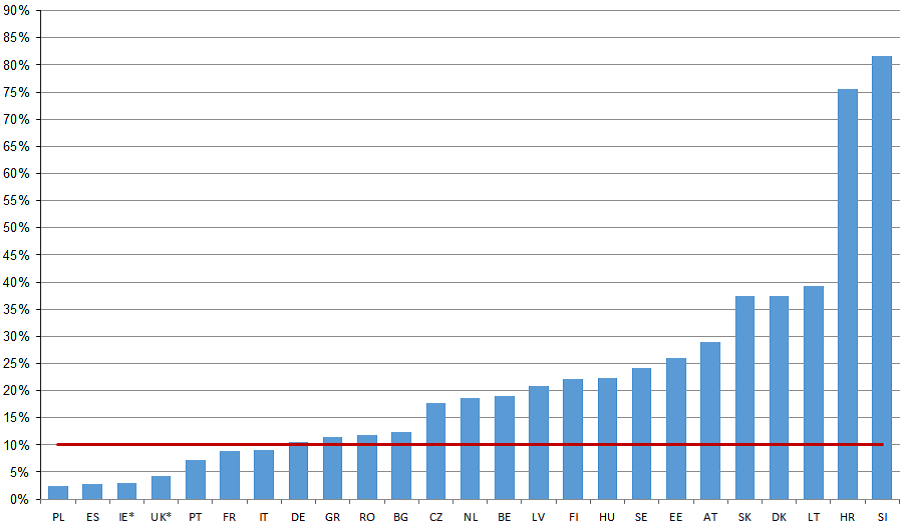
The EU’s goal of a single electricity market has the potential to help national Governments with all three horns of the energy trilemma (how to maintain security and decarbonise whilst keeping energy prices at a reasonable level).  But it cannot be realised without adequate interconnection capacity.  As long ago as 2002, the European Council set EU Member States a target of having electricity interconnections equivalent to at least 10% of their installed production capacity by 2005.  Twelve years on, the UK is only half way to meeting this target.  In May 2014, as part of its work on European energy security, the European Commission proposed an interconnection target of 15% for 2030.  This was adopted by the European Council in its 23 October 2014 conclusions on the EU’s 2030 Climate and Energy Policy Framework.

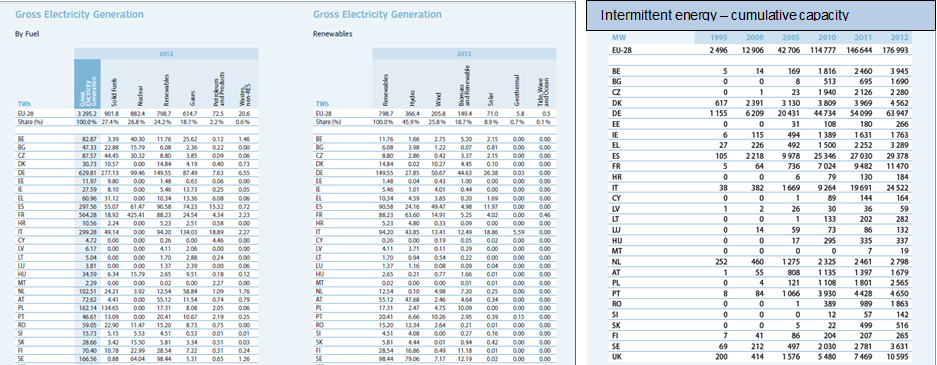
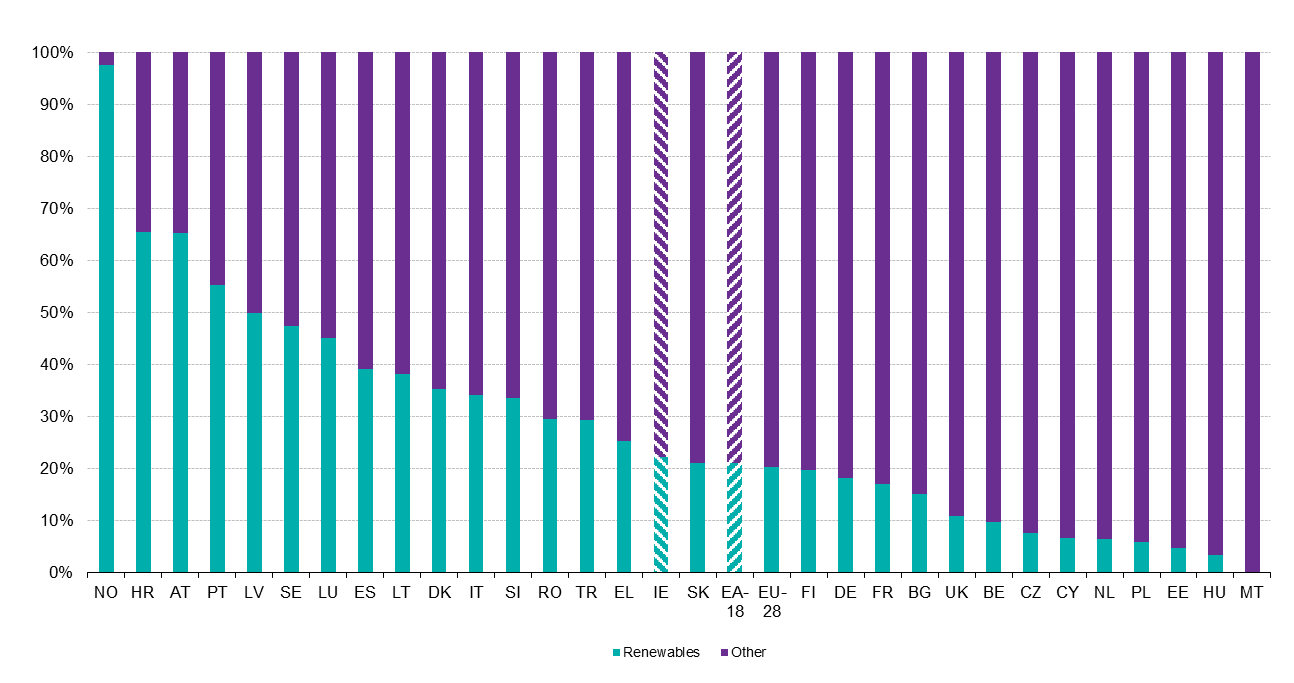
Meanwhile, as Member States connect increasing amounts of intermittent renewable generating capacity to their networks, leaving them in some cases with total generating capacity that is much greater than the amount of power they can reliably generate at any given moment, the goal of achieving 10% or 15% of total installed generating capacity becomes more challenging (see the statistics and charts below).  While such targets are undoubtedly useful, the optimum proportion of interconnection capacity is not the same for each Member State and is bound to change over time with the evolution of its generating mix and electricity consumption profile.  However, it is not always easy for the market to respond quickly and produce more interconnection capacity where it is most needed given the amounts of capital and the regulatory processes involved.

Achieving an interconnection target of 10% or 15% of installed generating capacity in the UK is particularly challenging.  Even before it began to add significant amounts of renewable generation, the UK had one of the larger generation capacities in the EU, and it is very much more expensive per MW to create connections between the electricity networks of Great Britain and other EU Member States than it is to connect networks between Member States which share a land border.  The costs per km of a subsea cable connection are several times greater than those of an overhead transmission line, and the distances involved in GB interconnectors tend to be larger than those which link the transmission systems of different countries in Continental Europe.

However, if the costs of interconnection are significant, so too are the potential benefits for UK consumers.  In a paper entitled Getting more connected published earlier this year, National Grid estimated that: “each 1GW of new interconnector capacity could reduce Britain’s wholesale power prices up to 1-2%…4-5GW of new links built to mainland Europe could unlock up to £1 billion of benefits to energy consumers per year“.  As the European Commission’s most recent report on energy prices and costs in Europe notes, in some of the countries to which the GB system either is not yet connected or with which it could be much more interconnected, average baseload wholesale electricity prices are up to 40% lower than those in the UK.

So is the potential for new UK interconnection capacity going to be exploited anytime soon?  There are encouraging signs both from a regulatory point of view and in terms of actual projects.

The regulatory treatment of projects is crucial to the development of more interconnection.  In this respect, there have been a number of helpful recent developments for potential UK interconnectors.

  • In August 2014 Ofgem confirmed its intention to implement, with only minor modifications, its previously consulted-on proposals for the regime that will apply to the regulation of near term GB interconnector projects (i.e. those expecting to be commissioned by the end of 2020 and likely to be taking significant investment decisions in 2015).  Ofgem recognises that if the development of new UK interconnection capacity is left to proceed without any form of regulated “consumer underwriting”, it is likely that insufficient new capacity will be built.  It therefore proposes a 25 year regulatory regime of a “cap and floor” on revenues, based on its assessment of the need case and efficient level of costs for projects.  The new regime, building on Ofgem’s approach to the Project Nemo interconnector, aims to combine advantages of both the traditional regulated revenue model and more purely market-based approaches.  Ofgem’s 27 October 2014 consultation on the Caithness Moray transmission project shows how far a regulator’s assessment of efficient costs for a project involving subsea cables can vary from a developer’s estimates.
  • Also in August 2014 the UK Government published a paper entitled Contract for Difference for non-UK Renewable Electricity Projects.  This raises the prospect of Contracts for Difference (CfDs) under the Energy Act 2013 being competed for by and awarded to renewable electricity generating projects outside the UK by 2018.  This is a significant step, given the continuing importance of subsidies for the renewables sector (and coming as it did shortly after the approval by the Court of Justice of EU Member States’ historic tendency not to extend their national renewables support schemes to generators in other Member States – notwithstanding the potential for such restrictions to impede free movement in the single market for electricity).
  • In September 2014, the Government included in a consultation on supplementary design proposals for the Capacity Market established by the Energy Act 2013 an outline of how interconnector owners could participate in future Capacity Market auctions.  This had been promised in the context of obtaining state aid clearance, so as to ensure that the Capacity Market, like similar measures being put in place by other Member States, does not militate against the integration of national markets – clearly a matter of concern to the European Commission.
  • Interconnection is most effective when the interconnector capacity is allocated most efficiently and facilitates the flow of electricity from areas of lower to areas of higher prices (see study on this).  These outcomes should be brought closer by the progress there has been in integrating EU national electricity markets through the Target Model.  In February 2014, the markets in GB and 14 other EU Member States became part of the day-ahead price coupling regime for North-West Europe (and in May 2014 they were joined by Spain and Portugal).  In April 2014, a number of Central European Transmission System Operators, National Regulatory Authorities and Power Exchanges signed an MoU to develop flow-based market coupling, which in time will enable better calculation of the network capacities that are allocated through the price coupling process.
  • Finally, the 2013 EU Regulation on cross-border infrastructure (“projects of common interest” or “PCIs”, which are to be fast-tracked through national consenting processes) should make it easier to get interconnection projects funded and built.

In terms of actual projects, Ofgem’s October 2014 preliminary decision on eligibility of projects to benefit from the cap and floor regime identifies five projects that aim to commission by 2020 and, having come forward in the first cap and floor application window, have been judged sufficiently mature to proceed to the three to six month initial project assessment stage.

The five projects are: FAB Link between GB and France; Greenlink, between GB and the Republic of Ireland; IFA2, between GB and France; NSN, between GB and Norway (recently granted a licence by the Norwegian Government); and Viking Link, between GB and Denmark.

According to Ofgem, these projects, together with Project Nemo and the Channel Tunnel-based ElecLink, could add up to 7.5GW of interconnection – more than doubling existing GB cross-border apacity.  They have a number of points in common.   A number of these projects feature in the ENTSO-E Ten Year Network Development Plan and the European Commission’s list of PCIs.  Most of them involve the Transmission System Operators of one or both of the countries they would run between or companies affiliated to them.  Establishing links between GB consumers and renewable generation outside GB is an important part of the rationale for many of them (the FAB Link project even involves plans for up to 300MW of electricity generated from the tides around Alderney). Recent publicity for the TuNur project to export large amounts of solar-generated electricity from North Africa to Europe, including the UK, shows the scale of the possibilities in this area.

It now remains to be seen whether the further development of the Government’s proposals on non-UK renewable and interconnected capacity – and perhaps more significantly the outcomes of the first CfD and Capacity Market auctions (which will not be open to interconnected / non-UK capacity) – will enhance or detract from the business case for these projects.


Illustrative statistics and charts (drawn from EU Energy in Figures: Statistical Pocketbook for 2014 and other European Commission and ENTSO-E publications)

1. Ratio of available cross-border electricity interconnector capacities compared to domestic installed power generation capacities

Source: Ten Year Electricity Network Development Plan, 2012

2. Electricity generation across EU Member States

Table 4_2

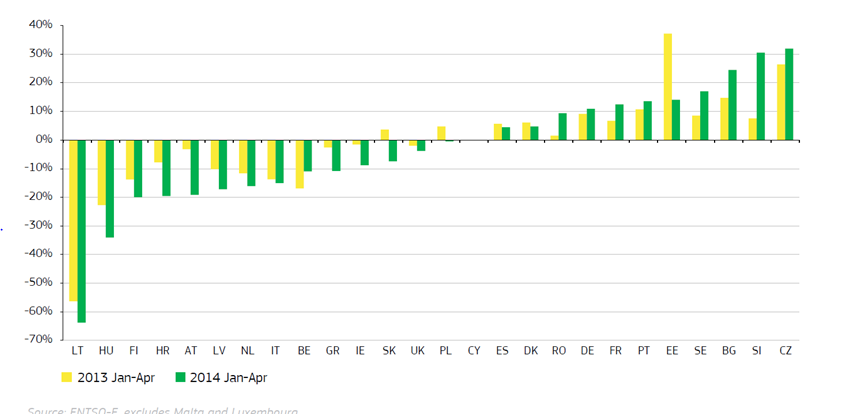
3. EU Member States’ power generation supluses and deficits compared to gross inland consumption in Q1 2013 and 2014

figure 2

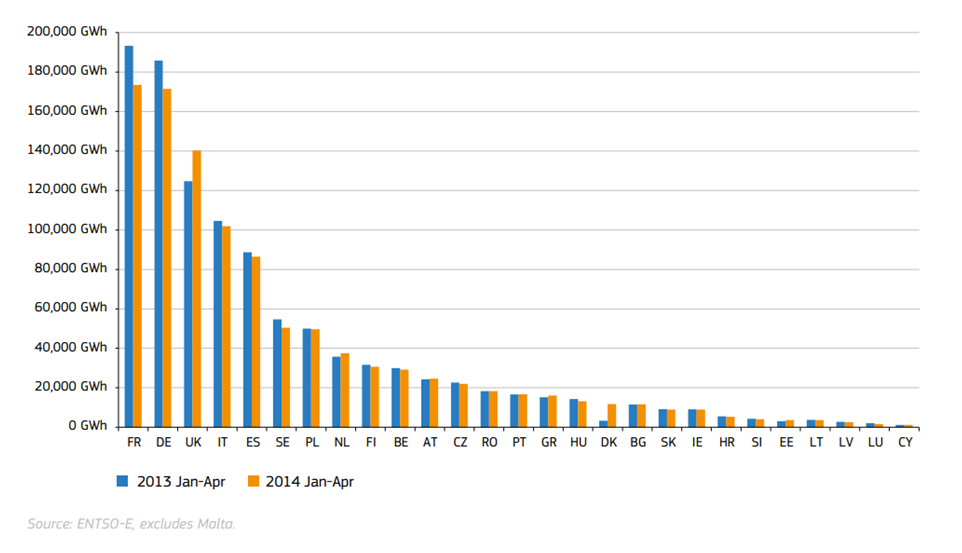
4. Electricity consumption across EU Member States in Q1 2013 and 2014

consumption

5. EU Member States’ renewable and non-renewable generation

Table 6

Subscribe and stay updated

Receive our latest blog posts by email.


Source link

Large scale solar and the Renewables Obligation: 9 more months of grace


DECC has confirmed that there will be a further year-long grace period for large scale solar PV projects which fail to be accredited under the Renewables Obligation (RO) by 31 March 2015.  In addition to the previously announced grace period for projects which are considered to have made a “significant financial commitment” before 13 May 2014, there will be a further opportunity for those projects which only fail to be accredited by 31 March 2015 for lack of a grid connection.

DECC’s announcement came in a response to a consultation that ran from 2 to 24 October 2014 and followed on the 13 May 2014 consultation on early closure of the RO to large scale solar PV (see our earlier post).   The key difference from what was proposed in the 2 October consultation document in relation to the proposed grid connection grace period is that it will now run for a full year, like the grace period for “significant financial commitment” projects, rather than just three months – giving those projects that meet the relevant criteria until 31 March 2016 to achieve accreditation.

Alongside the response to consultation, DECC has published a draft of the statutory instrument that it proposes to lay before Parliament in the New Year to amend the existing RO Closure Order.  This makes it possible to see exactly how DECC envisages eligibility for both grace periods working. 

Subscribe and stay updated

Receive our latest blog posts by email.
Adam Brown

About Adam Brown

Adam is a senior associate in the Energy practice. He has extensive experience in energy, planning, environmental and general public law, much of it gained over a decade spent working for the UK Government in a variety of legal and policy-making roles.


Full bio


Source link

Christmas to come late(r) for those seeking UK renewables CfDs


Two more milestones in the implementation of UK Electricity Market Reform (EMR) have been passed in the last 24 hours (15/16 December 2014): the first EMR Capacity Market auction began, and it became clear that the first auction of EMR Contracts for Difference (CfDs) has been postponed until February 2015.

The Capacity Market aims to secure the availability of 48.6GW of reliably despatchable generating plant from the autumn of 2018.  This is being procured by means of a series of bidding rounds in a “descending clock” auction which must be completed by 19 December 2014.  The auction pits existing coal, nuclear, CCGT and peaking plant against each other and against new build gas and diesel generators, but only new build plant and existing plant spending £125/kW or more on refurbishment can act as “price makers” in the bidding process (see further National Grid’s Auction User Guide).

According to the previously advertised timetable, the first CfD auction should already have taken place in early December, with results being notified to applicants between Christmas and the New Year.  Instead, the revised version of the Low Carbon Contracts Company’s GB Implementation Plan for CfDs, published on 15 December 2014, states that those seeking CfDs will be invited to submit their bids on 17 February 2015 (if, at that point, demand for CfDs exceeds supply under the allocation round budget).

The delay has been driven by appeals against decisions on the eligibility of applications.  The Implementation Plan notes that a longer delay is possible if “Tier 2” appeals are not completed by 6 February 2015.  It is interesting that DECC has chosen to delay the CfD auction rather than make use of the mechanism (provided for in Part 8 of the Allocation Regulations and Rule 21 of the Allocation Framework) that allows an auction to go ahead with disputed applications still “pending”.

While we await the eventual outcome of these two first-of-a-kind auctions, we can start to compare and contrast the CfD and Capacity Market processes.

One striking difference is in terms of transparency.  The Capacity Market prequalification process results in publication and regular updating on the EMR Portal of a full list of applicants (both successful and unsuccessful) and their plants.  By contrast, there is no published list of applications for CfDs or the decisions that have been made as to their eligibility to be allocated a CfD.  In some ways this mirrors the bidding processes themselves: the successive rounds of the Capacity Market auction are rather more interactive and offer bidders some (albeit limited) visibility of each other’s behaviour; in the CfD auction, applicants must effectively put everything into their initial sealed bid.

A second major difference is in the scrutiny to which applicants’ claims to have fulfilled the criteria that make them eligible to bid are subjected.  For example, under the CfD legislation, applicants’ claims to have the necessary planning permission for their generating stations have to be substantiated by submitting copies of the relevant documents, which will then be checked by National Grid (albeit possibly in a fairly mechanical way).  By contrast, compliance with the parallel obligations to have any requisite planning permission before bidding in the Capacity Market auction is simply self-certified.

No doubt there will be further debate about these and other design features during 2015.  Already, Ofgem is consulting on possible changes to the Capacity Market Rules.  It has identified as priority areas for consideration the possible streamlining of the prequalification process, price maker memoranda, and rules about demand side response.  Meanwhile, alleged discrimination against the demand side has prompted Tempus Energy to challenge the European Commission’s decision that the Capacity Market is compatible with EU state aid rules.

Subscribe and stay updated

Receive our latest blog posts by email.


Source link

UK Parliament votes against moratorium on fracking – but there may be a catch


Perhaps unsurprisingly, yesterday afternoon’s House of Commons debate on the Infrastructure Bill did not result in the introduction of the explicit moratorium on further attempts to develop a UK shale gas industry that had been proposed by a number of MPs opposed to fracking.  However, two significant changes have been made to the Bill’s provisions on shale gas exploitation in the UK.

Pre-match build-up

The debate was at the Bill’s “Report” stage in the Commons: this is the first opportunity that the full House, rather than the Committee which has done most of the line-by-line scrutiny work, has to vote on changes to a Bill.  (It is also the last such opportunity, unless the House of Lords subsequently disagrees with changes made by the Commons.)  A large number of amendments had been tabled, mostly seeking either to restrict fracking in some way or requiring further investigation of and reporting on its impacts on climate change, for example as a result of fugitive emissions of methane from fracking sites.  Whilst both the Government and the official Labour Party lines are that fracking should be allowed subject to proper safeguards, there are differences of view as to how far existing legislation and institutions provide sufficient protection for the environment.  And there are a number of MPs of all parties who disapprove of fracking in any circumstances.

This strain of opposition to fracking in principle was demonstrated when the House of Commons Environmental Audit Committee (EAC), which has been considering fracking, chose to publish its report on the morning of the debate.  The report puts the case against developing a UK shale industry on the grounds that it would inevitably be inconsistent with the UK’s climate change emissions reductions targets to do so.  The EAC argue that the Government is wrong if it argues that shale gas is good because it will displace coal as a fuel for electricity generation and so reduce emissions.  They believe that a flourishing shale industry would be bound to breach the UK’s carbon budgets, set under the Climate Change Act 2008.  Essentially, they see the UK’s apparent shale reserves as a prime example of “unburnable carbon“.  The Committee also express concern about the uncertainty surrounding some other impacts of fracking, e.g. on water, and cite “a lack of public acceptance” for the technology.  They conclude that “a moratorium on the extraction of unconventional gas through fracking” is required to “allow the uncertainty surrounding environmental risks to be resolved”.

By a further happy coincidence, The Guardian simultaneously published a leaked letter from George Osborne to Cabinet colleagues on fracking.  The letter demonstrates in some detail the extent of the efforts being made by central Government to ensure that it does everything that it can properly do to facilitate consent for fracking through processes that it does not entirely control (because planning and other consents are administered by local government or the Environment Agency).

Finally, in the days between the end of the Committee sessions and the debate, there was a slow drip-feed of anti-fracking amendments being published and trailed in the media – and Vivienne Westwood and others turned up to protest outside Parliament on the day.

The main event

In the end, as often happens, the debate itself was something of an anti-climax.  The Government used its control of the House to confine the debate to less than two hours, which was followed by votes on a more or less representative sample of the amendments.  Some of the debate generated (in participants’ own words) more heat than light.  Attention was paid to the fate of a report by Defra on the impact of shale gas on the rural economy, which has so far been published only in redacted form.  Some suspect that the Government is suppressing unwelcome analysis.  Ministers have done little to dispel this by saying that the report should not have been produced, is not analytically robust and would not help the debate.  A fair amount of time was also devoted to the question of whether or not MPs had received a copy of a letter from a Minister following up on an earlier debate.

But there was also a considerable amount of substantive discussion.  For example, the arguments from the EAC report were rehearsed, and rebutted by a number of speakers, who pointed out the continuing importance of gas to our heating, as well as electricity generation needs, and that the life-cycle carbon emissions of LNG (on which we are likely to depend in the long-term if we do not find new sources of indigenous gas) have been found to be higher than those associated with shale gas.

The question of further devolution of powers to Scotland was also raised: if legislative competence for the licensing of onshore oil and gas exploration and extraction is to be devolved to the Scottish Parliament, as the Government has proposed following the recommendations of the Smith Commission, should the Government not wait before awarding further licences in Scotland?  Unsurprisingly, Ministers were not persuaded by this view.  After all, they are not proposing to devolve the actual granting of licences to the Scottish Government.

If you don’t want to know the result, look away now…

In the end, only two substantive amendments have been introduced into the Bill in relation to shale gas as a result of yesterday’s debate.

  • A Government amendment requiring the Secretary of State to request the Committee on Climate Change (CCC) to provide advice on the impact which “combustion of, and fugitive emissions from, petroleum got through onshore activity” is likely to have on the Secretary of State’s ability to meet the Climate Change Act duties to reduce greenhouse gas emissions by 80% by 2050 and to meet each of the carbon budgets set under the Act in the meantime.  Future Governments will be obliged to report on the conclusions they have reached after considering the advice of the CCC – a sort of “comply or explain” mechanism.
  • As was expected, the Government allowed a Labour front bench amendment to pass.  The intention of the new clause it introduced is said to be: “to ensure that shale gas exploration and extraction can only proceed with appropriate regulation and comprehensive monitoring and to ensure that any activity is consistent with climate change obligations and local environmental considerations”.  Politically, accepting the new clause was clearly the expedient course.  From a legal point of view, it may cause more problems than it solves.

The new clause lists 13 things that must happen before “any hydraulic fracturing activity” can take place in Great Britain.  The list is a mixture.  Some of the pre-conditions it sets reflect existing legislation – for example requirements to carry out an environmental impact assessment; for planning authorities to consider the cumulative impact of fracking proposals in a given area; and to seek Environment Agency approval of fracking fluids.  Others include monitoring of the site for 12 months before fracking begins; “site-by-site measurement, monitoring and public disclosure of existing and future fugitive emissions”; independent inspection of well integrity; avoidance of groundwater source protection zones; a statutory requirement for the kind of community benefit schemes the industry has already promised; bans on fracking in “protected areas” (undefined), or at depths of less than 1,000 metres; and notification of residents in the area “on an individual basis”.

The House of Lords will now have an opportunity to consider the amendments made by the Commons.  Unless some changes are made to clarify the less tidy parts of the new clause’s drafting, uncertainties over what it requires may lead to a moratorium on GB fracking by the back door if and when the new clause comes into effect.

Subscribe and stay updated

Receive our latest blog posts by email.


Source link

New Environment Agency enforcement approach to CRC and EU ETS


The Environment Agency has published a new annex to its Enforcement and Sanctions Guidance to cover breaches under the CRC Energy Efficiency Scheme (CRC), EU Emissions Trading Scheme (EU ETS) and climate change agreements (CCAs).

In considering whether to exercise its discretion to enforce a breach of one of these regimes, the EA will take into account public interest factors, including financial implications, whether there has been any previous non-compliance and the attitude of the offender.

The Guidance confirms that the EA will not normally impose financial penalties on individuals or corporate entities that are subject to an insolvency procedure and action taken by an organisation to correct its non-compliance will be taken into account.

Failure to pay a civil penalty is recoverable as a civil debt, and in the case of a failure to pay a CCA penalty, the CCA may also be terminated.

There are no requirements to have public registers under the EU ETS, CRC and CCA regimes. However, the EA has decided that when it imposes a penalty under one of these three regimes, it will normally publish information (for a period of 12 months) about the:

  • Person on whom the penalty was imposed.
  • Legal requirements that were not complied with.
  • Amount of the penalty.

The guidance can be accessed here

https://www.gov.uk/government/uploads/system/uploads/attachment_data/file/389349/LIT_5551.pdf

Subscribe and stay updated

Receive our latest blog posts by email.

Helen Bowdren

About Helen Bowdren

Helen is a partner in the Environment and Safety team. She advises clients on all aspects of environmental and safety risk, in various sectors including waste, chemicals, oil and gas (onshore and offshore), mining, infrastructure and transport. Helen represents clients in contentious matters, including Environment Agency and HSE investigations and prosecutions, judicial reviews, and statutory appeals. Helen has an international practice, having worked in Dubai and South Africa, and regularly advises on environmental risk in cross-border transactions. She is a member of the UK Environmental Law Association (UKELA) and the City of London Law Society Environmental Sub Committee.


Full bio


Source link

UK fracking: the pursuit of safety


Further changes to the Infrastructure Bill have now addressed the potential problems for the UK unconventionals industry introduced by a Labour amendment two weeks ago, but the approach of Scottish and possibly Welsh Ministers is less encouraging for would-be shale developers.

Infrastructure Bill

At the last substantive debate on the Infrastructure Bill in the Commons, an amendment was inserted providing that “any hydraulic fracturing can not take place” unless 13 conditions are fulfilled.  As we pointed out in an earlier post, the drafting of this “safeguarding” provision (which can be seen here at amendment no.21) left considerable scope for doubt as to when some of these conditions would be satisfied.  Such uncertainty inevitably assists those who want to delay or obstruct fracking operations.

The House of Lords has now replaced the Commons’ amendment with some much better drafted provisions (see amendment 21B here) that provide a clear and practicable route to satisfying each of the safeguarding requirements proposed by the Commons.  Although the Labour spokesman, Lord Tunnicliffe, raised a number of points of detail which he suggested had been lost in translation from the Commons’ amendment to the Government’s version (see column 1079 of the Hansard report), it seems possible that there will be no further changes when the Bill returns to the Commons for the next stage of the so-called ping-pong process.

In the meantime, here are ten points to note about the new clauses:

1      The new clauses insert two new sections (4A and 4B) into the Petroleum Act 1998, under which oil and gas exploration, production and development licences are granted.

2      The standard conditions of licences for onshore development (the model clauses) provide that the licensee may not commence drilling of any well or borehole without the Secretary of State’s consent.  In future, any such “well consent” must contain a condition prohibiting fracking at a depth of less than 1000 metres and a condition requiring the licensee to have the Secretary of State’s consent for any fracking at a depth of 1000 metres or more.

3      Under new section 4A, the Secretary of State may only issue a “hydraulic fracturing consent” if he is satisfied that 12 conditions are met.  These conditions reflect the Commons’ 13 pre-conditions for permitting fracking, but they are expressed more clearly and 11 of them are accompanied by a description of the documents whose existence will be sufficient for the Secretary of State to be satisfied that the relevant condition is met – although the legislation explicitly states that he may also consider them to be satisfied without reference to such documents.

4      The 12th condition is “that a scheme is in place to provide financial or other benefit for the local area” – slightly wider than the equivalent Commons drafting.  The Commons’ 13th condition was about not fracking at less than 1000 metres: this is subsumed into the well consent itself, rather than being a condition for issuing the hydraulic fracturing consent.

5      The new conditions avoid imposing the Commons’ requirement to notify “residents in the area on an individual basis”, substituting a requirement for the local planning authority to confirm that the applicant has self-certified its compliance with publicity requirements under the planning regime.  Baroness Verma, speaking for the Government, pointed out that it would be difficult for the Secretary of State to be satisfied that all residents had been individually notified.

6      The picture is not yet quite complete.  Draft regulations are to be laid before Parliament, by 31 July 2015, to clarify the burning issue of exactly which “protected groundwater source areas” and “other protected areas” will be off-limits to fracking.  Unless the current Government (or its successor) means to beat that deadline by a wide margin, it may be Autumn before these important details have been clarified and we know whether Greenpeace’s analysis of the extent of the protected areas is unduly optimistic from an anti-fracking point of view.

7      Government has made a lot of statements and published guidance about the inter-relationship of the various different consenting regimes that apply to fracking, but new section 4A for the first time “joins the dots” between the different regimes in legislation.  So, for example, the condition on environmental impact assessment is linked to a notice from the local authority; the requirements about methane monitoring are linked to conditions in the environmental permit; and the requirement on well integrity is linked to an HSE certificate.

8      The decision to permit fracking in each case rests with the Secretary of State, but if everything is working as it should, he will issue the consent on the basis of work that is already required to be done under the existing planning and other regulatory regimes. Presumably for that reason, applications for hydraulic fracturing consents are not required to be published or consulted on.

9      A hydraulic fracturing consent may be issued subject to conditions.  Failure to comply with the conditions of a hydraulic fracturing consent, or with the prohibition on fracking at less than 1000m, could lead to revocation of the underlying licence.

10    Once the new sections are in force, the requirement to apply for and obtain a hydraulic fracturing consent before beginning to frack will apply whenever a licensee seeks a new well consent, regardless of when the licence under which the consent is sought was granted.

The provisions about hydraulic fracturing consents link to another change made to the text of the Bill as it left the Commons.  This relates to reporting by the Committee on Climate Change on the impact that greenhouse gas emissions from the use and extraction of gas from onshore sources may have on the UK’s ability to meet its Climate Change Act emissions reduction targets.  When such reports are produced (on 1 April 2016 and every 5 years thereafter), the Secretary of State will be obliged either to legislate to terminate the right of use of deep level land for petroleum and deep geothermal exploitation or to produce a report explaining why he has not done so.  But if the right of use is terminated, it will only be removed in respect of projects that have not already made use of that right.

Scotland and Wales

While for the Coalition Government in Westminster, a safety-first approach to fracking may be achievable simply by means of some deft legislative drafting, the politics in Edinburgh and Cardiff are different.  Both Scottish and Welsh Ministers have recently taken a less positive stance on fracking.

The negative noises from Ministers in the devolved governments come in the context of debates about further devolution of energy-related powers and against the background of the awkward split between the oil and gas licensing regime (currently administered by the Secretary of State for all of Great Britain, but a potential candidate for further devolution, particularly in Scotland)  and the planning regime (where Welsh and Scottish Ministers are, or can be, the ultimate decision-makers).  Any unconventional development will need both a Petroleum Act licence and planning permission.

On 28 January 2015, Fergus Ewing, the Scottish Energy Minister, announced that the Scottish Government’s “cautious, evidence-based approach” to fracking and its desire to hear “the voices of the communities…likely to be most affected…in a formal and structured way” meant that “it would be inappropriate to allow any planning consents in the meantime” and he announced ” a moratorium on the granting of planning consents to unconventional oil and gas developments…until such time as the work I have referred to has been completed”.  Scottish Ministers have also directed the Scottish Environment Protection Agency not to issue any “controlled activity regulation licences” during the moratorium (see page 17 of the report here for the full debate).

On 4 February 2015, there was a vote in the National Assembly for Wales in favour of both the devolution of energy consents and a fracking moratorium.  Discussion of fracking, ranging as far afield as New York and New South Wales, dominated the debate: the party lines on the subject in Cardiff are not the same as those in Westminster.

It seems that Welsh and Scottish Governments have made the political calculation that it is best to let England lead the way in building the UK evidence base on fracking.

Subscribe and stay updated

Receive our latest blog posts by email.



Source link

Failure of competition in retail energy markets: “disengaged customers” (still) the root cause?


Emerging analysis from the investigation into GB gas and electricity supply by the UK’s Competition and Markets Authority (CMA) suggests that consumers are paying more than they need to because of their failure to “engage in” the market and because of shortcomings in the regulation of the sector.

Some seven months into an investigation instigated by Ofgem and six months after producing its initial issues statement setting out the areas on which it would be focusing, the CMA has published an updated version of the issues statement and a summary of smaller suppliers’ views on barriers to entry and expansion in the market (one of a series of “working papers” that provide more detail of the CMA’s analysis and the evidence on which it is based).

The problem

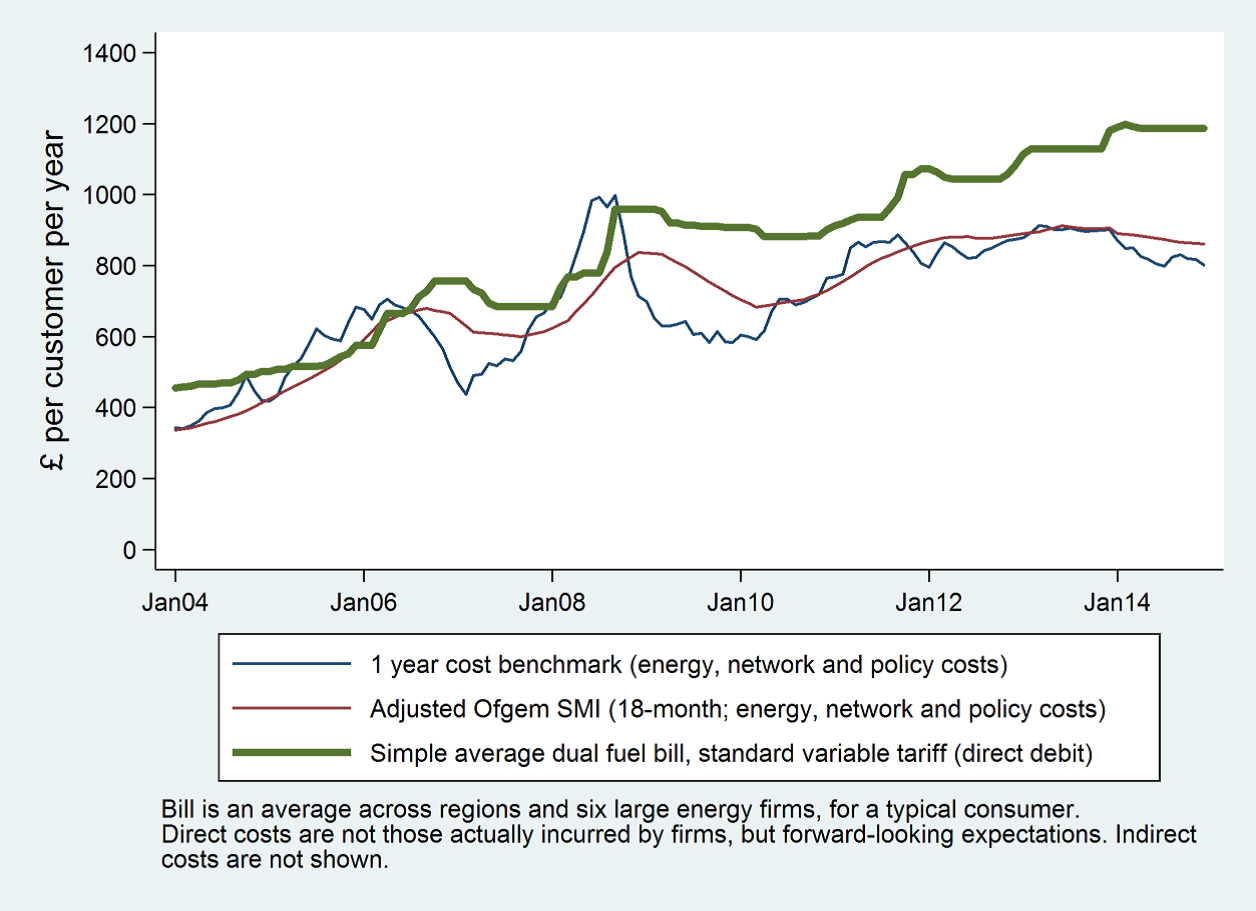
The CMA is fairly clear that both domestic and “microbusiness” consumers of gas and electricity are paying more than they need to – noting, for example, that “95% of the dual fuel customers” of the Big 6 could have saved an average of between £158 and £234 by switching tariff and/or supplier.  They also note, as others have done before them, that customers on “Standard Variable Tariffs” (SVT) tend to see their bills rising faster and falling slower than increases and decreases in the underlying costs of supply would suggest (the so-called “rocket and feather” effect – see graph below).

CMA fig 1

The search for causes

However, the CMA has so far rejected a number of the “usual suspects” when it comes to explaining why consumers appear to be paying more than they need to, without there being any obvious reason for their loyalty to their existing suppliers.  The initial issues statement was based on four hypothetical “theories of harm” that could account for failures of competition:

  • “market power in electricity generation leads to higher prices;
  • opaque prices and/or low levels of liquidity in wholesale electricity markets create barriers to entry in retail and generation, perverse incentives for generators and/or other inefficiencies in market functioning;
  • vertically integrated electricity companies harm the competitive position of non-integrated firms to the detriment of the customer, either by increasing the costs of non-integrated energy suppliers or reducing the sales of non-integrated generating companies;
  • energy suppliers face weak incentives to compete on price and non-price factors in retail markets, due in particular to inactive customers, supplier behaviour and/or regulatory interventions.”.

Taking each of these in turn, the CMA’s current (but explicitly provisional) analysis is as follows:

  • The Big 6 are not making excessive profits from generation and do not have the ability or incentive – individually or collectively – to increase profits by withdrawing capacity.
  • There are not significant problems as regards the transparency of the wholesale markets.  Those smaller suppliers who complain about a lack of liquidity, at least for certain products, have yet to persuade the CMA that this is a major concern, although they note that Ofgem’s Secure and Promote licence condition has not addressed all the problems in this area.
  • The CMA also does not think that the Big 6’s vertical integration enables them to cause independent generators to restrict their output or allows them to take action in the wholesale markets that disadvantages independent retailers.  One independent supplier saw vertical integration as a competitive disadvantage (potentially tying a supplier to generating plant whose efficiency reduces over time, especially if measured against the best in the market).
  • The only one of the original “theories of harm” which seems to offer an explanation of the failure of competition is the fourth one above, notably “inactive consumers”.  Although the domestic market share of independent suppliers grew from 1% to 7% (electricity) or 8% (gas) between July 2011 and July 2014, the fact remains that almost half of domestic consumers have not switched supplier for at least 10 years.  Many do not even believe switching is possible.  As one of the independent suppliers points out, having a large base of relatively price-insensitive customers on SVT may enable an incumbent to compete more aggressively against new entrants for the business of those who do take active steps to get a good deal.  Another suggests that it is almost as if there are two markets: one composed of potential switchers and another of those who are terminally loyal to their incumbent supplier.

Regulation may be stifling competition

One of the things that stands out in the CMA’s analysis is the emphasis on the potentially adverse effects that various aspects of sectoral regulation may be having on competition.  This is most conspicuous in the addition of two new hypothetical “theories or harm”:

  • “the market rules and regulatory framework distort competition and lead to inefficiencies in wholesale electricity markets;
  • the broader regulatory framework, including the current system of code governance, acts as a barrier to pro-competitive innovation and change.”.

But it is also seen elsewhere.  Examples of potentially problematic regulation identified include:

  • Elements in Ofgem’s recent reform of cashout prices (the Electricity Balancing Significant Code Review) “may lead to an overcompensation of generators”.
  • It may be inefficient not to have a system of locational prices for constraints and losses on the transmission network.  It may be that consumers in Scotland and the North of England should be paying more, and those in the South of England paying less, for their electricity.
  • The Capacity Market element of Electricity Market Reform (EMR) “appears broadly competitive”, but the CMA plan to look at if further.  They note that the Contracts for Difference regime may not secure the lowest prices for renewable generation subsidies by having separate “pots” for different technologies, rather than requiring them to compete all-against-all, or by allowing the award of contracts on a non-competitive basis, before observing, equally obviously, that “there are potentially competing objectives that need to be taken into account in the design of the CfD allocation mechanism”.  One independent supplier also characterises the system by which CfD costs are recovered from suppliers as “madness”.
  • But any problems caused by EMR are for the future.  Looking back, the CMA have clearly listened both to those who have criticised Ofgem’s 2009 decision to prohibit regional price discrimination (while providing exemptions for promotional tariffs), which may have led to a consumer-confusing increase in the number of tariffs, and to those who question Ofgem’s 2013 decision to force suppliers to “simplify” their tariff portfolios drastically, which resulted in the loss of tariff discount options that may or may not have been valued by consumers.  However, the CMA have yet to form a final view on the merits of either decision.
  • It has often been observed that the 250,000 account threshold, above which suppliers become subject to the Energy Company Obligation (ECO), may act as a barrier to growth for independent suppliers.  More interestingly, the CMA note that the costs of the social and environmental policies delivered by suppliers “fall disproportionately on electricity rather than gas”, meaning that “domestic consumption of electricity attracts a much higher implicit carbon price than domestic consumption of gas” – which may have implications for the take-up of electrical heating systems (normally thought of as part of decarbonising energy usage).  This is another area where the CMA will be investigating further.
  • Finally, the CMA identify aspects of the Balancing and Settlement Code (BSC) and other industry agreements that could be standing in the way of more effective competition.  They ask, for example, why, once smart meters have been rolled out, there are no plans to move away from the system whereby domestic customers’ consumption is “profiled”, rather than being based on half-hourly meter readings.  Failure to take advantage of the new technology in this way could “distort incentives to innovate”.  The CMA will also be considering further whether there are just too many codes in the electricity industry (constituting a barrier to entry) and whether the mechanisms for changing industry rules may be stacked too heavily in favour of incumbents and the status quo.  On the first point, Elexon itself, administrator of the BSC, apparently thinks that “rationalising” the codes will remove potential barriers to competition.

Next steps

Interested parties have until 18 March 2015 to comment on the updated issues statement.  The next major step will be the publication of “provisional findings”, currently scheduled for May 2015.  Overall, the investigation is not due to conclude before November / December 2015, and it could be extended into 2016.  It is of course far too early to speculate on possible remedies, but for now the more obviously Draconian options in the CMA’s armoury, such as the breaking up of vertically integrated groups, appear unlikely outcomes.  Something eye-catching to cause “inactive” consumers to “engage”, and a lot of “boring but important” changes in the regulatory undergrowth around industry codes and agreements seem reasonable bets for now, but there is a long way to go yet.


Subscribe and stay updated

Receive our latest blog posts by email.



Source link