
Blog

Published at last – a winning strategy for the UK Continental Shelf?


Finally, we have the missing piece of the jigsaw.  The current reforms to the UK’s regulatory regime for the offshore oil and gas industry were recommended by the Wood Review in 2014.  They began to be implemented with the creation of the Oil and Gas Authority (OGA) and the amendments made to the Petroleum Act 1998 (the 1998 Act) by the Infrastructure Act 2015; they are continuing with the current Energy Bill (now half way in its passage through Parliament).  But it is perhaps only with the publication of a draft of the strategy for maximising the economic recovery of UK petroleum on 18 November 2015 that we start to get a full sense of how the new regime may work in practice.

What is the draft strategy, and why does it matter?

The legislation describes the strategy as “enabling” the “principal objective” of “maximising the economic recovery of UK petroleum” (MER UK) to be met.*  The principal objective and the strategy occupy a central position in the revised regulatory scheme.

To begin with the regulators.  In one way or another, the OGA is taking over most of the Secretary of State’s statutory functions under the Petroleum Act 1998 and Chapter 3 of Part 2 of the Energy Act 2011.  The OGA is also to acquire a raft of new functions under Part 2 of the Energy Bill.  In exercising all these functions (including any of its powers under a petroleum licence), the OGA will be obliged to “act in accordance” with the strategy.  The Secretary of State will be similarly obliged to act in accordance with the strategy when exercising her functions under the Part 4 of the 1998 Act “to the extent that they concern reduction of the costs of abandonment”.

At the same time, the strategy will be binding on holders of, and operators under, petroleum licences, when planning and carrying out their activities as such; persons planning or carrying out the commissioning of upstream petroleum infrastructure (broadly defined); and (subject to the Energy Bill) owners (broadly defined) of offshore installations and upstream petroleum infrastructure, when carrying out their activities as owners of such installations or infrastructure, or decommissioning it.  Such persons and (in so far as they can affect the fulfilment of the principal objective) activities are referred to in the draft strategy as “relevant persons” and “relevant functions” respectively.

The Energy Bill provides that if a business which is a relevant person fails to act in accordance with the strategy, the OGA can impose sanctions including financial penalties of up to £1 million (and potentially up to £5 million if the Secretary of State raises the penalty cap by regulations) and revocation of the business’s status as a holder of, or operator under, a petroleum licence.

Although the strategy will become more important as and when the Energy Bill completes its passage through Parliament and becomes an Act, many of the provisions establishing the importance of the principal objective and the strategy are already embodied in the amendments made to the 1998 Act by the Infrastructure Act 2015.  So it is noteworthy that reform of the offshore oil and gas regulatory regime has gone so far without public consultation on a full draft of the strategy.

What the draft strategy says

The Wood Review pointed out, and subsequent OGA papers have elaborated on, the fact that the inter-dependence of different installations and infrastructure in the UK upstream oil and gas industry is such that if each relevant person only seeks to optimise its own financial position, the performance of the industry as a whole is likely to be sub-optimal.  So the key question for the draft strategy to answer is how (and how far) businesses are to be induced to compromise their interests for the greater good.

To look at how the draft strategy answers this question, it is best to start with two of its key definitions.

  • “economically recoverable petroleum” means “those resources which could be recovered at an expected (pre-tax) market value greater than the expected (pre-tax) resource cost of their extraction, where costs include capital and operating costs but exclude sunk costs and costs (like interest charges) which do not reflect current use of resources.  In bringing costs to a common point for comparative purposes a 10% real discount rate will be used“.
  • “satisfactory expected commercial return” means “a reasonable post-tax return having regard to the risk and nature of the investment“.

These two definitions underpin what are perhaps the draft strategy’s two most important provisions:

  • The Central Obligation applies to relevant persons in the exercise of their relevant functions, and obliges them to “take all steps necessary to secure that the maximum value of economically recoverable petroleum is recovered from the strata beneath UK waters“.  (Emphasis added: as a recital to the draft strategy puts it: “all stakeholders should be obliged to maximise the expected net value of petroleum produced from relevant UK waters, not the volume expected to be produced”.  The focus on value (undefined) rather than quantity contrasts with the similar but different words about “securing the maximum ultimate recovery of petroleum” in the petroleum licence model clauses on unitisation, which represent perhaps the greatest degree of intervention by the licensing authority under the existing regulatory regime.)
  • Paragraph 27 provides that if relevant persons “decide not to ensure the recovery of the maximum value of economically recoverable petroleum from their licences or infrastructure (including because that does not achieve a satisfactory commercial return, in accordance with paragraph 3) they must relinquish or divest themselves of such licences or assets“.

The “paragraph 3” referred to here is one of the draft strategy’s Safeguards: “No obligation imposed by or under this Strategy requires any person to make an investment or fund activity where they will not make a satisfactory expected commercial return on that investment or activity.”.

It is hard to quarrel with any of this in the abstract, but applying these principles in any given case will not necessarily be easy.  For example, how do you assess “expected pre-tax market value” in the context of massive uncertainty over future oil and gas prices?  DECC’s own most recent fossil fuel price projections suggest that the average oil price for the next 10 years could be anything from $46.8 to $140.4 a barrel (depending on whether you take the “low” or “high” scenario).

What does this mean in practice?

The consultation document spells out where all this leads.  If you are the owner or operator of an asset or infrastructure and take the view that you cannot make a satisfactory commercial return from its continued operation, you may be obliged to divest it to somebody who takes a different view of what constitutes a satisfactory return or what is economically recoverable.

Paragraph 27 is one of a number of “supporting obligations” and “required actions and behaviours” listed in the draft strategy in respect of exploration, development, asset stewardship, deployment of new technology and decommissioning.  So, for example, owners and operators of infrastructure must plan, commission and construct it in a way that meets the optimum configuration for MER UK, and must allow access to it on fair and reasonable terms.  If the infrastructure is not able to cope with demand for its use, they must prioritise “access which maximises the value of petroleum recovered”.  Meanwhile, the OGA may produce plans addressed to “a single or small group of relevant persons” setting out its view of how the obligations of the strategy may be met in their particular circumstances”.  According to the consultation document: “A plan might target a particular or small range of circumstances, or might be broader and more strategic in nature, for example setting out how the OGA thinks a region should be developed or decommissioned.”.

The new regime

In the words of the consultation document: “How the OGA uses and acts on the Strategy is…of great importance – it will set the tone for the basin and will be a key factor determining its attractiveness to industry and investors.”.

One could perhaps sum up the spirit of the strategy by mangling a famous line from John F. Kennedy: “Ask not what the strategy can do for you, but what you can do to maximise the economic recovery of UK petroleum.”; or perhaps quoting Karl Marx, without modification: “From each according to his ability, to each according to his needs”.

But enough flippancy.  The consultation document goes out of its way to emphasise that the OGA will not be unduly interventionist: “whilst enforcement measures are a necessary backstop, the OGA is expected to act primarily as a convenor and facilitator, working together with industry to deliver increased value from the UKCS for both industry and the UK as a whole”.  If it is “occasionally…the case that the OGA [finds] that a relevant person’s contractual provisions place that person…in breach of the Strategy”, or if the OGA finds that it needs “to assert its right as a regulator to use its sanctions where a relevant person fails to avoid a breach of its MER responsibilities through continued reliance on contractual provisions which conflict with the Strategy…. it will always be for the relevant person to decide for itself how to deal with that in terms of its contracts.”.

Perhaps a useful point of comparison here is the UK power market.  It has become commonplace to note that the UK’s various schemes for subsidising new low carbon electricity production, and the Capacity Market which subsidises old nuclear and fossil fuelled generating stations, have turned the liberalised GB power generation market into something closer to a “planned economy”.  Where the fulfilment of the principal objective is at stake, the Energy Bill requires that the OGA be allowed to participate in meetings between relevant persons, and recommend ways of resolving disputes between them.  Reading such provisions side by side with the draft strategy, it is clear that in the oil and gas industry too, future commercial decision-making may be much more strongly directed by the state than before.

Then again, perhaps one should compare oil and gas production not so much with the power generation market, which is supposed to be characterized by free competition, but with the monopoly markets of transmission and distribution, where it is accepted that it is only economic for one operator to build and operate infrastructure in any given location – just as petroleum licence holders enjoy exclusive rights in their licensed areas and many oil and gas infrastructure owners are de facto monopoly service providers.  In the power sector, to avoid any abuse of monopoly, the returns which network operators can earn on their investment are regulated.  The strategy does not go (quite) that far.

In the end, the strategy highlights the two risks that the OGA will need to guard against particularly carefully in administering the reformed regulatory regime.  The first is highlighted in a letter of 3 December 2015 from the UK Competition and Markets Authority, using for the first time its new powers to make and publish recommendations to Ministers about proposed new legislation: the OGA and those it regulates could collaborate so closely that beneficial competitive pressures, which are important to reduce costs and support the principal objective, could be dampened, so that, for example, the regulatory process ends up facilitating the anti-competitive exchange of information between competitors.  The second and opposite risk is that a less co-operative attitude amongst industry players prompts the OGA to start using its enforcement and other formal powers to an extent that in turn stimulates the kind of “over-zealous commercial and legal behaviour” on the part of the industry that Wood wanted to make a thing of the past.

So perhaps what matters most is not the strategy itself, but the tactics of those who must follow it – both the OGA and industry players.

* Note: The definition given above of the “principal objective” reflects the current text of section 9A of the 1998 Act.  If clause 8 of the Energy Bill (introduced by an Opposition amendment) survives, it will become instead “maximising the economic return of UK petroleum, while retaining oversight of the decommissioning of oil and gas infrastructure, and securing its re-use for transportation and storage of greenhouse gases” – although how much difference some of those additional words will make now the Government has abandoned its CCS commercialisation programme is debatable.

Subscribe and stay updated

Receive our latest blog posts by email.



Source link

Know your JOA: top 10 tips for anxious partners in upstream oil and gas joint ventures


A year dominated by the story of low oil prices is drawing to a close amid predictions that the pressures on upstream oil and gas companies’ financial positions may well intensify through 2016.  For those who may be concerned about the financial health of their joint venture partners, we offer below a quick guide to taking stock of where you stand under your Joint Operating Agreements (JOAs) to put you in the best position to deal with any emerging problems.

Know what the JOA says about default

Most JOAs contain an unqualified and absolute obligation on a party to pay all cash calls, pre-funding and invoice requests.  But check if a partner is in trouble, it may try to dispute the validity of payment obligations – most JOAs depend on a ‘pay now argue later’ formulation – but it’s worth checking.

If the operator is in trouble

Check that the JOA allows a non-operator to issue a default notice and ask for all joint account statements. The JOA should require the operator to provide periodic information on funding the joint account to evidence that non-operators and the operator are funding their participating shares.

The operator is not responsible for a shortfall

Do not suppose the operator’s functions extend to funding any default – they will almost certainly not.  The non-defaulting parties will be liable for the defaulting party’s share in proportion to their respective shares and non-payment of the additional share will be a default event itself.  The operator may be able to borrow funds instead – this may be a more attractive means of funding any immediate work commitments, so talk to the operator.

Know the short-term remedies

The defaulting party will cease to have voting rights – and a non-defaulting party’s rights at OPCOM will increase proportionately.  Other entitlements will be lost as well: the right to information, the right to transfer an interest or withdraw.  Again, check the JOA.  The prohibition on transfer should be at the non-defaulting party’s discretion – there may be a willing buyer and the advantage of a quick sale.

What happens to the petroleum?

Rights over petroleum entitlements will be lost as well. Check what the operator’s obligations are – usually to sell the defaulting party’s petroleum on the best terms available to offset against the shortfall.  Non-defaulting parties will want transparency on this and no sweetheart deals with the operator’s affiliates.

What happens next?

Here’s where JOAs differ in approach, so it’s important to know the process. Options include compulsory withdrawal, interest sales, mortgage security enforcement and forfeiture. The process for enforcing additional remedies will be spelt out in the JOA.  Timing, and the role and exposure of the non-defaulting parties will differ depending on the form of the sequestration sanction.

Mortgage security enforcement

This avoids the uncertainties with forfeiture and is potentially attractive.  The non-defaulting parties have a secured interest – and can rank ahead of unsecured creditors.  But it can be problematic in some respects, multiple charges need to be registered and commercial lenders to the defaulting party may have some priority.

Interest sales … what needs to be passed over

Know what deductions can be made from the sale price beyond the amount in default. It is easy to justify all associated costs of the sale, marketing, legal and so on.  However, any deduction that cannot be easily justified (such as fixed percentage deduction) may look like a penalty – and that can be problematic.

A slippery slope

Forfeiture – i.e. distribution of the defaulting party’s interest to the others.  Fine in principle, but it only works if all the non-defaulting parties are willing to assume an additional burden.  If others won’t do this, the situation can rapidly worsen – with other parties withdrawing and the handback or surrender of the concession.  This can be off-putting to buyers – have the sellers got good title?

The ultimate sanction … perhaps not

Forfeiture comes with baggage – how effective is it?  Not commercially justifiable – so perhaps a penalty?  Or an unfair preference over unsecured creditors, such that a private contract defeats the law of insolvency?  Not straightforward and plenty of scope for mischief by those in default.

If you would like to discuss any of the issues raised above, please do not hesitate to get in touch with the author or any of your other regular contacts in the Dentons oil and gas team.

Subscribe and stay updated

Receive our latest blog posts by email.



Source link

Ready to “stand on its own two feet”? Government’s vision for UK solar industry


In a series of announcements on 17 December 2015, the UK Government has almost completely answered the question it posed in a series of consultations in July and August 2015: how to minimise, and then stop, any further subsidies to the UK solar industry. The headline points are as follows.

  • As proposed in its consultation of 22 July 2015, the Government has decided to close the Renewables Obligation (RO) to new solar PV plants of <5 MW from 1 April 2016.
  • There will be a grace period until 31 March 2017 for projects that had progressed to the stage of meeting specified criteria relating to preliminary accreditation or “significant financial commitment” (accepted grid connection offer, planning application and land rights) by 22 July 2015, or subsequent grid connection delays.
  • The Government is proposing a change in the level of ROC banding with effect from 1 June 2016, such that projects with an accreditation date after 22 July 2015 would receive 0.8 ROC / MWh rather than their previous levels of 1.5 or 1.4 (for roof-mounted projects) or 1.3 or 1.2 (for ground-mounted projects).
  • Projects that had not satisfied the “significant financial commitment” criteria by 22 July 2015 will not necessarily benefit from the same level of RO support (0.8 ROC from 1 June 2016) over the 20 year period of their eligibility for Renewable Obligations Certificates (ROCs) – i.e. the policy of “grandfathering” will not apply to them and their ROC support could be reduced at any time.
  • The Feed-in Tariff (FIT) scheme will be reformed broadly in line with the consultation proposals of 27 August 2015 – that is, the tariffs for most technologies and installation sizes will be significantly reduced, future deployment under the scheme will be tightly limited, and the overall administration of the scheme will become more complex.

One point on which the 17 December announcements do not elaborate is whether any future allocation process for Contracts for Difference (CfDs), which are intended to replace the RO for most eligible technologies, will include solar projects. More on that below. DECC has also left the door open to, or positively indicated that it will, make further reforms in 2016.

We set out below some further points to note in respect of each of the 17 December announcements and some thoughts about where all this is, or may be, going. For background, particularly on FITs, see our earlier blog post on the FIT reform proposals.

Renewables Obligation changes

It is hard to imagine what any consultees could have said to persuade the Government not to close the RO to new <5 MW solar projects a year before the general RO closure date of 31 March 2017.

Government concern about breaching the limits on renewables subsidies set out in the Levy Control Framework (LCF) runs very deep. The Impact Assessment suggests that early closure will save the LCF between £60m and £100m. This is on the assumption that those plants that qualify for grace period treatment are unlikely to need to rely on it (perhaps likely in most cases except where it is an unforeseen delay in the grid connection that qualifies the project for grace period treatment). However, the Impact Assessment is also even-handed enough to note that the LCF savings could be counter-balanced by the negative value of CO2 emissions not avoided as a result of losing 1.2 to 2.0 GW of new solar generating capacity that might otherwise have been constructed.

The Government appears to have been concerned that if it were not for the removal of grandfathering and the banding review, projects that did not enjoy grace period treatment (some of them perhaps projects failing to accredit at current FIT generation tariff levels and seeing 1.3 or 1.2 ROC as an attractive fall-back) would have come forward and been accredited before 31 March 2016 – in numbers that would have been prejudicial to the LCF limits: “the spike of deployment of solar projects of greater than 5 MW at the end of the last financial year demonstrates the solar industry’s ability to react quickly and decisively to changes in the policy environment”. If there is no similar spike in <5 MW RO projects in the current financial year, it will probably be because by consulting in July on both the removal of grandfathering and the possibility of a banding review, but only announcing in December what the level of post-banding review ROC support might be, the Government created a climate in which the majority of prudent solar developers would not consider pursuing, in the intervening period, projects that did not meet the significant financial commitment criteria.

It is to be hoped that investors will perceive the removal of grandfathering in this case as a tactical manoeuvre by a Government that believed it faced a unique problem.  If, instead, investors were to form the view that what has happened in this case heralds a general departure from the policy of grandfathering renewables subsidies that has been almost universally adhered to by the UK to date, they would obviously be more reluctant to commit to UK renewables projects in future.

A sizeable minority of consultees agreed that costs have reduced since the last banding review (and about half of them thought the reductions significant). Many also cited plausible reasons why – notwithstanding e.g. the fall in panel prices – the Government should not take the strike price for solar projects set in the first CfD auctions earlier this year (£50 and £79.23 / MWh) as necessarily representative of the typical costs of an RO-supported solar project. However, the Impact Assessment for the banding review consultation, supported by an Arup study, suggests that 0.8 ROC / MWh is not a prohibitively low level of subsidy for some projects and industry players.

As the banding review and grandfathering changes only affect projects in England and Wales the trend of increasing interest in Scottish projects is likely to continue. Northern Ireland will also continue to enjoy different bandings.

Clarification of what is required to satisfy the planning component of the significant financial commitment grace period criteria has been provided in a draft of the Order that will implement the early closure of the RO to <5 MW solar projects. This may well terminate the viability of some projects whose promoters hoped to obtain grace period treatment in cases where something less than what constitutes a valid application under the relevant planning legislation had been submitted to the local planning authority by 22 July 2015.

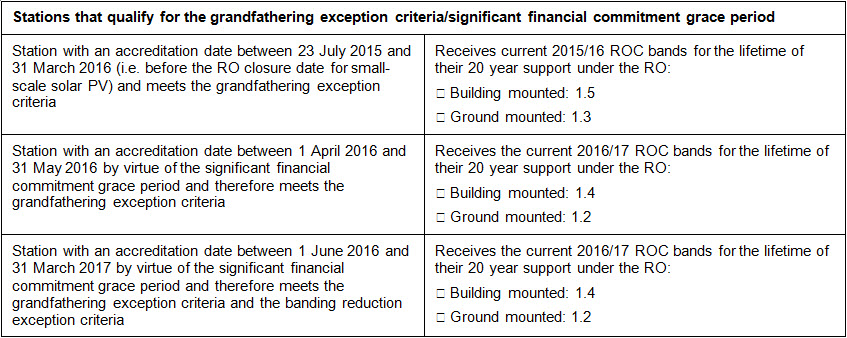
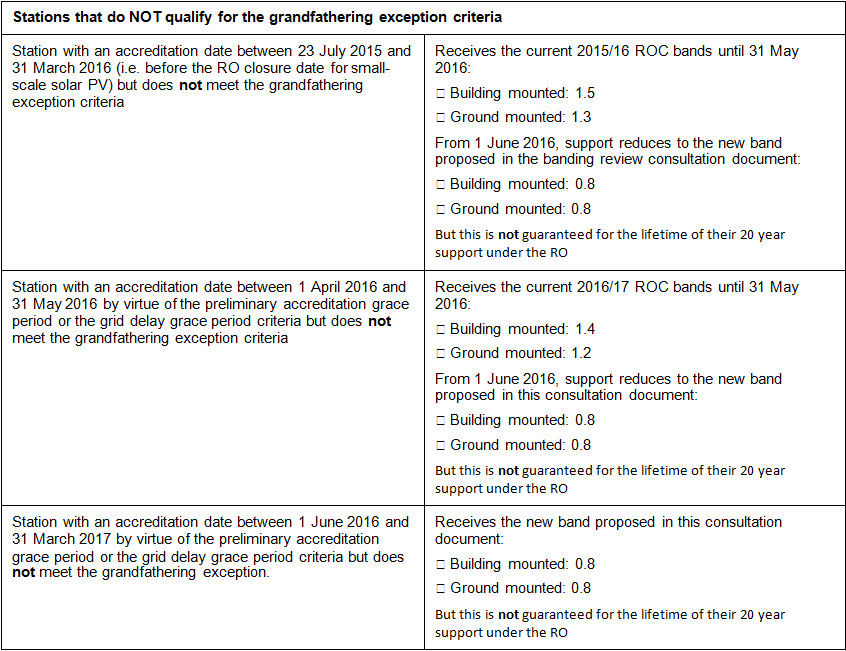
The combined effect of the decisions on early closure and grandfathering, coupled with the proposed banding review changes, is well summed up in the following tables from DECC.

Stations that qualify for the grandfathering exception criteria/significant financial commitment grace period

Stations that do NOT qualify for the grandfathering exception criteria

FIT reforms

The FITs changes affect smaller-scale onshore wind and hydro projects as well as <5 MW solar projects.  The starting point is clear from the first page of the Impact Assessment for the FITs announcement: “The intention is that a maximum of £100m is spent on new-build deployment per year over this FITs review period (from early 2016 to the end of 2018/19).”.

If it achieves this, the Government expects to reduce LCF costs by between £380m and £430m, reduce deployment by between 5.6 GW and 6.2 GW (or between 802,000 and 912,000 fewer installations) and see between 9,700 and 18,700 fewer jobs in the solar industry by 2020/21.

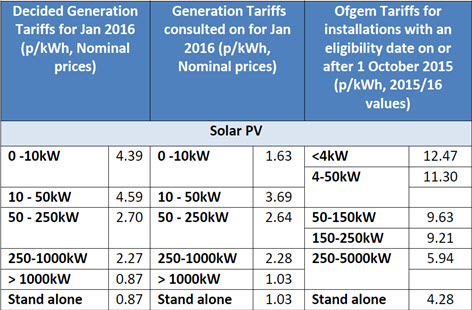
The principal means of securing these results are severe cuts in generation tariff rates.  The DECC table below shows how the new rates for solar PV projects compare with those currently in force, and those proposed in the August 2015 consultation.

DECC table

It is the smallest installations, representing domestic roof-mounted solar, which have done best out of the consultation process, but it is those in the 250-1000 kW bracket that will see the lowest reductions in subsidy. Good news for commercial and industrial premises with lots of roofspace and a significant daytime electricity demand on-site – even if the consultation process has led to 0.01p/kWh being trimmed from their proposed tariff. (The cuts to wind and hydro tariffs are somewhat less severe, but still swingeing in many cases.)

The Impact Assessment and response to consultation together are more than 150 pages long. Blog posts are meant to be short and pithy, so there is not space here to mention everything that is of interest in the FITs announcement. However, the following points are worth noting.

  • The consultation response confirms that support under each tariff band will be subject to quarterly rationing (“deployment caps”). For the largest bands this may mean that only one or two installations are accredited in each quarter. Everything will depend on the date and time (“to the second”) of an installation’s MCS certificate or ROO-FIT application. Those who miss out in one quarter will be “frozen” in a queue until the next cap opens.
  • There is a lot of detail on the working of the caps and the reformed degression mechanism in the consultation response (see also Ofgem’s draft guidance).
  • Pre-accreditation, removed as long ago as 1 October 2015, is to be re-introduced (for those installations to which it was previously available – i.e. not including those of <50 kW) but in an attenuated form: installations will get the tariff rate that applies on the date of their accreditation, not that of their pre-accreditation.
  • Some of the post-consultation tariff adjustments reflect changes in what the Government considers to be appropriate target hurdle rates (now 4.8% for solar). These may not be enough to motivate those who are thinking of installing domestic rooftop solar.

What happens next?

RO

The early closure of the RO to <5 MW solar will be implemented by amendments to the Renewables Obligation Closure Order 2014. The banding review proposals, if taken forward after the current consultation ends on 27 January 2016, will need to be implemented by amendments to the Renewables Obligation 2015, by 1 June 2016.

The statutory instruments required to make both sets of changes will require the approval of both Houses of Parliament – which, although likely, cannot be guaranteed, particularly in the case of the House of Lords, who recently voted down the proposed early closure of the RO for onshore wind.

FITs

Implementing the policy decisions on FITs requires a combination of modifications to the standard conditions of electricity supply licences and amendments to the Feed-in Tariffs Order 2012.  Differences in Parliamentary procedure mean that the licence modifications take longer to bring into force than the amending Order. Accordingly, Government expects the Order to come into effect on 15 January 2016 and the licence modifications (which include the new tariff rates) to come into effect on 8 February 2016. As mentioned briefly in the FITs consultation, there is to be a pause in the FITs accreditation process between 15 January and 8 February 2016.

As in the case of the RO changes, there is (at least in theory) scope for a negative vote in either House of Parliament to blow the implementation off course. It would also be surprising if there were not some attempts to challenge the changes by way of judicial review, although the litigation process would inevitably play out over a slower time-frame.

And there is more to come…

The Government has expressly flagged or left open a number of areas of possible further reform. For example, the feedback received on possible changes to the FIT export tariff “will be used to frame a detailed consultation on these issues in the future” – Government “may make changes to the structure of the export tariff…for new entrants [including] changes to indexation”.

And just in case anybody should feel too comfortable, the new tariffs, the system of deployment caps and the overall scope of the FITs scheme (i.e. whether it should be more tightly focused in terms of technologies or sizes of installation) are all to be kept under review.

What about CfDs (and everything else)?

The original reason for closure of the RO is its replacement by CfDs, the costs of which, because they are allocated in a competitive process and using defined budgets, can be more easily be controlled. The expectation was that CfD allocation rounds and Capacity Market auctions would be (at least) annual events. However, whilst the Government has held a second Capacity Market auction a year after the first such auction, more than one year on from when the first CfD auction process began, there is no sign yet of the process for a second CfD auction being set in motion. And although one has been announced in general terms as taking place in 2016, there has been no definite pronouncement as to whether it will include a budget for solar.

Is the Government waiting to see how the new ROC band and FIT tariffs play out before deciding whether to include solar in the next CfD auction, and/or how much money to allocate to the part of the auction where solar projects will compete? The rules allow the Secretary of State to decide these points only a very short time before the allocation process begins. For developers considering whether to commit significant sums of money to progress potential solar CfD projects to the stage where they could bid in a 2016 auction, the lack of clarity about such an auction is not helpful.

The FITs consultation response says that it contains measures that “seek to maintain a viable renewables industry which, in the longer-term, can continue to reduce its costs, seeking to achieve grid parity”. By the Government’s own admission, that industry, if still viable, will be considerably smaller once these reforms have been implemented.  It is to be hoped that the industrial and commercial rooftop sector will continue to expand, given the relatively less severe FIT tariff rate reductions that are to be imposed on it. It is likely that some business will be lost to other European jurisdictions which currently enjoy a more benign solar subsidy environment.

Away from the narrow focus on subsidy costs, the hottest strategic topic about the growth of solar deployment is how to manage the system integration costs of low carbon technologies (particularly intermittent wind and solar generation) and encourage the use of storage by renewable generators so as to smooth their export profile and increase system flexibility. (See also Ofgem’s position paper of 30 September 2015 on system flexibility.) These issues were essentially absent from the consultation proposals and decisions. However, the FITs consultation response states that DECC is engaging closely with Ofgem and stakeholders to identify barriers to the deployment of storage and are considering potential remedial actions. The Government plans to consult on this work in “spring 2016”. Perhaps less advantageously for the solar industry, Government is also  “continuing to explore” with National Grid and Ofgem the question of “distributed generation paying for its impact on the whole system”.

Another interesting year ahead for an industry which learnt some time ago that the only certainty is change.

Subscribe and stay updated

Receive our latest blog posts by email.


Source link

Nigeria’s Petroleum Industry Governance and Institutional Framework Bill 2015


Reform of Nigeria’s oil and gas sector has been at the top of President Muhammadu Buhari’s agenda since assuming office in May 2015.

Despite being drafted in 2007, the 223-page Petroleum Industry Bill (PIB) has failed to become law, consequently creating uncertainty in the sector.  Since its inception, the PIB has been dogged by lack of political consensus and disagreements between the government and global oil majors over its key terms.  The new head of the Nigerian National Petroleum Corporation (NNPC), Emmanuel Kachikwu, has been quoted as saying: “the average source of volumes in investments that we are losing on an annual basis because of the lack of PIB is in excess of $15 billion”.

The PIB has now been split into a series of bills that unbundle the controversial fiscal provisions from the non-fiscal components, which the government hope will ease its passage through parliament.  The first of which is the 45-page Petroleum Industry Governance and Institutional Framework Bill (PINGIF).

If the PINGIF is passed, Buhari, the former military ruler who served as Chairman of the state oil giant NNPC in the 1970’s, will oversee the break-up of the NNPC and transfer of its responsibilities to successor entities.  Under the PINGIF, the NNPC will be replaced by two new entities (as opposed to the numerous companies previously proposed in the PIB):

  1. a National Petroleum Company (NOC) will be created to operate as a fully commercial entity which will be partly privatised, with at least 30% share capital to be divested to the public in a ‘transparent manner’ within six years of its incorporation; and
  2. a Nigerian Petroleum Assets Management Company (NPAM) will be created to own and manage petroleum assets on behalf of the government.

The PINGIF also legislates for the creation of a new industry regulatory body called the Nigeria Petroleum Regulatory Commission (NPRC).  The NPRC would oversee oil licencing rounds as well as the renewal and cancellation of licences.  The powers of the NPRC are wide and include the power to require licensees and permit holders to publish particular information relating to petroleum operations where it considers it to be in the public interest and, through the NPRC Special Investigation Unit, the power to arrest without warrant any person who is found committing an offence under the PINGIF. However, any decisions made by the NPRC must be in writing, contain the basis for the decision and be accessible to the public; which will assist with accountability.  Compared with previous PIB drafts, the PINGIF removes ministerial powers on board appointments which will now be made by the Nigerian president and confirmed by the senate.

Moody’s is optimistic about the future of Nigeria’s economy, stating in the 2015 Annual Report on Nigeria that: “…the successful presidential elections have caused a structural shift that opens up the possibility of gradual improvement concerning institutional strength over the medium term especially concerning rule of law, control of corruption and government effectiveness”.

The PINGIF is the first step on a long road to reforming, and restoring investor confidence in, the Nigerian oil and gas sector.  The slump in oil prices, weakening of the Naira and the depletion of Nigeria’s foreign reserves, caused by Nigeria’s continued dependence on oil for more than 90 per cent of government revenues, has increased the pressure on the government to remove the uncertainties caused by the delays in passing the PIB. Uncertainty remains around taxation and fiscal reform which has not been addressed in the current draft of the PINGIF.  However, this is expected to be addressed in the next piece of draft legislation.

While there are concerns that the draft legislation does not go far enough, the hope is that the PINGIF is a step in the right direction towards greater certainty, transparency and accountability and will unlock much needed further investment into the sector.  Time will tell how industry stakeholders will react to its contents and how quickly it will be adopted into law. For further insight into M&A and financing transactions in Nigeria’s oil and gas sector see: http://www.dentons.com/en/insights/articles/2016/january/19/a-legal-overview-of-ma-and-financing-transactions-in-nigerias-oil-and-gas-sector

If you would like to discuss any of the issues raised above, please do not hesitate to get in touch with the authors or any of your other regular contacts in the Dentons oil and gas team.

Subscribe and stay updated

Receive our latest blog posts by email.


Source link

Current trends in oil and gas finance


Leslie Benedict: “Money isn’t everything, Jett”
Jett Rink: “Not when you’ve got it.”
Giant (1956)

And when you don’t got it, as independent oil guy Jett Rink knew, it is everything. The world may run on oil, but the oil industry runs on capital, and for some US shale producers that capital appears to be drying up. After flowing downhill throughout the second half of last year, the price of West Texas Intermediate (WTI) crude oil (as of the date this article is being written) is currently at about US$30. Natural gas has faced a similar decline. Might the worst be over? Not yet. Credit Suisse believes that between 1864 and 2008, the four oil bear markets lasted on average two decades and the shortest 11 years. Expect more pain ahead for many exploration and production (E&P) companies who focus on shale oil, deep water oil, or oil sands (collectively, “unconventional oil”) with additional ramifications in the oil field services sector and other related industry segments.  If commodity prices settle at or near today’s prices, many E&P unconventional oil companies may face a liquidly crises while others will require either in-court or out-of-court restructurings. To date, 48 North American E&P companies have filed for bankruptcy. Six E&P companies have filed bankruptcy so far this year. Oil has had its weakest start in history and has negated five year gains.

The current downturn is a reminder that oil and gas exploration and production has always been a cyclical business. Memories of the last downturn in the sector may have faded but investors should keep in mind some of the unique industry and legal issues involved in oil and gas finance.

Weak global demand and the quest for yield

The immediate cause of the present oil price collapse is found in increasing production and weak demand for all commodities and loans since 2008 despite the herculean efforts of central banks to restart global demand via ultra loose monetary policy.  Since the Financial Crisis of 2008, the US Federal Reserve and central banks across the world have increased debt, artificially kept interest rates low and devalued their currencies.

Oil prices rose with a weak US dollar and interest rates near zero in 2009. As prices passed US$80 per barrel in late 2009, unconventional oil production began in earnest. Low-interest rates forced investors to look for yields better than they could find in the US Treasury bonds or conventional savings instruments. Money flowed to E&P companies through high-yield corporate bonds, loans, joint ventures and share offerings.

The extended period of ultra-loose monetary policy, including both exceptionally low interest rates and huge expansions in the balance sheets of central banks helped produce the highest sustained oil prices in history. They also led to investments that are not particularly productive but promise higher yields that can be found otherwise in a zero-interest rate world.

A US-led supply surge from high-cost unconventional fields such as the Bakken, Eagle Ford and the Permian Basin outstripped demand last year and sent oil prices spiraling downwards. The rout deepened in November 2014 after OPEC, led by Saudi Arabia, its largest producer, refused to cut production. Other sizeable producers, like Russia, are hard pressed economically and need to keep producing for current cash income. And this is before the impact of Iranian oil coming back into the market.

The key to recovery is increased demand. With demand from China dramatically down and the potential for recession in many other sizeable energy consuming markets, the short-term scenario for demand does not look promising.

Continuing technical innovation which increases production from existing fields and new areas can also be a factor going forward, as it has been over the past decade or so. This can further increase supply from one or more regions of the world, often in dramatic fashion and/or at lower cost than some current production techniques.

E&P restructuring drivers

Since the 1970s, oil companies have put up their own reserves as collateral for loans as a way to secure improved lending conditions. E&P companies rely on reserve-based lending (RBL) to fund operations.  In return, banks demand to revalue those reserves every six months, in April and October —a process called “redetermination”.  Under RBL facilities, banks agree to lend up to limits set by the value of the borrower’s proved oil and gas reserves. They then adjust those limits periodically to maintain adequate loan-to-value and cash flow coverage ratios.

During the previous round of redeterminations last autumn, banks cut limits for most customers between 10 and 20 per cent. With oil still languishing at about US$30 a barrel, analysts say that the next round could be just as severe.  As reported recently in the Financial Times, John Shrewsberry, chief financial officer of Wells Fargo, one of the most active lenders in US energy, told an industry conference in Miami that borrowing availability would be about “10 or 20 per cent down” again in the spring. Banks have also been warned by the Office of the Comptroller of the Currency, the federal regulator, to watch out for the risk involved in lending to oil and gas companies, prompting fears that loans could be withdrawn from businesses that would be financially viable if they were given a little more time.

In times of steep declines in commodity prices, most E&P companies will find the availability for additional borrowings under an RBL facility reduced, in some instances to a level below the aggregate principal amount of loans outstanding, resulting in a borrowing base deficiency. Once a borrowing base deficiency has occurred, most RBL facilities will provide the borrower the option to add additional collateral with a value equal to at least the deficiency amount or to pay down the outstanding loans in an aggregate amount equal to the deficiency in a single payment or in equal installments of three to six monthly payments. In a typical RBL financing, substantially all of the collateral has already been pledged to the lenders as collateral, which leaves the borrower only the option of paying down the debt. Choosing to repay the deficiency amount in installments gives the borrower a short window of time to raise capital, including by selling properties or securing additional credit through junior lien or subordinated debt, in order to avoid an event of default under its RBL facility.

Financing alternatives

The cliché about the hydrocarbon business is that the cure for low prices is low prices, meaning that excess production should lead to a mass wave of insolvencies, cutbacks in activity and eventual price recovery for the rational, hardy survivors. But to date, that does not seem to be happening. Relatively strong debt and equity markets (aided by private equity and hedge funds) have allowed many energy companies to access the financing needed to fight another day.

At the corporate level, there are 2nd lien debt (bond or loans) “replacement” revolvers, DIP financings and equity investments. According to Bloomberg, oil companies have sold US$61.5 billion in stocks and bonds since January 2015 as oil prices have tumbled. Approximately half the money has been used to pay down or re-structure debt. According to Bloomberg, drillers in the Permian Basin, the biggest US shale field, have raised at least US$2 billion from share sales over the past eight weeks. And more issuances are on the way as producers try to avoid piling on additional debt. Pioneer Natural Resources Co.’s 12 million-share issuance on Jan. 5 was followed a week later by Diamondback Energy Inc.’s announcement of a four million-share sale. Private equity firm Kayne Anderson Capital Advisors LP is investing in a startup called Invictus Energy LLC with $150 million to drill the Permian and the Eagle Ford Shale.

At the asset level, there are many creative ways to invest in E&P companies, including, production payments, net profit interest, overriding royalty interest and out right purchase of a stake in the working interest. Whether acquired as part of a recent restructuring initiative or historical purchase, investors who own such carved out royalty interests need to take inventory of counterparty risk and how these positions will be treated in a bankruptcy, including the potential risks of contract recharacterization or rejection and clawbacks of payment already received. For instance, when these types of interests are structured correctly, the party advancing the money is treated as a purchaser of the future production. If the borrower fails, the oil and gas subject to the production payment belongs solely to the investor and cannot be borrowed against or sold by the debtor. Other creditors of the borrower have enormous incentive to attack the transaction and have it characterized as a financing rather than a sale of assets. If an attack is successful, an investor may find themselves a creditor potentially holding a large unsecured claim against a debtor as opposed to holding what they thought was a separate property. That claim will be subject to treatment in a plan of reorganization.

Oil and gas restructuring considerations

E&P companies facing excess leverage or insufficient cash flow may pursue restructuring strategies out-of-court and, if necessary, reorganization in court by filing for bankruptcy, most often under Chapter 11 of the United States Bankruptcy Code (Bankruptcy Code). The typical parties in an energy restructuring or reorganization include the company as debtor, management, secured lenders, bondholders, potential asset purchasers, trade vendors, service vendors, oil and gas lessors, contract counterparties under joint operating agreements, derivatives counterparties, co-working interest owners, farmors, farmees, production payment counterparties, first purchasers and equity holders. Additionally, the Bankruptcy Code provides standing under appropriate circumstances for statutory committees of creditors and equity holders, and potentially for appointment of a bankruptcy trustee or examiner.

E&P cases also present some unique legal issues compared to most Chapter 11 cases, including (i) whether the personal property or real property rules apply (which provide for different rights and time periods), (ii) how special state law rights and priorities such as liens and royalties are treated vis-à-vis secured and other creditors, (iii) whether certain production payments are true sales or disguised financings (as highlighted above) and (iv) whether environmental and clean up obligations can be discharged in the bankruptcy and how such claims are classified and treated.

It is important to note that bankruptcy is a tool and not a strategic plan by itself. Among the tools bankruptcy provides are: (i) a breathing space from creditor payment demands and remedies, (ii) the ability to borrow funds or use cash collateral (e.g. cash on hand and incoming receivables and payments) on a post-petition basis to fund its business, (iii) the ability to sell assets to fund operations often on a free and clear basis, (iv) the ability to pay certain claims at a large discount and/ or over time, (v) the ability to bind holdouts and dissenting creditors in certain situations, and (vi) the ability to reject certain burdensome contracts and leases.  Companies that restructure crippling debt loads can often emerge from bankruptcy and start life anew, but with the latest fall in energy prices, even a freshly capitalized balance sheet may not be enough to save the company

Indeed, bankruptcy by itself does not solve problems such as ongoing revenue and pricing issues or the need for going forward capital and trade creditor support. For example, when Samson Resources filed for bankruptcy in September 2015, wiping out US$4.2 billion of equity, the expectation was that second lien lenders, in the middle of the capital structure, would take over the company, wiping out the junior debt but paying senior debt holders 100 cents on the dollar. Now that assumption is being questioned and the pre-filing agreement with creditors has fallen apart. With the drop in energy prices “elements of the restructuring agreement, including refinancing senior debt and a commitment to inject new money, are likely no longer feasible”, according to a court document filed on December 17, 2015, in Delaware. “Any new restructuring would likely provide significantly less value for stakeholders than the transaction (originally) contemplated.” Second lien lenders who expected to take over Samson had pledged to put US$400 million into the company. But with prices of natural gas less than US$1.75 per million British thermal units —when the investment thesis of the original owners required prices of US$4 per mmbtu —“it was rational to take another look”, said one person involved in the talks. In its attempt to survive, Samson has cut costs and suspended all drilling.

Conclusion

Although the immediate cause of the collapse is over-production of tight oil, the key to recovery is a material increase in demand. Worldwide demand for oil has increased—its just that the rate of increase in demand has dramatically slowed down. The problem is structural and firmly rooted in the speculative money that was funding under-performing US unconventional oil companies since 2010. A possible first step to price recovery is the severing of capital supply to E&P companies that could not fund their operations from cash flow when oil prices were more than US$80 per barrel. If this does not happen, the world could be in for a long period of low oil prices. Until then, distressed investors should remain mindful of the inherent benefits and risk of investing in the E&P space as they evaluate opportunities resulting from this downtown.

Subscribe and stay updated

Receive our latest blog posts by email.


Source link

UK renewable Contracts for Difference – now only for offshore wind?


The UK’s Contracts for Difference (CfD) regime for renewable subsidies was one of the principal pillars of the Electricity Market Reform programme put in place by the 2010-2015 Coalition Government.  In one way or another, the CfD regime aimed to provide revenue stability for most renewable technologies in projects of more than 5 MW, with consumers sharing in the upside at times when power prices exceed the guaranteed “strike price” set in a competitive allocation process.

Before the UK General Election of May 2015, it was also expected that auctions would follow a regular annual rhythm – or possibly occur more than once a year for some technologies. But things have changed a lot in the last seven months in the world of CfDs – and they continue to change.

  • The Conservative Party, victorious in May 2015, had campaigned on a manifesto promise of “no new subsidies for onshore wind”, which they have been quick to implement, and which appears to include the exclusion of onshore wind (except perhaps on Scottish islands) from future CfD auctions.
  • On 11 February 2016, the Secretary of State for Energy and Climate Change, Amber Rudd, told Parliament: “We don’t have plans at the moment for a large-scale solar contract [for difference]“.
  • The day before, her Department announced “an independent review into the feasibility and practicality of tidal lagoon energy in the UK” – appearing to cast more than a little doubt over the prospects of the Swansea Bay Tidal Lagoon project, with which the Department had previously been said to be negotiating CfD support (tidal lagoon projects, like nuclear ones, fall outside the scope of the competitive CfD allocation framework).
  • The news that the European Commission has doubts about the compatibility with EU state aid rules of the proposed CfD for the conversion of a third unit at the Drax coal-fired power station to burning biomass perhaps makes it unlikely that there will be many, or any, more CfDs awarded for this technology.
  • Almost a year after the results of the first (delayed) CfD auction were announced, there is no sign as yet of Government gearing up for a second auction any time soon – merely a promise that there will be funding for three more auctions before mid-2020.

To be fair, so far, nothing has been said to suggest that Energy from Waste with CHP, Hydro (up to 50 MW), Landfill Gas, Sewage Gas, Wave, Tidal Stream, Advanced Conversion Technologies, Anaerobic Digestion, Biomass with CHP or Geothermal will not be eligible if and when the second auction finally takes place, but the fact remains that for the foreseeable future, offshore wind appears likely to dwarf all the other CfD-eligible technologies.

In clearing the original CfD rules for state aid purposes, the European Commission noted, as apparently relevant facts, that “All generators producing electricity from renewable energy sources will be able to bid for a CfD on non-discriminatory basis (albeit that some less established technologies will initially benefit from allocated budgets in order to promote their further development).“, and that “in the absence of aid renewable energy technologies will not be deployed at the required scale and pace, as without the aid such projects would not be financially viable.”  This was in keeping with the emphasis in the relevant State Aid Guidelines that an “auctioning or competitive bidding process open to all generators producing electricity from renewable energy sources…should normally ensure that subsidies are reduced to a minimum“, but admitting that “given the different stage of technological development of renewable energy technologies“, technology specific tenders may be allowed “on the basis of the longer-term potential of a given new and innovative technology, the need to achieve diversification; network constraints and grid stability and system (integration) costs“.

The statutory framework for CfD auctions allows the Secretary of State enormous flexibility to determine, at very short notice and in documents which are not subject either to Parliamentary approval or any statutory consultation requirement (the “budget notices” and “allocation frameworks”), which technologies will be eligible for support in a given auction.  However, it must be arguable that a decision effectively to exclude technologies as significant (and competitive) as onshore wind and solar from the allocation process could amount to a change in the CfD rules which should itself be notified to the Commission for state aid approval.  And it is not entirely clear that such exclusions could be – or at any rate have been – justified on the grounds specified in the Guidelines as a basis for technology specific tenders.

A cynic or conspiracy theorist might suspect that the lack of urgency in proceeding to a second CfD auction may not be unrelated to the UK Government’s reluctance to put itself – in advance of a referendum on the UK’s continued membership of the EU – in the position of appearing to have to ask the Commission’s permission (in the form of a state aid clearance for alterations to the CfD rules) not to offer CfDs to technologies that Ministers do not want to subsidise.  But cynics and conspiracy theorists are often wrong.  The Government is perhaps more likely to be just taking its time to consider the future of CfDs more broadly.  For example, in the 11 February 2016 Parliamentary exchanges referred to above, Ministers confirmed that they are looking “very closely” at the seductively labelled and highly fashionable concept of “subsidy-free CfDs” (which means different things to different people, but for one interesting suggestion, see this blog post by Professor Michael Grubb of UCL).

Subscribe and stay updated

Receive our latest blog posts by email.



Source link

Estimating Upstream GHG Emissions – Global Energy Blog


On Saturday, March 19, 2015, the Department of Environment and Climate Change Canada (“ECCC“) published its proposed methodology for estimating the upstream greenhouse gas (“GHG“) emissions associated with “major oil and gas projects” undergoing federal environmental assessments (“proposed methodology“) in the Canada Gazette.

The Government of Canada (“GOC“) announced in late January that it intended to “restore confidence in Canada’s environmental assessment processes”. Dentons’ commentary on that announcement can be found here. As part of that announcement, the GOC articulated five principles for how it would exercise its discretionary decision making authority for projects undergoing federal environmental assessments. Among the five principles was a commitment to assess “upstream greenhouse gas emissions linked to projects under review”. The proposed methodology published in the Canada Gazette has not yet been finalized. Interested parties, including industry stakeholders, have 30 days from the publication date (until April 18) to comment on the proposed methodology.

The proposed methodology begins by providing a definition of what ECCC considers “upstream” for the purposes of its estimating GHGs associated with a project. It then sets out two parts of its proposed approach to assessing upstream GHG emissions.

Defining “upstream”

The proposed methodology defines “upstream” to be all industrial activities from the point of resource extraction to the project under review. Apparently anticipating questions on what this definition means for crude oil pipeline projects, ECCC gives several examples of “upstream” activities for such projects:

  • Extraction – crude oil and gas wells and oil sands mining and in situ facilities;
  • Processing – field processing and upgrading, if occurring;
  • Handling – products transfer at terminals; and
  • Transportation – any pipeline operation in advance of the project.

The activities considered “upstream” would depend on the project under review.

The Proposed Methodology

We are told that the assessment of upstream GHGs will consist of two parts. The first part is a relatively straight forward quantitative estimation of emissions released from upstream production associated with the project. The second part is a more opaque “discussion” of the project’s potential impact on Canadian and global GHG emissions.

The quantitative component of the assessment will focus on emissions from upstream activities “exclusively linked” to the project being assessed. How ECCC will decide whether something is “exclusively linked” to a project is unclear. The quantitative assessment will not include “indirect emissions” which, for the purposes of the proposed methodology, would include matters such as manufacture of equipment and fuels “produced elsewhere”.

The quantitative assessment begins by determining expected throughput of each “component” (e.g. heavy oil and diluent as separate components) in the product stream. ECCC will rely on project proponent data for this information. Though not expressly stated, information contained in a publicly available application, such as one filed with the National Energy Board would likely be considered.

Next, each product component will be assigned an emission factor using ECCC emissions data, among other information sources. Because different product components will involve different extraction, processing, handling and transportation activities, the emissions factors applied in a given assessment would reflect those differences.

Multiplying the emissions factor for a given component by the throughput of that component (taking into account a vaguely defined “adjustment”) provides the upstream emission for a given component. Upstream emissions for each component would then be totaled to provide the upstream emissions for the entire project.

The second stage to the proposed methodology is a “discussion” that is intended to accomplish two objectives. First, the discussion will assess conditions under which the upstream emissions associated with the project could be expected to occur even without the project. Second, the discussion will consider the potential impact of the project’s emissions on overall Canadian GHG emissions and on Global GHG emissions.

To inform the discussion, ECCC will examine current production levels, the trajectory of future production with and without the project, as well as potential markets for future resource production.

The next stage of the “discussion” is to evaluate “technical and economic potential” for alternatives to be used in absence of the proposed project. The proposed methodology then considers the various alternatives and “discusses the potential implications for Canadian and Global upstream GHG emissions”.

The outstanding issues

When the GOC first articulated the five principles, including the commitment to assess direct and upstream greenhouse gas emissions, its stated intention was to provide greater certainty on how it would exercise its discretion on projects undergoing a federal environmental assessment. This proposed methodology, once finalized, will give proponents some understanding of how ECCC will assess upstream emissions. However, proponents are arguably no closer to understanding how the GOC will exercise its discretion on individual projects.

The proposed methodology gives only a high level overview of how upstream GHGs will be assessed and is vague in a number of respects. For instance, it is not clear how “the technical and economic potential for alternative modes of transportation” will be evaluated. If a proposed pipeline has more “economic potential” or is considered safer than the hypothetical rail alternative, will that tilt the scale in favour of the proposed project for the purposes of an upstream GHG assessment? The proposed methodology also includes a fleeting reference to comparing emissions intensity between Canadian and non-Canadian crude oil sources. What crude oil sources will be used as the comparator or how “upstream emissions” from those non-Canadian-sources will be quantified is anyone’s guess.

The most significant issue outstanding from the perspective of a project proponent is the lack of guidance on how the National Energy Board, ECCC, or the Governor in Council, as the case may be, will exercise its discretion to approve or recommend approval of a project based on its GHG emissions. Will projects be given a green light regardless of the upstream GHGs they facilitate? At the other end of the spectrum, will any increase in Canadian or global GHG emissions from a project be enough to delay or halt a proposed project? The true answer presumably lies somewhere in the middle. The problem from the prospective of a proponent contemplating a substantial investment is that there is no way to assess this potential roadblock.


Subscribe and stay updated

Receive our latest blog posts by email.



Source link

Daniels v. Canada: Métis and non-status Indians fall under Parliament’s legislative authority


On April 14, 2016, the Supreme Court of Canada (SCC) rendered its decision in Daniels v. Canada (Indian Affairs and Northern Development), 2016 SCC 12.

Members of the Dentons Canada LLP Aboriginal Law practice addressed the significance of the decision in their latest Insights post. You can find that post here.

Subscribe and stay updated

Receive our latest blog posts by email.

Dan Collins

About Dan Collins

Dan is a member of Dentons’ Energy Regulation group in Calgary, practicing in the areas of energy regulatory, environmental, and aboriginal law. Dan has represented clients before the Canada Energy Regulator, Alberta Energy Regulator, Alberta Utilities Commission and Alberta Environmental Appeals Board. Dan also advises clients on compliance with federal and provincial environmental obligations, including on enforcement actions, environmental prosecutions and investigations resulting from operational incidents.


Full bio


Source link

Alberta’s Metis Consultation Framework – Global Energy Blog


On April 4, 2016, the Government of Alberta (“GoA”) released The Government of Alberta’s Policy on Consultation with Metis Settlements on Land and Natural Resource Management, 2015 (the “Policy”) as well as The Government of Alberta’s Guidelines on Consultation with Metis Settlements on Land and Natural Resource Management, 2016 (the “Guidelines”). Additional information on the Policy and the Guidelines including the text of each can be found here.

The modest aim of this post is to outline some of the key features of the Policy and Guidelines as they relate to energy project proponents.

Alberta Metis Settlements

The term “Metis” refers to people of mixed European and indigenous heritage who developed their own customs, way of life, and recognizable group identity separate from their settler or indigenous ancestors. Metis people are expressly included within the definition of “aboriginal peoples of Canada” in section 35 of the Constitution Act, 1982. Accordingly, Metis practices that were historically important features of these distinctive communities and that persist today as integral elements of Metis culture are constitutionally protected. According to the Alberta Indigenous Relations website, approximately 5,000 people live on the eight Metis Settlements in the province which collectively cover 1.25 million acres in the central and northern part of the province.

Policy and Guideline Highlights

The stated objective of the Policy is to establish a meaningful consultation process to address potential adverse impacts to Metis Settlement members’ harvesting or traditional use activities. The Guidelines are intended to clarify expectations of all parties participating in the consultation process including project proponents, the Aboriginal Consultation Office (the “ACO”), Metis Settlements, and government agencies.

According to the Policy, and consistent with Supreme Court of Canada decisions on Aboriginal consultation, the GoA policy is to consult with Metis Settlements when:

  1. GoA has real or constructive knowledge of Metis Settlement members’ harvesting or traditional use activities;
  2. GoA is contemplating a decision relating to land and natural resource management; and
  3. a GoA decision has the potential to adversely impact the continued exercise of Metis Settlement members’ harvesting or traditional use activities.

The Policy, therefore, will impact not only strategic resource planning decisions made by the GoA, but also project specific decisions including land dispositions, facility and pipeline approvals, and water use authorizations. It will not, however, apply to leasing or licencing Crown mineral rights.

Borrowing from the GoA’s approach to consultation with First Nations, the Guidelines establish a framework for determining the level of consultation required based on the impact of the project and the sensitivity of the affected location. The level of consultation informs how deep the consultation should be, what process steps are required, and the timelines for completing consultation.

The Policy lists a number of “guiding principles” which it considers will lead to meaningful consultation. These guiding principles will generally not surprise energy project proponents who are accustomed to engaging with First Nations. In some cases, the guiding principles provide reassurance regarding the GoA position on consultation. Notably, the guiding principles include the following:

  • Consultation will take place with the Metis Settlements, not their individual members;
  • GoA will consult with honour, respect, and good faith, with a view to reconcile Metis Settlement members’ harvesting and traditional use activities with the GoA’s mandate to manage provincial Crown lands and resources for the benefit of all Albertans;
  • Consultation requires all parties to demonstrate good faith, reasonableness, openness, and responsiveness;
  • Metis Settlements have a reciprocal onus to respond with any concerns specific to the anticipated Crown decision in a timely and reasonable manner and work with Alberta and project proponents to resolve issues as they arise during consultation;
  • Consultation does not give Metis Settlements or project proponents a veto over Crown decisions nor is the consent of Metis Settlements or project proponents required as part of Alberta’s Consultation process.

The Policy and Guidelines contemplate direct consultation by the GoA as well as GoA delegation of procedural aspects of consultation. In either case, the ACO will “direct, monitor and support consultation activities”. ACO support includes providing staff to assist with consultation, advising both Metis Settlements and proponents when disputes arise, and evaluating consultation records. Energy project proponents will recall that the Alberta Energy Regulator (“AER”) has no authority under the Responsible Energy Development Act to assess the adequacy of Crown consultation. In matters before the AER, the ACO will make a consultation adequacy determination and advise the AER of its decision.

For their part, project proponents may need to carry out certain tasks if the GoA decides to delegate procedural aspects of the consultation process. The Guidelines state that “proponents are encouraged to notify and consult with Metis Settlements as early as possible in the pre-application stage”, “document their consultation activities, share their consultation record with Metis Settlements and provincial staff and advise the GoA of any issues that arise”. The Policy and Guidelines identify a number of consultation activities that may be passed to proponents, such as providing Metis Settlements with plain language information on the project, meeting with Metis Settlements to discuss their concerns, developing and implementing mitigation strategies, and preparing consultation records.

Finally, the Guidelines state that “although the optimal outcome of consultation is that all consulting parties reconcile interests, agreement of all parties is not required for consultation to be adequate”.

Comments for Energy Project Proponents

The Policy and Guidelines closely model the GoA’s approach to engaging with First Nations in Alberta and will be familiar to many project proponents. They serve as a useful starting point for setting expectations on how consultation will proceed and the roles of each party. However, they are just that – a starting point.

The Guidelines acknowledge that consultation must remain flexible. They do not state, however, whether Metis Settlements will be consulted on how the Policy will be implemented in any given case. Further, while the Policy and Guidelines clearly contemplate delegating consultation activities to proponents, there is no commitment by the GoA to communicate the fact of delegation to the concerned Metis Settlements.

Clear communication at every stage of the consultation process is important to avoid delays as the process unfolds. Proponents should ensure from the outset when they undertake delegated consultation activities, such as in-person meetings, that the Metis Settlement representatives understand the consultation activities were delegated and are meant to contribute to fulfilling the Crown’s duty to consult.

Subscribe and stay updated

Receive our latest blog posts by email.



Source link

The New North Sea – Part 1: the revolution begins here


How much of a difference will the recent reforms of UK offshore oil and gas regulation make to the industry and its stakeholders? It may be too early to say whether the creation of the Oil and Gas Authority (OGA), the articulation of the “MER UK Strategy” and the other changes introduced by the Infrastructure Act 2015 and the Energy Act 2016 will facilitate solutions to all the significant problems faced by North Sea operators, but in our view it is already clear that the changes of the last two years will have a profound impact on the industry.

Government intervention in the UK’s offshore oil and gas industry is nothing new. It has taken different forms at different times, and has included, as well as numerous changes in taxation, Government participation (or at least the ability of Government to participate) in decision-making at the individual asset level through rights granted to state-owned entities.

More specifically, for almost 20 years, Government has been aware of, and has been taking action to address, the particular set of problems that the UK Continental Shelf (UKCS) faces as a mature basin.  Between 1999 and 2004, the Department of Trade and Industry and its successors took a series of steps to foster investment and innovation in the industry and improve its efficiency: a joint Government / industry report (A Template for Change) was published in 1999; task forces were appointed; changes were made to the administration of the licensing regime; new types of licence were introduced.

PILOT and small-scale regulatory changes, 1999-2004
1999


Brent at $9/barrel – a record low – in February, but recovers to $25 by December.

Oil & Gas Industry Task Force report (September) set a vision for the UKCS in 2010, aimed at increasing investment and employment, and prolonging UK self-sufficiency in oil and gas.

2000 PILOT established to take over the work of the Task Force and give effect to its recommendations
2002 PILOT “Progressing Partnership” Work Group launched to address behavioural and supply chain barriers. Initiatives include transferring “fallow” assets to those best placed to exploit them.
2003 “Promote” licences offered for the first time to attract new small players.
2004 22nd offshore licensing round: largest number of blocks since 1965.   “Frontier” licences first offered.
   

However, by the time that Ed Davey, as Secretary of State for Energy and Climate Change, commissioned Sir Ian Wood to carry out a review of the industry in 2013 and the Wood Review’s final report was issued early in 2014, it had become clear that all the good work done after the 1999 report had not resolved or prevented some fundamental problems, and that the “vision for 2010” which it articulated had not been fully realised.   Average production efficiency declined from 81% in 2004 to 60% in 2012.  There had been a downward trend in numbers of exploration wells drilled since 2008 (with about 70% fewer being drilled in 2013 than were drilled five years before).  Perhaps worst of all, costs of production per barrel had risen fivefold in ten years.  And all that was before global oil prices began a period of sharp decline which has seen them fall to levels at which most North Sea fields are said to be uneconomic, with no certainty of a rapid or sustained recovery.

A false sense of security? North Sea licensing events highlighted in Government reports, 2005-2012
2005 24 new companies enter the North Sea as part of a record offering of 151 licences.
2006 UK a net importer of gas in value terms for the first time since the early 1980s.
2007 Legislation to allow storage of natural gas under the seabed / unloading of LNG at sea announced.
2008 Brent crude tops $100 / barrel for the first time, rising to over $140 / barrel in June and July.
2010 Largest number of blocks applied for since the first licensing round in 1964.
2011 Brent crude tops $100 / barrel for the first time since 2008.
2012 Demand for offshore licences again breaks all records (applications covering 418 blocks).
   

Many of the concerns that were articulated in the 1999 report and addressed in the initiatives that followed from are echoed in the Wood Report. Both reports are in favour of such things as “collaboration in place of competition”, “improving relationships between licensees” and encouraging innovation, for example.  But the final results of Wood’s work are very different from those of the earlier report and its follow-up.  Where the 1999 report tends to talk about “deregulation”, the Wood Report has led to the creation of a new, more powerful and better resourced body to regulate the industry.  In the words of the Wood report itself: “In the early days with large fields to be found by major operators, the free market model worked well with a light touch Regulator…However, over time, the number of fields has increased, now to over 300, new discoveries are much smaller, many fields are marginal and very inter dependent, and there is competition for ageing infrastructure. Alongside this, the…Regulator has halved in size in 20 years and…is clearly struggling to perform a more demanding stewardship role.

There has been general agreement with Wood’s conclusion that “a stronger Regulator with broader skills and capabilities able to significantly enhance the level of co-ordination and collaboration” would “largely resolve” the problems that his review identified.  It is rare for an industry to be so apparently united in its desire for stronger regulation – even if it was clear from the first that a regulator based on Wood’s prescription would be different from many sector regulatory bodies in terms of its remit, composition, and its interactions with industry.  It has probably helped that the fall in oil prices has made the problems identified by Wood more acute, increasing the demand for a powerful independent regulator to get to work on solving them.  This, together with the compelling nature of Wood’s analysis and strong political support, has enabled the necessary legislative changes to be put in place rapidly.

Why do we think that North Sea regulation from now on (or at least from the date on which the relevant provisions of the Energy Act 2016 come into force and the Regulator’s staff complement is up to full strength) will be radically different from what operators have been accustomed to? There are six main reasons.

For the first time, the UK offshore regulatory regime (excluding its environmental and health and safety aspects) has a single governing principle articulated on a statutory basis – the objective of maximising the economic recovery of UK petroleum (MER UK).

Although MER UK is defined in general terms in a strategy promulgated by DECC under the Infrastructure Act 2015, its specific meaning and impact in any given situation will in large measure be determined by the Oil and Gas Authority (OGA).

The obligation to act in accordance with MER UK, as so defined and interpreted, applies – or could be said to apply – to at least one person involved in the taking of almost any commercially important decision in the offshore industry.

Under the new regime, the OGA and DECC will potentially have access to vastly more information about North Sea assets and infrastructure, the commercial intentions of those with interests in them, and the relations between them, than DECC has had to date.

The OGA does genuinely appear to be a new kind of regulator, in terms of its composition, capabilities, culture and combination of functions. It is also likely to take a more proactive approach than its predecessors.

The terms of the MER UK strategy and the robustness of the enforcement tools at the OGA’s disposal suggest that it will enjoy unparalleled leverage over licence holders and others to ensure that collaboration “for the greater good” really does happen.

In future posts in this series, we will explain in more detail how the relevant provisions of the Infrastructure Act 2015, the Energy Act 2016 and the MER UK strategy achieve these results and how we think the application of the new rules by industry parties, DECC and the OGA will affect key moments in the life of North Sea infrastructure and assets.

Subscribe and stay updated

Receive our latest blog posts by email.



Source link